PUK Agreed to Hand Over Kirkuk Governorship to Turkmen Front in Presidency Bid, Sources Say
The geopolitical arrangement, brokered alongside political figures including Bafel Talabani, Mohammed al-Halbousi, Qais al-Khazali, and Rayan al-Kildani, fundamentally alters the administrative hierarchy in Kirkuk.
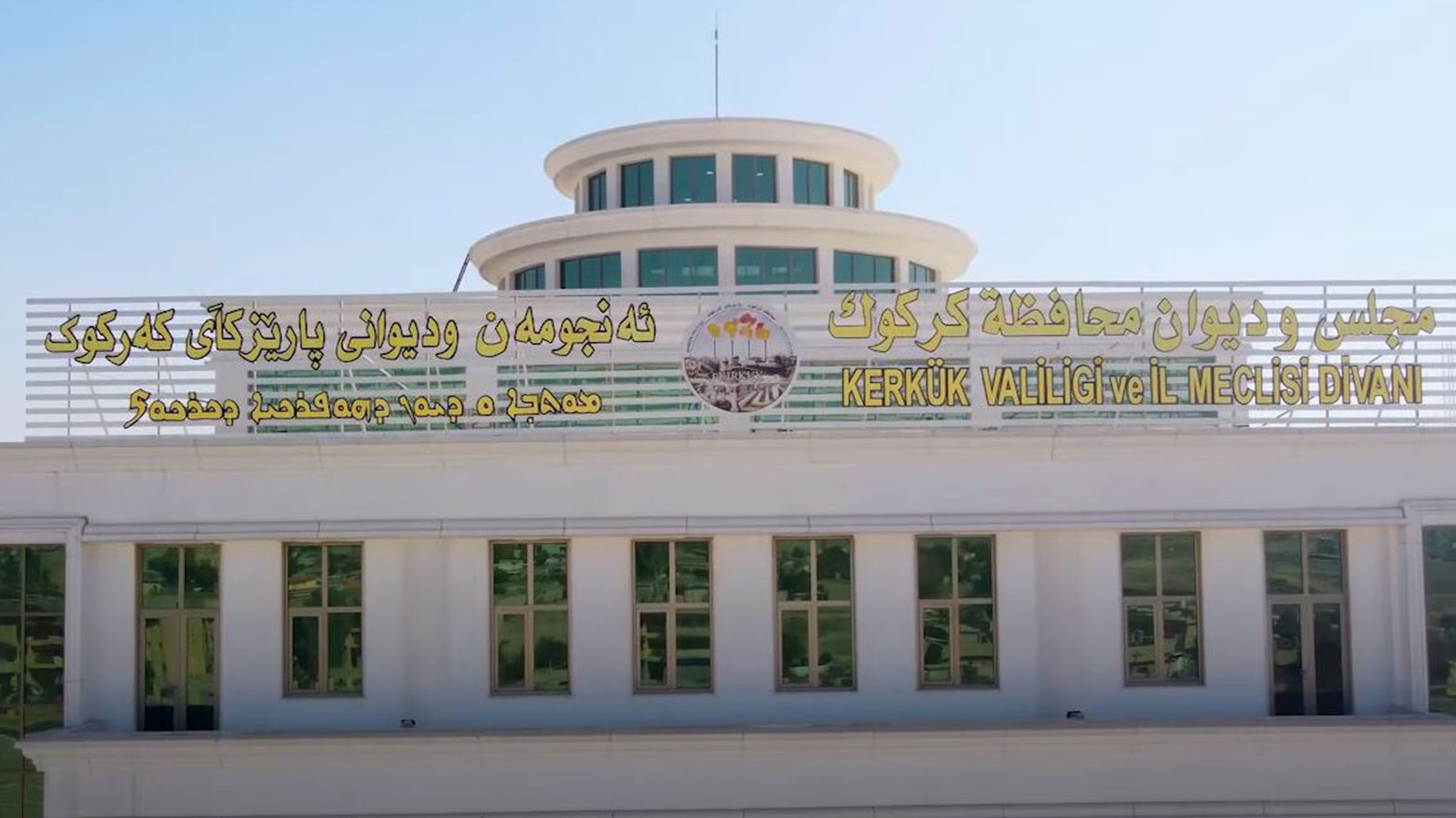
ERBIL (Kurdistan24) - The Patriotic Union of Kurdistan has agreed to relinquish the governorship of the Kurdistani province of Kirkuk to Turkmen and Sunni Arab factions in a negotiated political exchange designed to secure external legislative backing for its candidate in the Iraqi presidential election.
According to an informed source, the rotation of the strategic provincial office was formalized through a multifaceted agreement involving senior political and militia figures in Baghdad, effectively trading local administrative control for the federal presidency.
The geopolitical arrangement, brokered alongside political figures including Bafel Talabani, Mohammed al-Halbousi, Qais al-Khazali, and Rayan al-Kildani, fundamentally alters the administrative hierarchy in Kirkuk. The core terms of the pact mandate that in exchange for legislative support to elect Nizar Amedi as the President of Iraq, the Patriotic Union of Kurdistan will surrender the governorship.
The transition process, heavily mediated by Halbousi, serves a dual diplomatic purpose, operating simultaneously to facilitate a political rapprochement between the Patriotic Union of Kurdistan and the Republic of Türkiye.
In direct response to the negotiated terms, two Turkmen members of the Iraqi Council of Representatives cast their votes in favor of the Patriotic Union of Kurdistan’s presidential candidate.
To finalize the administrative handover, Talabani recently held formal discussions with Mohammad Semaan Kanani, the head of the Turkmen Front, in the federal capital to establish the operational mechanisms for the transition.
Under the established timeline, the implementation of the governance rotation is scheduled to commence in June.
The Turkmen component will assume the post of Kirkuk Governor for an initial period of seven months. Following this term, the governorship will be transferred to Sunni Arab representatives, who will retain the executive office until the next provincial council elections are conducted.
In exchange for conceding the governorship, the Patriotic Union of Kurdistan formally requested several compensatory administrative and security positions within the province. These include the post of Deputy Governor, the command of the Kirkuk Police Directorate, and the mayoralties of both the Dibis and Daquq districts.
The revelation of the administrative concessions has precipitated a wave of dissatisfaction among various Kurdish political factions, including significant internal dissent within the Patriotic Union of Kurdistan itself.
Opponents of the rotation arrangement have characterized the deal as a major strategic failure for Kurdish interests in Kirkuk. Critics noted the stark reversal in policy, pointing out that following the previous "Al-Rasheed Hotel" agreement, the party had maintained a stringent refusal to hand over the governorship to any competing ethno-sectarian faction.
The strategic concessions utilized to secure the federal presidency have prompted immediate institutional pushback from the Kurdistan Democratic Party, which views the circumvention of Kurdish political unity as a dangerous precedent that undermines the region’s constitutional standing in Baghdad.
Ali Hussein, a member of the Kurdistan Democratic Party Politburo and the head of the Sulaimani-Halabja Organizing Office, addressed the political fallout, detailing the party’s formal institutional objections to the parliamentary outcome.
Hussein clarified that the party’s opposition is rooted in structural political principles governing regional representation rather than partisan hostility toward the newly elected president or his sponsoring party.
“Our problem is neither with Nizar Amedi nor with anyone else, we do not even have a problem with the PUK as a political party,” Hussein stated. “Our problem is based on a political principle that has been established in Iraq since 2003.”
Hussein detailed the customary ethno-sectarian division of Iraq’s highest sovereign offices, wherein the Presidency of the Republic is allocated to the Kurds, the Presidency of the Parliament to Sunni Arabs, and the Presidency of the Council of Ministers to Shiite Arabs.
Crucially, the established framework dictates that each demographic component internally designates its own representative through consensus before presenting the candidate to the broader legislature.
“Each component designates its own representative itself. The Shiites together designate the Prime Minister, and the Sunnis together designate the Parliament Speaker,” Hussein noted.
Consequently, the Kurdistan Democratic Party’s baseline demand was that Kurdistani political entities jointly determine the presidential candidate to project a unified diplomatic front in the federal capital.
Hussein directed explicit criticism toward the strategic approach employed by the Patriotic Union of Kurdistan, asserting that finalizing a bilateral agreement with Arab factions outside the framework of Kurdish unity inherently compromises the geopolitical standing of the Kurdistan Region.
By relying on external political alliances to secure a sovereign position reserved strictly for the Kurdish component, the negotiation process empowered federal Arab parties to extract significant political concessions—most notably the Kirkuk governorship—at the direct expense of long-standing Kurdish institutional interests.
To preserve the integrity of Kurdish representation, Hussein suggested that an alternative procedural path should have been pursued.
“If the Kurdish parties do not agree on the President, the parliamentarians in the Iraqi Council of Representatives who are Kurds could designate a representative for the President, rather than one Kurdish party deciding on the President alone and reaching an agreement with an Arab party,” he stated.
Hussein warned that federal Iraqi parties prioritize their own strategic interests, which often run counter to those of Erbil. “Otherwise, whoever the President is, we do not have a problem,” he added.
Contextualizing the current institutional rift, Hussein invoked the historical relationship between the two major Kurdish parties, noting that the Kurdistan Democratic Party has maintained a posture of support during pivotal phases of Iraq's post-2003 history.
“From the era of Mam Jalal until now, the KDP's stance has been clear; the KDP has supported and backed the PUK at many stages,” Hussein said, referring to the late former Iraqi President Jalal Talabani.
Addressing the specific loss of the Kirkuk governorship, Hussein described the province and its residents as the "heart of Kurdistan." He invoked the historical legacy of the Kurdish liberation movement, asserting that his party never compromised on the status of Kirkuk, even during intense negotiations with the former Ba'ath regime.
Hussein emphasized that the designation of the Kirkuk governor must project a unified Kurdistani message to ensure the implementation of Article 140 of the Iraqi Constitution, prevent renewed Arabization policies, and protect Kurdish farmers facing systemic oppression in the disputed territories.
The Politburo member also drew a direct correlation between the fragmentation of Kurdish political unity in Baghdad and the deteriorating security environment in the Kurdistan Region.
Hussein stated that the identities of those responsible for the daily bombardments of Kurdish territory are widely known, asserting that a consolidated Kurdish political front would have established a sufficient deterrent against such kinetic aggression.
“We believed that if the Kurds had a unified voice, those people who bombard the Kurdistan Region would not have had the audacity to bombard Kurdistan,” he said.
Highlighting the stark reality of the federal alliances, Hussein noted, “Those who elected the President were the very same ones who were bombarding Kurdistan.”
In response to widespread reports regarding the physical absence of Kurdistan Democratic Party representatives in the federal capital following the contested vote, Hussein explicitly denied that the faction had executed a formal withdrawal from Baghdad. He clarified that the movement of officials was a calculated internal consultation directed by the highest levels of party leadership.
“We did not withdraw; President Barzani has asked both the parliamentary and governmental factions for consultation and assessment of the situation (to return to Erbil), and yesterday the meeting was held,” Hussein stated.
Concluding his assessment, Hussein confirmed that the structural frameworks regarding meetings and bilateral agreements between the two major Kurdish parties will undergo changes as a direct consequence of the recent federal maneuvers.
“Our meetings are continuing to determine our future program and to know how we will deal with the new situation,” he stated. He reaffirmed his party's commitment to protecting the region's constitutional standing, noting, “We want to decide on fateful issues with unity, because this is not just the fight of one party, but rather the fight to protect the position of the Kurdistan Region and the future of our people.”
Kurdistan24's correspondent Hemin Delo contributed to this report.