Kurdish Purebred Horse in Folklore, Poetry, and Cultural Memory
Across Kurdish oral storytelling, the horse rarely stands as backdrop. In dengbêj tradition it is spoken to, mourned, and remembered—an extension of exile, love, and endurance moving through mountain landscapes, where narrative and animal presence blur into a shared cultural memory.
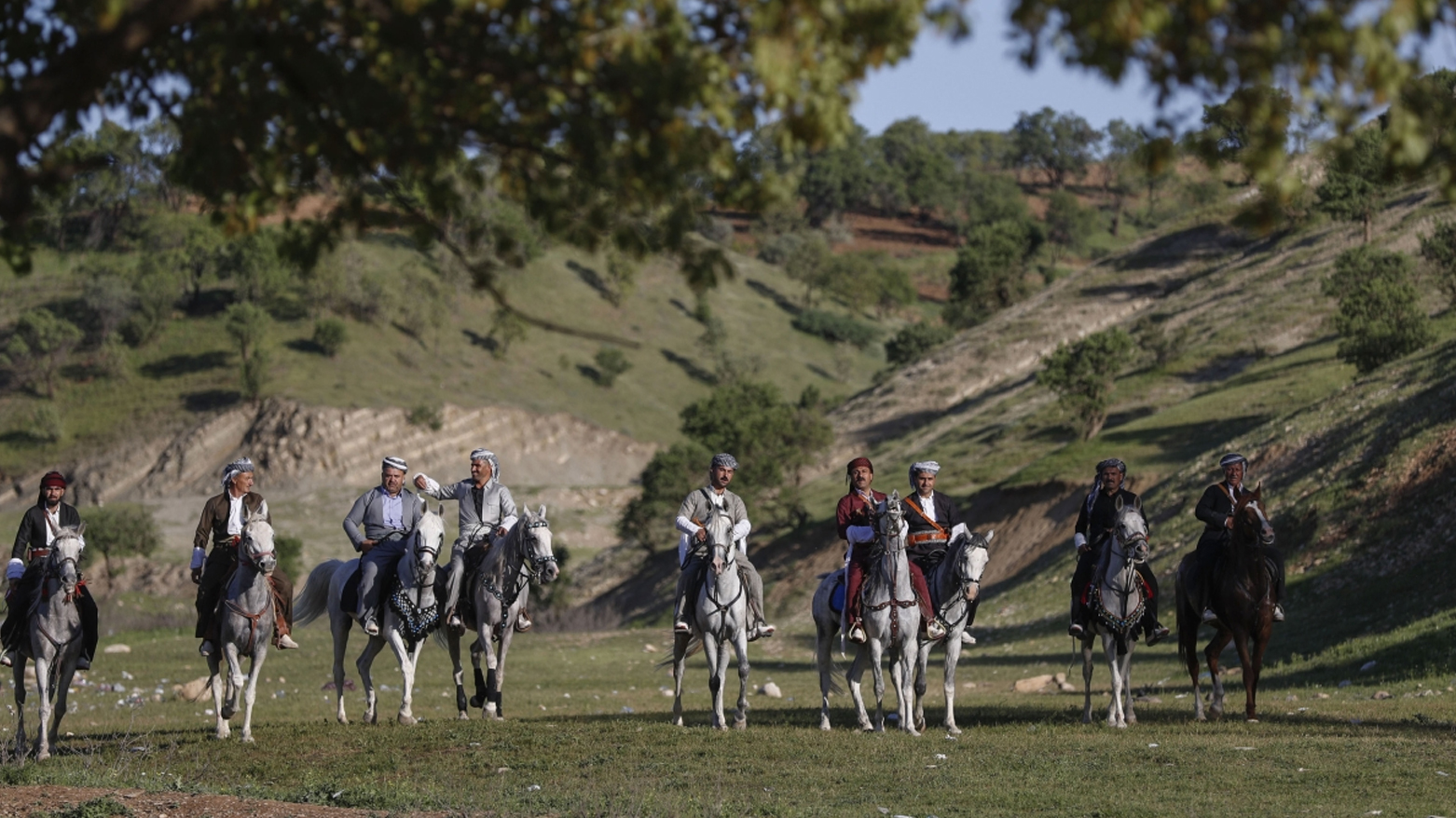
ERBIL (Kurdistan24) - In Kurdish oral storytelling, the horse rarely appears as a background animal. It enters the narrative as an extension of the human figure—sometimes a companion in exile, sometimes a witness to battle, and often a silent participant in love stories that unfold across mountains and unfinished journeys.
In folktales preserved by dengbêj (singing storytellers) traditions, the horse is not simply ridden; it is spoken to, mourned, and remembered. Across these narrative forms, the Kurdish purebred horse (Hespên Kurdî) emerges less as a biological category than as a recurring cultural presence through which movement, fate, and endurance are imagined.
This symbolic centrality continues to shape how the Kurdish purebred horse is understood today in breeding communities and cultural institutions across the Kurdistan Region, where folklore remains one of the primary interpretive frameworks through which the animal’s significance is articulated.
The horse in Kurdish oral narrative: companion, witness, and mediator
Across Kurdish folktales transmitted orally over generations, the horse occupies a narrative position that is structurally distinct from its role in many other pastoral or martial storytelling traditions. It is neither merely a vehicle nor an accessory to heroic figures. Instead, it often functions as a mediating presence between human intention and the limits imposed by geography, conflict, or fate.
In recorded dengbêj performances and ethnographic collections, horses are frequently assigned names, emotional attributes, and narrative agency.
Some oral accounts describe horses that refuse riders they do not recognize, or animals that continue to accompany fallen warriors beyond the battlefield. These elements are understood within scholarship as symbolic devices embedded in oral tradition, used to articulate ideas of loyalty, dignity, and endurance rather than empirical behavior.
In the epic cycle of Mem û Zîn and related narrative traditions across Kurdistan Region, Eastern, Northern, and Western Kurdistan, horses appear as extensions of emotional states—carrying longing across distance or marking irreversible departures.
Folklorists who have documented these traditions emphasize that the horse in Kurdish oral literature is rarely neutral; it is a narrative instrument through which separation, attachment, and moral consequence are made visible.
A cultural figure shaped by landscape and storytelling
The Kurdish purebred horse is historically associated with mountainous terrain and pastoral life, but its cultural meaning is most clearly preserved in storytelling practices rather than in purely agricultural records.
Breeders and cultural practitioners describe the animal using vocabulary that overlaps with oral tradition: endurance, alertness, resilience, and relational intelligence. These traits, while observable in husbandry, are also mirrored in folk narratives where horses are described as perceiving emotional states or responding to the moral character of riders.
This convergence between lived breeding practices and narrative attribution has made the horse a stable figure in Kurdish cultural memory.
In many oral accounts, the animal becomes a moral counterpoint to human behavior—refusing violence in some stories, enduring hardship in others, or symbolically reflecting the consequences of action through its condition and movement.
Historical continuity and the boundaries of oral tradition
Historical accounts of horse breeding in Kurdish-inhabited regions extend into antiquity, though the evidentiary record varies in density and interpretation.
Archaeological and textual studies frequently reference ancient equine cultures in the Zagros highlands and broader Median-era formations, during which horses held significant military and ceremonial roles.
Some Kurdish oral traditions extend this continuity further, linking contemporary horses to ancient lineages associated with early mountain societies.
These narratives are widely treated by researchers as cultural memory rather than verifiable genealogy. Within ethnographic scholarship, they are understood as expressions of continuity of identity rather than literal historical documentation.
What remains consistent across both documented history and oral tradition is the persistence of the horse as a central figure in Kurdish life across centuries of shifting political and environmental conditions.
Symbolism in poetry and moral imagination
In Kurdish poetry—particularly in oral and classical forms—the horse often functions as a metaphor for controlled force, dignity under constraint, and the tension between freedom and attachment.
Rather than being idealized in abstract terms, it is typically situated within relational contexts: a rider and horse navigating terrain, a departure marked by hoofprints, or a journey interrupted by historical rupture. These images are not decorative but structural, used to articulate emotional states that are otherwise difficult to express directly.
In dengbêj traditions, horses are frequently invoked alongside themes of exile, separation, and endurance. The animal becomes a narrative proxy for movement through uncertain terrain—both physical and social—without losing its grounding in material life.
Contemporary breeding and cultural continuity
Today, Kurdish purebred horse breeding exists primarily through decentralized networks of rural breeders, equestrian associations, and cultural practitioners.
Unlike standardized international breeds governed by unified registries, the Kurdish horse is maintained through selection practices rooted in performance, endurance, and cultural continuity rather than formal pedigree systems.
Breeders consistently emphasize sure-footedness, stamina, and adaptability to mountainous terrain as core selection criteria.
These practical standards are frequently intertwined with cultural knowledge transmitted through family and community memory, including oral descriptions of desirable temperament and behavior.
In parts of Eastern Kurdistan, associations such as the Kurdish Horse Breed Association, established in recent years, have undertaken documentation of breeding lines and support for preservation efforts. Similar initiatives exist across the Kurdistan Region, where private breeders and equestrian clubs participate in both recreational riding and conservation-oriented practices.
Despite these developments, veterinary and agricultural observers note that the absence of a unified studbook continues to define the Kurdish horse as a landrace population rather than a standardized global breed.
Horse Island: landscape, leisure, and narrative perception
Within this broader cultural ecology, semi-natural equine environments contribute to how horses are perceived in public life and storytelling imagination. One such site is Horse Island (Dûrgey Espekan), located in the Shemiran area of Darbandikhan, Sulaimani Governorate, in the Kurdistan Region.
The island, situated within Darbandikhan Lake, is known for its free-roaming horse population and its role as a recreational and scenic destination.
Visitors reach it by boat, and the site is commonly used for picnics, photography, and informal camping, particularly during spring months when vegetation and water levels make the landscape more accessible.
While the horses on the island are not formally classified within a documented breeding registry of Kurdish purebred lines, their presence has nonetheless entered local cultural interpretation.
In visitor accounts and regional descriptions, the animals are often read through the same narrative frameworks that shape Kurdish oral tradition: freedom of movement, endurance in landscape, and coexistence with mountainous terrain.
From an ethnographic perspective, Horse Island functions less as a controlled breeding site and more as a cultural space where equine presence is observed outside structured agricultural use.
This distinction is significant: it allows the horse to be encountered not only as livestock or breed category, but as part of a broader environmental and cultural experience that resonates with established narrative motifs.
Regional cultural context and shared equestrian heritage
Within the broader equestrian traditions of Kurdish-inhabited regions, the horse is not framed as an isolated symbol but as part of a wider cultural system in which animals, landscape, and oral memory are interconnected.
Across parts of Kurdistan, despite differences in dialect and local tradition, the horse consistently appears as a narrative constant in storytelling, poetry, and ceremonial life. This continuity suggests not uniformity of practice, but repetition of cultural themes across varied ecological and social settings.
Analytical synthesis: the horse as narrative infrastructure
The persistence of the horse in Kurdish folklore indicates that its significance extends beyond utility or symbolism. It functions as narrative infrastructure—a recurring figure through which movement, loyalty, loss, and endurance are structured in oral and poetic systems.
Unlike static cultural symbols, the horse in Kurdish tradition remains active within storytelling. It moves between contexts, adapts to shifting social conditions, and retains its central narrative role across generations.
This continuity is sustained not through formal preservation alone, but through repeated cultural use: in storytelling, in poetry, in rural practice, and in shared interpretive frameworks that link lived experience with inherited narrative forms.
In a rural gathering near Sulaimani, a young horse is led across uneven ground while nearby conversation shifts between practical concerns and remembered stories.
The animal’s movement is unremarkable in itself, yet it becomes the reference point for accounts of earlier journeys and named horses preserved in oral tradition.
In such moments, landscape, speech, and animal presence converge without formal distinction. The horse continues forward, integrated into both material life and narrative memory, without requiring separation between the two.