Iraq’s Coordination Framework Deadlocked as U.S. Sanctions Reshape Political Calculations
Rivalry between Sudani and Maliki camps deepens divisions amid mounting international pressure
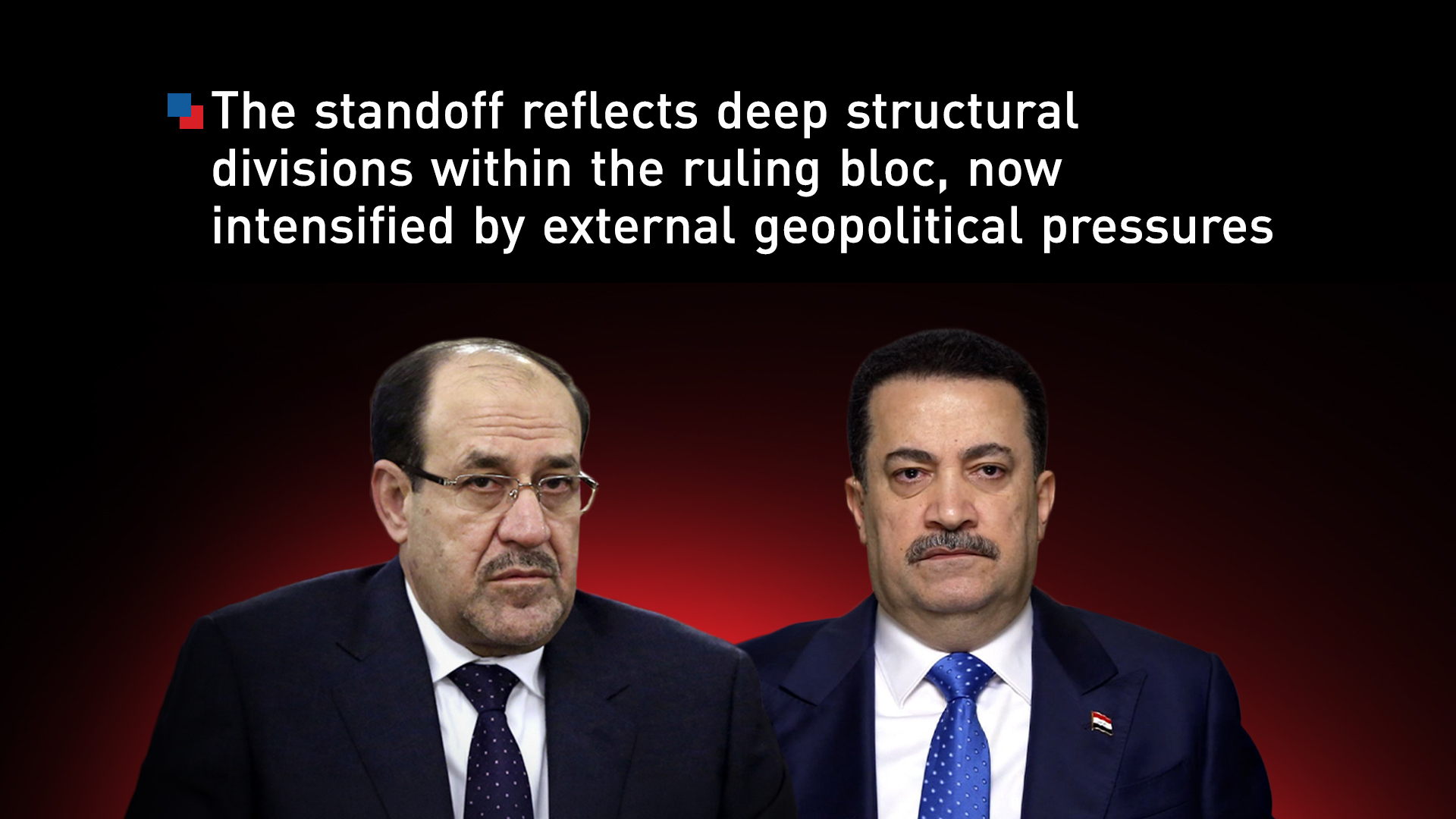
ERBIL (Kurdistan24) — Iraq’s powerful Shiite Coordination Framework is facing a deepening political impasse after failing to agree on a candidate for prime minister, with internal rivalries compounded by fresh U.S. sanctions targeting Iran-aligned militia leaders.
A high-stakes meeting of the alliance scheduled for Saturday was postponed until Monday at the request of Prime Minister Mohammed Shia' al-Sudani, according to Kurdistan24 correspondent Dylan Barzan in Baghdad. The delay underscores widening fractures within the bloc over leadership of the next government.
At the center of the dispute is an intense rivalry between Sudani and former prime minister Nouri al-Maliki. Sources indicate that five leaders within the framework back Sudani for another term, while seven others support Bassem Badri, a candidate aligned with Maliki.
This division has resulted in a political stalemate, with neither faction willing to concede ground. According to informed sources, the Sudani camp has argued that if his candidacy is no longer viable, Maliki’s bloc should also withdraw Badri and put forward an alternative—raising the likelihood of a last-minute replacement candidate.
The deadlock comes amid escalating external pressure following a sweeping sanctions announcement by the U.S. Department of the Treasury. The move targeted seven commanders from Iran-backed Iraqi militias accused of orchestrating attacks against U.S. personnel and interests.
The sanctions, issued under Executive Order 13224, focus on senior figures linked to groups such as Kata’ib Hizballah, Asa’ib Ahl al-Haqq, Harakat al-Nujaba, and Kata’ib Sayyid al-Shuhada—all of which Washington has designated as terrorist organizations.
In a statement, U.S. Treasury Secretary Scott Bessent said the United States would not allow “terrorist militias, backed by Iran, to threaten American lives or interests,” signaling a continuation of Washington’s hardline stance.
Analysts suggest the sanctions have had an immediate ripple effect on Iraq’s internal political dynamics, prompting caution among Coordination Framework leaders and contributing directly to the postponement of Saturday’s meeting.
Under the measures, all U.S.-based assets of the designated individuals are frozen, and American entities are broadly prohibited from engaging in transactions with them.
The restrictions also expose foreign financial institutions to secondary sanctions if they facilitate dealings with the sanctioned figures.
The targeted individuals include operational commanders and senior officials accused of coordinating attacks, deploying drones, and directing militia activities across Iraq.
The measures are part of a broader U.S. effort to curb the influence of Iran-aligned armed groups, which Washington says undermine Iraq’s sovereignty and stability.
Political observers warn that unless a compromise is reached, even Monday’s rescheduled meeting may be postponed. The prolonged deadlock risks further delaying government formation at a time of heightened regional tensions and economic uncertainty.
With both Sudani and Maliki factions entrenched, expectations are growing that the Coordination Framework may ultimately turn to a consensus candidate unaffiliated with either camp as a way out of the crisis—an outcome seen as increasingly likely if current divisions persist.
The current deadlock within the Shiite Coordination Framework has also reignited debate over the true causes behind months of delays in forming Iraq’s federal government.
In recent months, several leaders within the bloc have publicly criticized Kurdish political parties, accusing them of obstructing progress by failing to agree on a unified candidate for the presidency.
However, following last week’s election of Iraq’s president, the focus has shifted back to the Coordination Framework itself. The bloc’s inability to unify around a prime ministerial candidate, despite holding a parliamentary majority, has prompted political observers to reassess earlier claims.
Analysts note that the ongoing divisions between camps aligned with Mohammed Shia' al-Sudani and Nouri al-Maliki highlight internal fragmentation as a central factor behind the broader political paralysis.
This shift in narrative suggests that intra-Shiite rivalries—rather than disputes between Baghdad and Erbil—may have played a more decisive role in delaying the government formation process.
The latest sanctions imposed by the U.S. Department of the Treasury come at a particularly sensitive moment, as Iran-aligned armed groups maintain significant influence within Iraq’s political and security landscape.
Several of the targeted factions, including Kata’ib Hizballah and Asa’ib Ahl al-Haqq, are not only active militarily but also hold political representation, with affiliated figures participating in parliament and shaping key state decisions.
Western officials have long expressed concern that such groups operate with dual roles—maintaining armed capabilities while exerting political authority.
U.S. policymakers argue that these factions, which maintain close ties to Tehran, have been involved in attacks against American personnel and facilities in Iraq, often in alignment with broader regional dynamics.
In this context, the sanctions are widely seen as part of a broader effort by Washington to constrain the influence of Iran-backed actors within Iraqi state institutions.
Analysts further suggest that the timing of the measures reflects growing U.S. interest in Iraq’s leadership transition, with an emphasis on supporting a prime minister perceived as more independent from militia influence and external directives.
This evolving dynamic adds another layer of complexity to an already fragile political process, where domestic negotiations are increasingly shaped by international considerations.