Curious Why Qaani Was in Baghdad? IRGC’s Commander Explains
A patron and a strategic partner: IRGC's Qaani preaches "Iraqi" choice, as U.S. sanctions on Iran-aligned Iraqi militias tightens the screws on the Shiite bloc, further stalling the race between Nouri al-Maliki and incumbent Sudani.
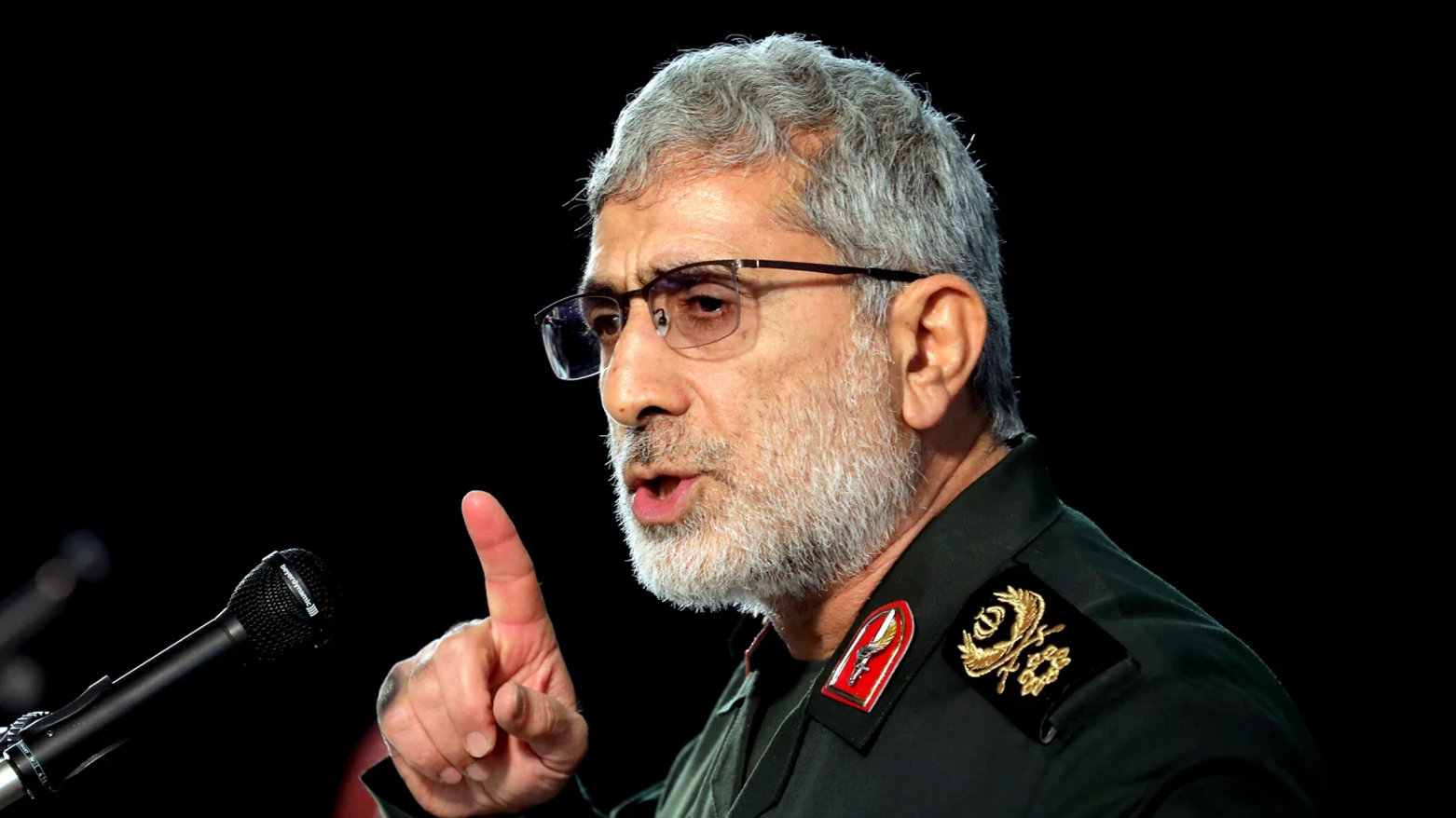
ERBIL (Kurdistan24) - Esmail Qaani, commander of the Iranian Revolutionary Guard Corps’ Quds Force, issued a formal message on Monday asserting that the selection of Iraq’s prime minister is a "solely Iraqi" decision, signaling a push against external influence as Baghdad navigates a volatile leadership race.
His visit to the Iraqi capital follows a significant April 17 declaration from the U.S. Department of the Treasury, which designated seven high-ranking Iraqi militia commanders for their roles in attacks against American personnel, effectively tightening the financial and political constraints on the Shiite Coordination Framework.
The arrival of Qaani in Baghdad’s fortified Green Zone coincided with the presence of Tom Barrack, the United States President’s envoy for Syrian affairs.
The simultaneous arrival of these rival mediators underscores the precarious state of Iraqi sovereignty as the country’s rival Shiite factions remain paralyzed by internal competition and external economic pressures.
Within this vacuum of local consensus, the diplomatic maneuvering of Washington and Tehran has transitioned from a background influence to a direct and public contest over the future of the Iraqi executive branch.
This convergence of Iranian diplomatic messaging and American economic pressure matters because it directly impacts the survivability of Iraq’s “consensus” model of governance.
The outcome will determine whether the next administration can insulate itself from the expanding conflict between Washington and Tehran or if the Prime Minister’s office will become a permanent site of institutional collapse under the weight of secondary sanctions.
By designating senior military figures within the very parties currently negotiating the government's formation, the U.S. has effectively placed a financial veto over certain candidates, while Tehran’s mediation efforts aim to preserve the structural integrity of the Shiite political umbrella at any cost.
The Quds Force Message
Writing on April 20, Esmail Qaani framed his visit to Baghdad as an act of solidarity with the Iraqi people and the "Supreme Marja'iyya," the country’s high religious authority.
In a statement released following his meetings with senior leaders of the Coordination Framework, Qaani expressed gratitude for the "sympathy and friendship" shown toward the Islamic Republic.
However, the core of the message was an explicit warning against international mediation efforts that contradict Tehran’s regional interests.
"Forming the government is their right," Qaani stated. "Iraq is far too great to allow others—especially criminals against humanity—to interfere in its affairs. The selection of the Prime Minister will be made solely based on an Iraqi decision."
While the Iranian commander did not mention the United States by name, his use of the phrase "criminals against humanity" aligns with Tehran's standard rhetorical framing of U.S. military and diplomatic activity in the region.
According to political sources familiar with the discussions, Qaani’s mission is focused on bridging the widening rift between incumbent Prime Minister Mohammed Shia al-Sudani and former Prime Minister Nouri al-Maliki, ensuring that the Coordination Framework remains unified before a critical constitutional deadline on April 28.
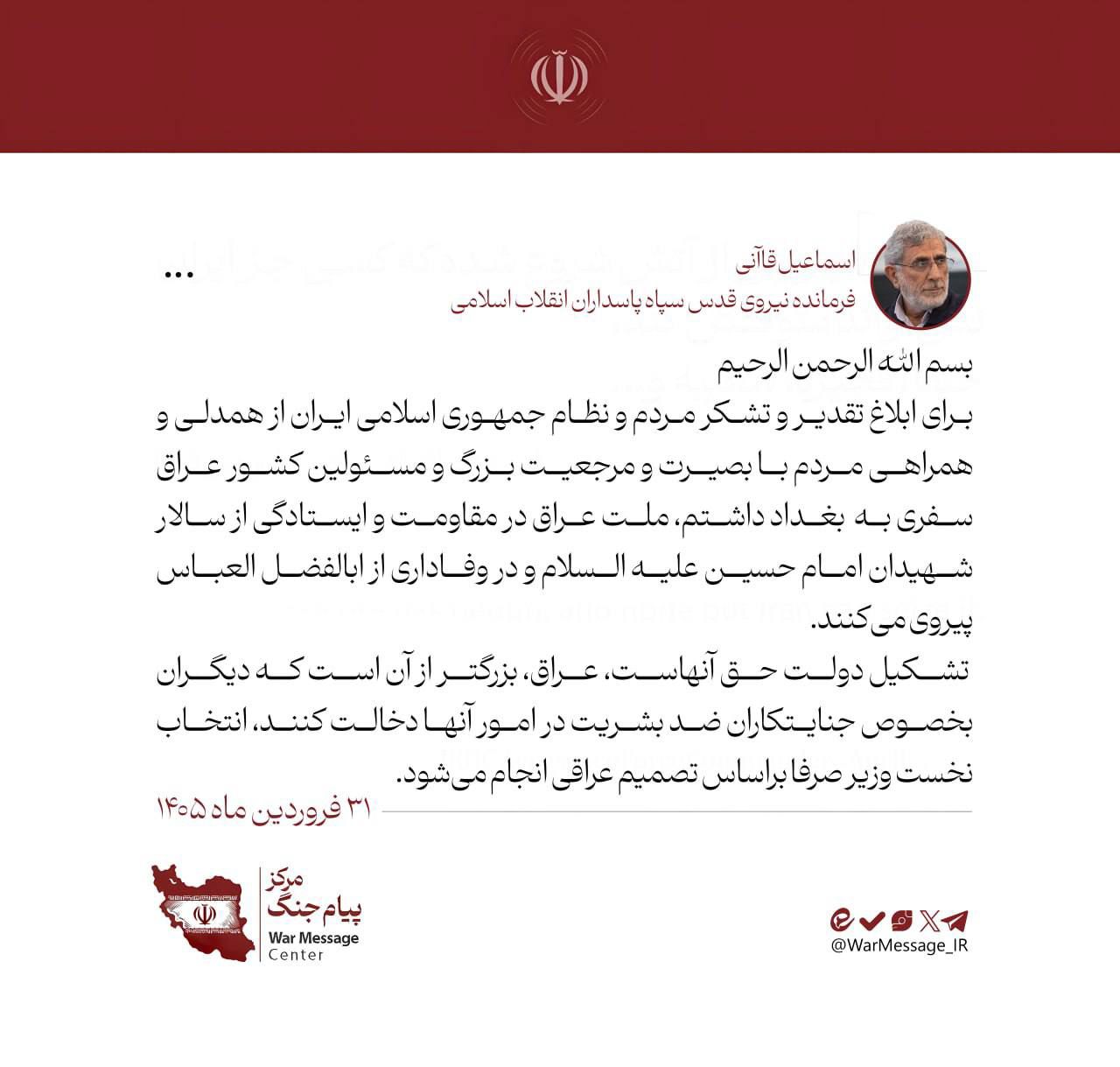
Esmail Qaani
Commander of the Quds Force of the Islamic Revolutionary Guard Corps
In the name of Allah, the Most Gracious, the Most Merciful
I traveled to Baghdad to convey the appreciation and gratitude of the people and the government of the Islamic Republic of Iran for the solidarity and support shown by the insightful Iraqi people, the supreme religious authority (Marja'iyya), and the Iraqi officials. In their resistance and steadfastness, the Iraqi nation follows the example of the Lord of Martyrs, Imam Hussein (Peace Be Upon Him), and in their loyalty, they emulate Abulfazl al-Abbas.
Forming the government is their right. Iraq is far too great to allow others—especially criminals against humanity—to interfere in its affairs. The selection of the Prime Minister will be made solely based on an Iraqi decision.
April 20, 2026
U.S. Treasury Escalation
The Iranian commander’s visit took place under the shadow of a sweeping new sanctions package announced by the U.S. Department of the Treasury on April 17.
Under Executive Order 13224, the Office of Foreign Assets Control (OFAC) designated seven commanders from four of Iraq's most influential armed groups: Kata’ib Hizballah (KH), Asa’ib Ahl al-Haqq (AAH), Harakat al-Nujaba (HAN), and Kata’ib Sayyid al-Shuhada (KSS).
According to a statement from Treasury Secretary Scott Bessent, these individuals were targeted for planning and executing attacks against U.S. personnel and facilities.
"We will not allow Iraq’s terrorist militias, backed by Iran, to threaten American lives or interests," Bessent said. "Those who enable these militias’ violence will be held accountable."
The specific designations highlight the granular intelligence being deployed by Washington to shape the political environment.
Among those sanctioned are Ammar Jasim Kadhim Al Rammahi, a KH operational commander accused of directing attack planning, and Safaa Adnan Jabbar Suwaed, a senior AAH official and military commander in Salah ad-Din Province.
The Treasury’s report specifically noted that AAH utilized Iranian drones as recently as March 2026 to attack Coalition forces in the Kurdistan Region (referred to in the Treasury report as "Northern Iraq").
The legal implications of these designations are profound.
All property and interests of these individuals within U.S. jurisdiction are now blocked, and foreign financial institutions that facilitate significant transactions for them risk secondary sanctions.
This financial isolation targets the very heart of the Coordination Framework’s patronage networks, as several of these militias maintain political wings that are currently part of the government-formation horse-trading.
A Fractured Domestic Bloc
The impact of these external pressures is visible in the deepening fracture between the camps of Mohammed Shia al-Sudani and Nouri al-Maliki.
On Sunday, Faisal Maslamawi, a spokesperson for the Construction and Development Coalition which supports Sudani, told Kurdistan24 that the incumbent maintains the "highest probability" of securing a second term.
Maslamawi claimed that Nouri al-Maliki had withdrawn from the race due to "several reservations regarding him"—reservations that analysts suggest are tied to Washington’s "red line" regarding Maliki’s return to power.
The State of Law Coalition, led by Maliki, moved aggressively to dismiss these claims as misinformation. Hisham Rukabi, head of Maliki’s media office, issued a statement on Sunday rejecting "all rumors" of a withdrawal and insisting that Maliki remains the officially recognized candidate of the Coordination Framework.
This public contradiction is the result of a failed attempt to achieve consensus during a recent phone call.
Senior sources informed Kurdistan24 that Maliki was approached with a proposal to withdraw in favor of a compromise candidate, reportedly Basim al-Badri. Maliki reportedly rejected the proposal with visible anger and has subsequently boycotted recent leadership sessions, leading to the postponement of a critical meeting until Monday.
Institutional Context and the "Consensus" Trap
The current deadlock matters because of the strict 15-day constitutional mandate triggered by the selection of a new President on April 13.
According to Iraqi law, the presidency must task the "largest parliamentary bloc" (al-kutla al-akbar) with forming a cabinet by late April. While the Coordination Framework currently holds this status, its inability to nominate a unified premier threatens to trigger a vacuum of authority.
The "consensus" model of governance, which has defined Iraq since 2003, requires that the prime minister be acceptable not only to the Shiite bloc but also to Kurdish and Sunni partners, as well as regional powers.
However, this model is being strained by the personal and ideological rivalries between Sudani and Maliki.
Maslamawi emphasized that Sudani remains "committed to the unity of the Coordination Framework" and would not attempt to form a government via a simple parliamentary majority, yet it is precisely this umbrella that is now leaking under the pressure of U.S. sanctions.
The presence of Tom Barrack in Baghdad suggests that Washington is advocating for a candidate who can maintain the neutrality of state institutions and protect diplomatic facilities.
Conversely, Tehran’s strategic interest, as mediated by Qaani, lies in a prime minister capable of preserving Shiite political dominance while avoiding the total economic isolation that would follow a direct confrontation with the U.S. Treasury.
Power Dynamics and Uncertainty
The involvement of the militia landscape adds a layer of kinetic uncertainty to the political bargaining.
Late Saturday, Kata’ib Hizballah issued a statement suggesting that the choice should be limited to Maliki or Sudani, warning against the "monopolization" of state offices by any single faction.
This indicates that while the armed wings of the Coordination Framework are divided on the personality of the leader, they are unified in their demand that the premiership remain a vehicle for their collective interests.
From a structural perspective, the Iraqi premiership functions less as an executive mandate and more as a negotiated settlement between competing domestic blocs and their respective regional patrons.
By relying on immediate mediation from Tehran and Washington to resolve internal disagreements, the Coordination Framework has highlighted a persistent inability to insulate Iraqi sovereign decision-making from broader Middle Eastern security dynamics.
As the Monday meeting of the Coordination Framework proceeds, the coalition faces an unresolved institutional dilemma. Faisal Maslamawi’s assertion of Sudani’s "highest chance" rests on the assumption that Maliki’s candidacy is no longer viable in the face of international sanctions.
Conversely, Maliki’s refusal to withdraw suggests that the State of Law Coalition is prepared to test the limits of the bloc's unity. With the constitutional deadline looming, the sovereignty of the Iraqi state remains caught between the "economic fury" of the U.S. Treasury and the strategic imperatives of the Iranian Quds Force.