In the Footsteps of Dr. King: Kurdish Activist Completes Epic Walk to Atlanta to Champion His People's Cause
Kani Xulam, a U.S.-based Kurdish activist, spent 55 days on foot traveling from Washington, D.C., to the birthplace of Martin Luther King Jr. in Atlanta, Georgia, carrying a message of Kurdish identity, and the right to be heard.
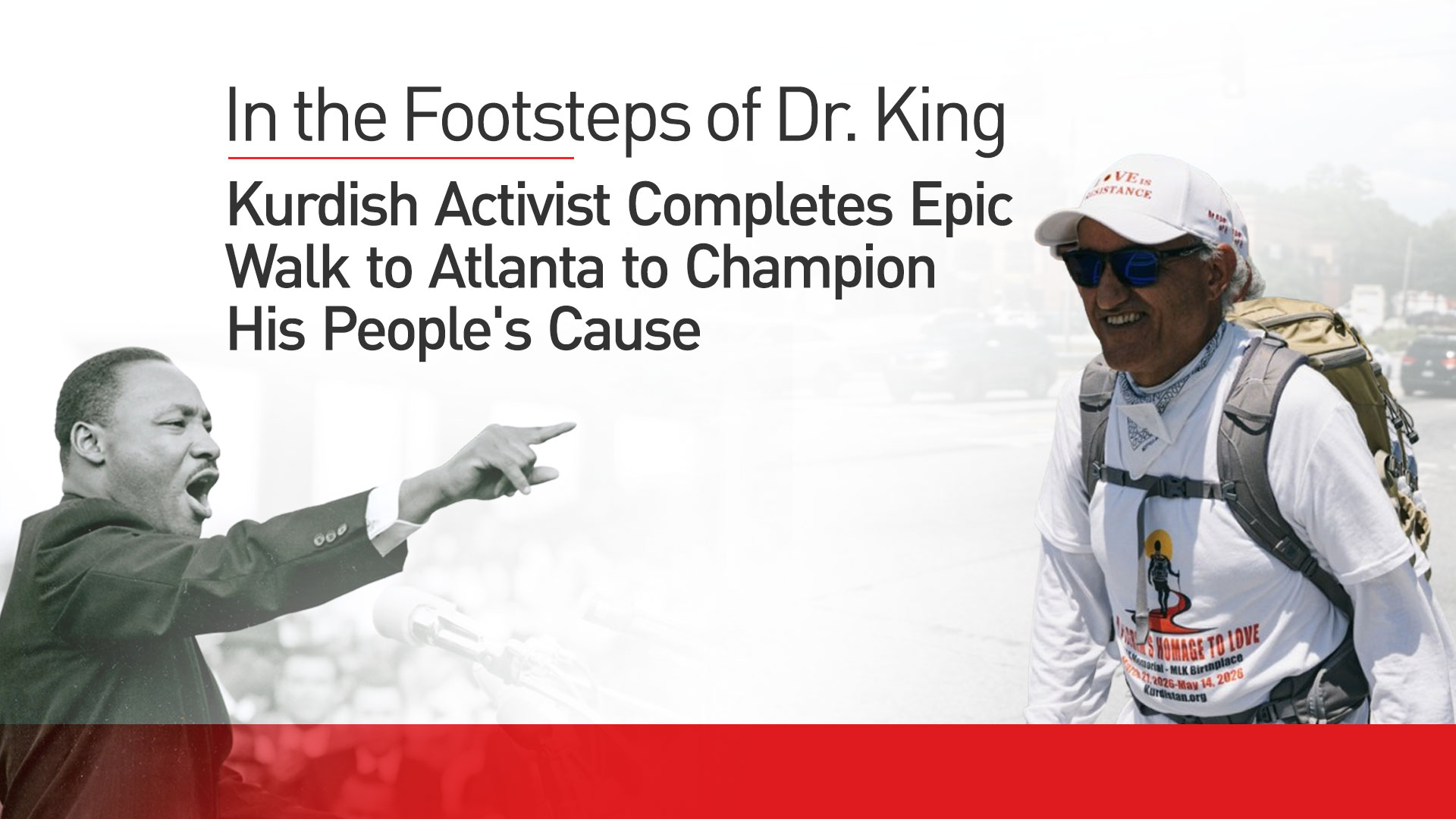
ERBIL (Kurdistan24) - On March 21, 2026—Newroz, the Kurdish new year, a symbol of identity and rebirth for millions, Kani Xulam, a U.S.-based Kurdish activist, began a 1,200-kilometer walk from Washington, D.C. Fifty-five days later, on May 14, he arrived in Atlanta, Georgia, having carried not only the weight of his people’s struggle but also the legacy of Dr. Martin Luther King Jr., whose birthplace became the deliberate end of his pilgrimage.
Speaking to Kurdistan24's Washington, D.C.–based correspondent, on Wednesday, after completing the journey, Xulam reflected on what he had set out to prove, and what he believed he had.
The choice of Atlanta was not incidental. For Xulam, King's life offered a framework through which to understand and articulate the Kurdish struggle, a parallel between a people denied their rights on American soil and a people denied recognition across the Middle East.
"In American history, Dr. King is regarded as one of the three most pivotal figures," Xulam said. "George Washington established the American government and brought independence; Abraham Lincoln ended slavery; and Dr. King expanded rights for all Americans, both Black and White."
It was within that arc of American history — of recognition fought for and ultimately won — that Xulam sought to place the Kurdish cause. "During those 55 days, I sought to convey that Kurds exist, they have goals, and they have rights," he said. "They must be heard, their voices must be accepted, and their identity must be recognized."
The journey was as physically demanding as it was symbolic. Xulam began on March 21 and structured his walk around a rhythm of six days of walking followed by one day of rest — 48 days on the road and seven in recovery, across terrain stretching from the American capital deep into the South.
He spent 22 nights in the homes of Kurdish and American families he met along the route, and 33 nights in hotels — expenses largely covered by those same families. The evenings, he said, became their own form of advocacy. "We would share meals and sit together for hours, discussing the Middle East, American history, and the legacy of Dr. King," Xulam recalled.
The road, in other words, was not merely a physical undertaking but a rolling series of conversations about history, identity, and the future of a people. His message traveled not only through the communities he passed through but across social media, where he documented the journey and broadened its reach beyond the American roads he walked.
Now that the walk is done, Xulam's hopes are fixed on what it might set in motion. "I hope this journey inspires our youth to do more for the Kurdish people, for Kurdistan, and for the cause of freedom," he said. "I hope that a new horizon opens up for the Kurds and all the peoples of the Middle East."
It was not his first such undertaking. In 2024, Xulam completed a similar walking journey from Washington, D.C., to New York City — a pattern that suggests less a series of isolated gestures than a sustained, embodied form of advocacy: one step, one conversation, one kilometer at a time.
Whether a walk across the American South can move the needle for a people whose cause has long struggled to break through the noise of international politics is a question no single journey can answer. But Kani Xulam has now walked 1,200 kilometers to insist that the question be asked.