EXCLUSIVE: Houthi Commander Tells Kurdistan24 U.S. Ships Face Targeting If Washington Enters Conflict
In an exclusive statement to Kurdistan24 on Monday, commander Abdulghani Ali Zubaidi stated that Houthi forces consider themselves a core component of the current conflicts spanning Iran, Beirut, and Gaza.
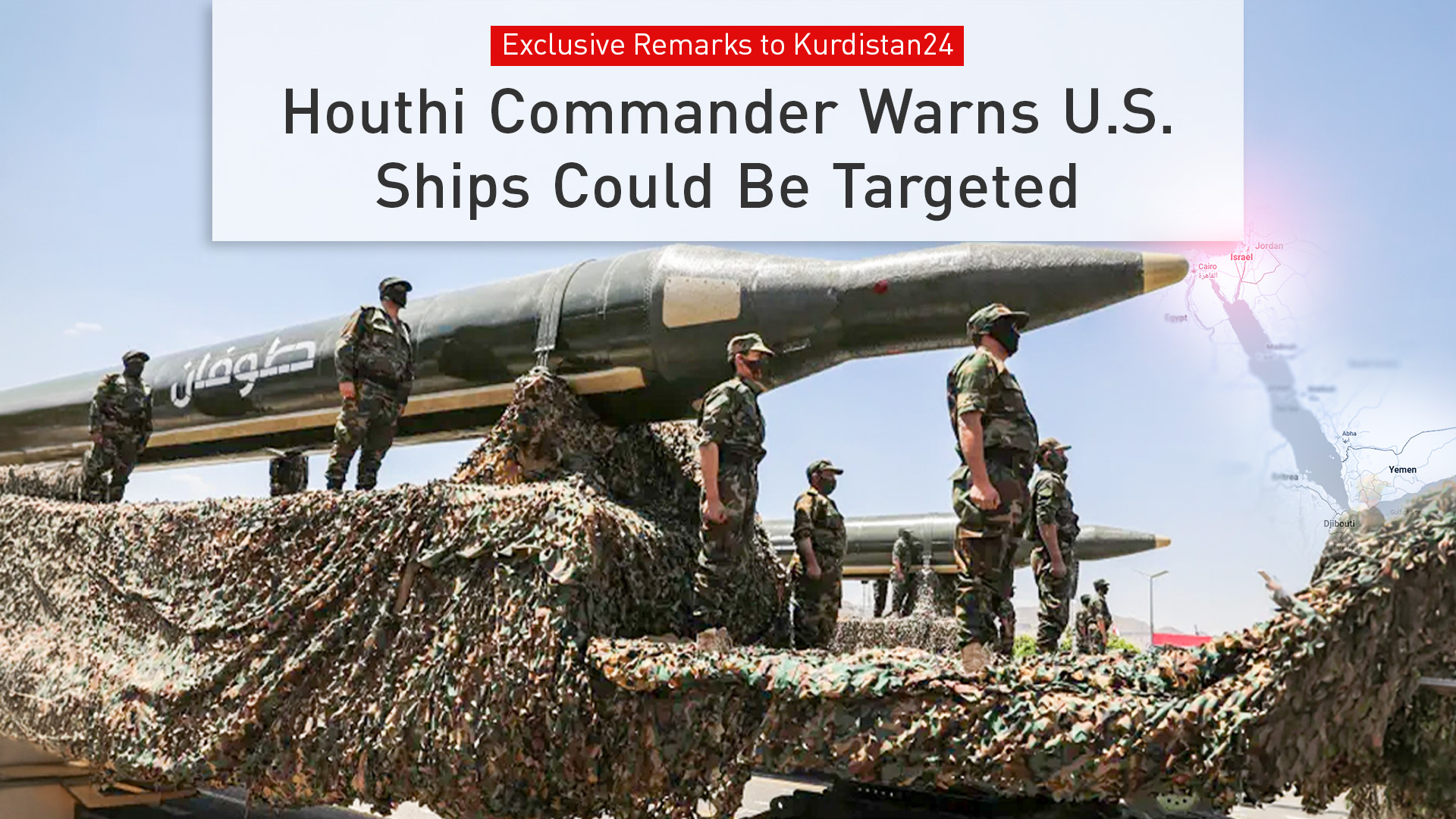
ERBIL (Kurdistan24) - The intricate web of conflicts destabilizing the Middle East threatens to widen dramatically after a senior Houthi military commander issued a stark ultimatum to Washington. In an exclusive interview, the commander warned that United States naval vessels operating in the Red Sea will become immediate targets if American forces directly join Israeli military operations against Iran or Lebanon.
The explicit threat from the Iran-aligned Yemeni group comes at a perilous moment in regional geopolitics, expanding the potential scope of the conflict far beyond the Levantine and Persian Gulf battlegrounds. By conditioning maritime attacks on U.S. involvement, the Houthis are engaging in a calculated campaign of strategic deterrence aimed at keeping Washington from directly intervening in the volatile standoff between Israel and Tehran.
In an exclusive statement provided to Kurdistan24 on Monday, Houthi commander Abdulghani Ali Zubaidi declared that the group considers itself a core component of the conflicts currently spanning Iran, Beirut, and Gaza. Providing context on the group's targeting parameters, Zubaidi explained that Washington has not yet officially declared its participation in the latest round of hostilities against Iran. Consequently, U.S. assets are currently excluded from Houthi strikes during this specific phase of the conflict.
However, the commander established a precise escalation threshold. Zubaidi specified that if U.S. involvement in strikes against Iran is proven, or if Washington publicly announces its participation, the Houthis will extend their prohibition of passage and actively target American vessels in the Red Sea. He claimed the group possesses advanced military capabilities, including ballistic missiles, hypersonic weapons, and naval assets, which he asserted have already been tested against Israeli and American interests.
The threat was reinforced by broader actions taken by the group. According to a separate Kurdistan24 report detailing the escalation, Houthi spokesperson Yahya Saree signaled the commencement of various military operations unless Israel halts its strikes. Furthermore, the Houthi armed forces declared a "complete and total ban on Israeli maritime navigation in the Red Sea," confirming their first missile attack against Israel since early April.
The Strategic Stakes in the Red Sea
The Houthi threat to target U.S. vessels in the Red Sea elevates the crisis from a regional dispute to a global economic and security concern. The Red Sea and the Bab al-Mandab Strait serve as critical arteries for global commerce, connecting Europe and Asia through the Suez Canal.
Read More: Houthis Ban Israeli Shipping in Red Sea as Iran and Israel Exchange Fire Amid Diplomatic Push
Prior Houthi attacks on commercial shipping in the corridor severely disrupted international trade, forcing major shipping conglomerates to reroute vessels around the southern tip of Africa—a costly diversion that increased transit times, spiked maritime insurance premiums, and disrupted global supply chains. If the Houthis execute their threat against the U.S. Navy, the resulting militarization of the waterway could paralyze commercial traffic entirely, exerting immense pressure on global energy markets and international trade.
An End to 'Strategic Patience'
The Houthi warning aligns seamlessly with hardening rhetoric emerging from Tehran, signaling a coordinated posture among the "Axis of Resistance." In an exclusive interview with Kurdistan24 on Monday, Ibrahim Rezai, spokesperson for the Iranian Parliament's National Security and Foreign Policy Committee, declared that Tehran's era of "strategic patience" has definitively concluded.
Rezai characterized the United States as the "prime culprit" behind the regional instability, asserting that Israel takes no action without Washington's explicit approval. He noted that U.S. taxpayer funds are utilized to provide Israel with the weaponry and aircraft necessary to conduct its strikes.
"We now see ourselves at the height of our power, stronger than ever before," Rezai stated. "Therefore, the Americans and Israelis must brace themselves for even darker and more painful days ahead."
Rezai further clarified the interconnected nature of the alliance network, telling Kurdistan24 that while Tehran supports stability and ceasefires across all fronts, it views an attack on Lebanon as an attack on Iran itself, which is why the Islamic Republic has responded with such force.
Read More: 'Iran's Era of Restraint Has Concluded,' Iranian Parliament Official Tells Kurdistan24
This rhetoric reflects the reality of the escalating conflict. According to Kurdistan24's reporting on the military exchanges, Iran recently launched missile strikes against Israel, with the Islamic Revolutionary Guard Corps (IRGC) claiming to have targeted the Nevatim and Tel Nof air bases in response to Israeli missile attacks on Iranian radar facilities. In retaliation, the Israeli Air Force struck several Iranian military targets in the western and central parts of the country.
Diplomacy in the Shadow of Escalation
As military threats escalate across the region, a frantic diplomatic push is underway to contain the crisis. Regional mediators are intensifying efforts to prevent the tit-for-tat strikes from spiraling into a full-scale war that could easily draw in the United States.
According to Kurdistan24, Iranian Foreign Minister Abbas Araghchi held a series of critical telephone conversations over the weekend with the foreign ministers of Britain, France, and Turkey. Araghchi also engaged with Qatari Prime Minister and Foreign Minister Sheikh Mohammed bin Abdulrahman Al Thani, as well as members of a Pakistani mediation team attempting to facilitate an agreement between Tehran and Washington.
Meanwhile, Qatar and Saudi Arabia are coordinating efforts to support de-escalation initiatives. The Qatari Ministry of Foreign Affairs reported that Al Thani stressed the importance of all parties responding positively to ongoing mediation efforts in order to secure a lasting agreement.
Yet, as diplomatic channels struggle to keep pace with military developments, the ultimatum delivered by Houthi commander Abdulghani Ali Zubaidi underscores the precarious nature of the current standoff. By directly threatening the U.S. Navy and the security of the Red Sea, the Houthis have dramatically raised the cost of American intervention, ensuring that any further escalation between Israel and Iran risks igniting a broader, uncontainable conflict with profound global consequences.
|
Summary A senior Houthi commander, via exclusive remarks provided to Kurdistan24, warned that U.S. naval vessels in the Red Sea will be targeted if Washington joins Israeli strikes on Iran or Lebanon. The threat raises the risk of expanding the conflict and disrupting global shipping in one of the world's most vital maritime corridors. |