President Barzani Commemorates 41st Anniversary of Zewa Camp Bombing
President Masoud Barzani issued a message marking the 41st anniversary of the 1985 Zewa refugee camp bombing, honoring the victims and highlighting Kurdish resilience against the former Iraqi regime.
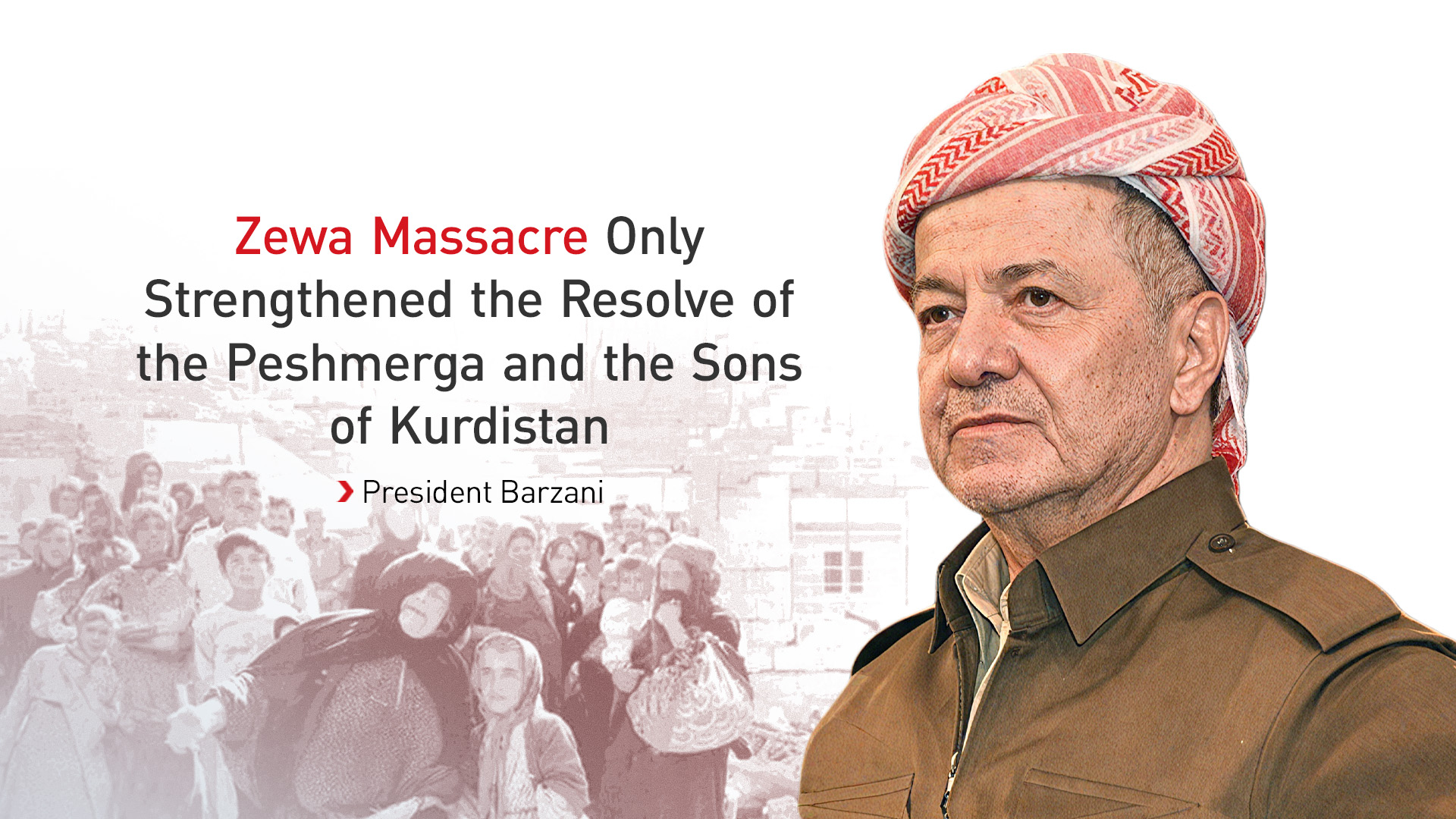
ERBIL (Kurdistan24) - President Masoud Barzani issued a solemn message on Tuesday marking the 41st anniversary of the devastating air raid on the Zewa refugee camp, describing the June 9, 1985 massacre as one of the darkest chapters in the history of the former Iraqi regime and the saddest day of his life.
In a statement released through the Barzani Headquarters, the Kurdish leader honored the memory of the hundreds of civilians who were killed or wounded when Iraqi warplanes bombed the encampment in Eastern Kurdistan.
The statement underscored that the attack, designed to crush Kurdish resistance, instead served to strengthen the determination of the Peshmerga and the broader Kurdish freedom movement.
"The Zewa tragedy is another bloody page in the dark record of the former Iraqi regime," President Barzani stated.
"That day remains one of the saddest of my life. The wails and lamentations of mothers, and the sight of the burned and mangled bodies of the martyrs and the wounded of Zewa, would have shaken the soul of anyone with a conscience," he added.
President Barzani stated that the regime's objective behind the massacre was to shatter the will of the refugees and freedom fighters of Kurdistan.
"However, these atrocities only served to fortify the resolve of the Peshmerga and the sons of Kurdistan to persevere in their struggle against the oppressors and the then-ruling authorities of Iraq," he said. "As a result of this sacrifice and relentless struggle, the fate of the tyrants and criminals was humiliation and defeat, while pride and victory remained with the people of Kurdistan."
The historical significance of the Zewa bombing remains deeply embedded in Kurdish collective memory.
According to documentation compiled by Adalat Omar for the Kurdistan Genocide National Archive (KGNA), the Zewa camp was established near Urmia in Eastern Kurdistan following the 1975 Algiers Agreement.
The political pact led thousands of Kurds from Southern Kurdistan to flee across the border into Iran as political refugees, seeking shelter from the severe oppression of the Ba'ath regime.
The camp housed numerous families, children, and relatives of Peshmerga fighters.
As documented by the KGNA, the refugee settlement became a repeated target during the Iran-Iraq War, reportedly facing bombardment nine separate times between 1980 and 1988.
The most catastrophic of these attacks occurred on the morning of June 9, 1985.
According to the KGNA report, eight Iraqi warplanes heavily bombed the civilian settlement. Witness accounts summarized in the archive recall that the raid struck as many students were walking to school to receive their final exam results, leaving the camp's residents with no opportunity to seek shelter.
The human toll was immense.
The KGNA records state that 150 people were killed in the bombardment, including pregnant women, infants, and students.
An additional 373 individuals, comprising women, children, the elderly, and people with disabilities, were severely injured. The victims were buried in a local cemetery, while survivors continue to bear the physical and psychological scars of the attack.
Decades later, the tragedy of Zewa continues to resonate as a powerful symbol of endurance. Annual commemorations of the massacre play a crucial role in preserving the experiences of victims and survivors, reinforcing ongoing calls for historical recognition and accountability.
In his message, President Barzani connected this historical remembrance directly to contemporary Kurdish identity, viewing the sacrifices of the past as the foundation of modern Kurdish resilience.
"On the 41st anniversary of the Zewa tragedy, we salute the pure souls of the martyrs of Zewa and all the martyrs who gave their lives on the path to Kurdistan's freedom," President Barzani concluded.
|
Three Key Takeaways: - President Masoud Barzani marked the 41st anniversary of the Zewa camp bombing, calling it one of the saddest days of his life. - The 1985 Iraqi air raid killed 150 civilians and injured 373 more at the refugee camp in Eastern Kurdistan. - President Barzani stated that the atrocities strengthened the resolve of the Peshmerga and the Kurdish freedom movement. Summary President Masoud Barzani issued a message marking the 41st anniversary of the 1985 Zewa refugee camp bombing, describing the Iraqi air raid that killed 150 civilians as a dark chapter. He emphasized that the atrocity ultimately fortified Kurdish resilience and the struggle for freedom. |