From Local Staple to Global Export: Kurdistan's Rice Boom Signals Agricultural Shift
A remarkable turnaround is unfolding in Kurdistan's countryside, where one season is changing the outlook for farmers and local markets alike.
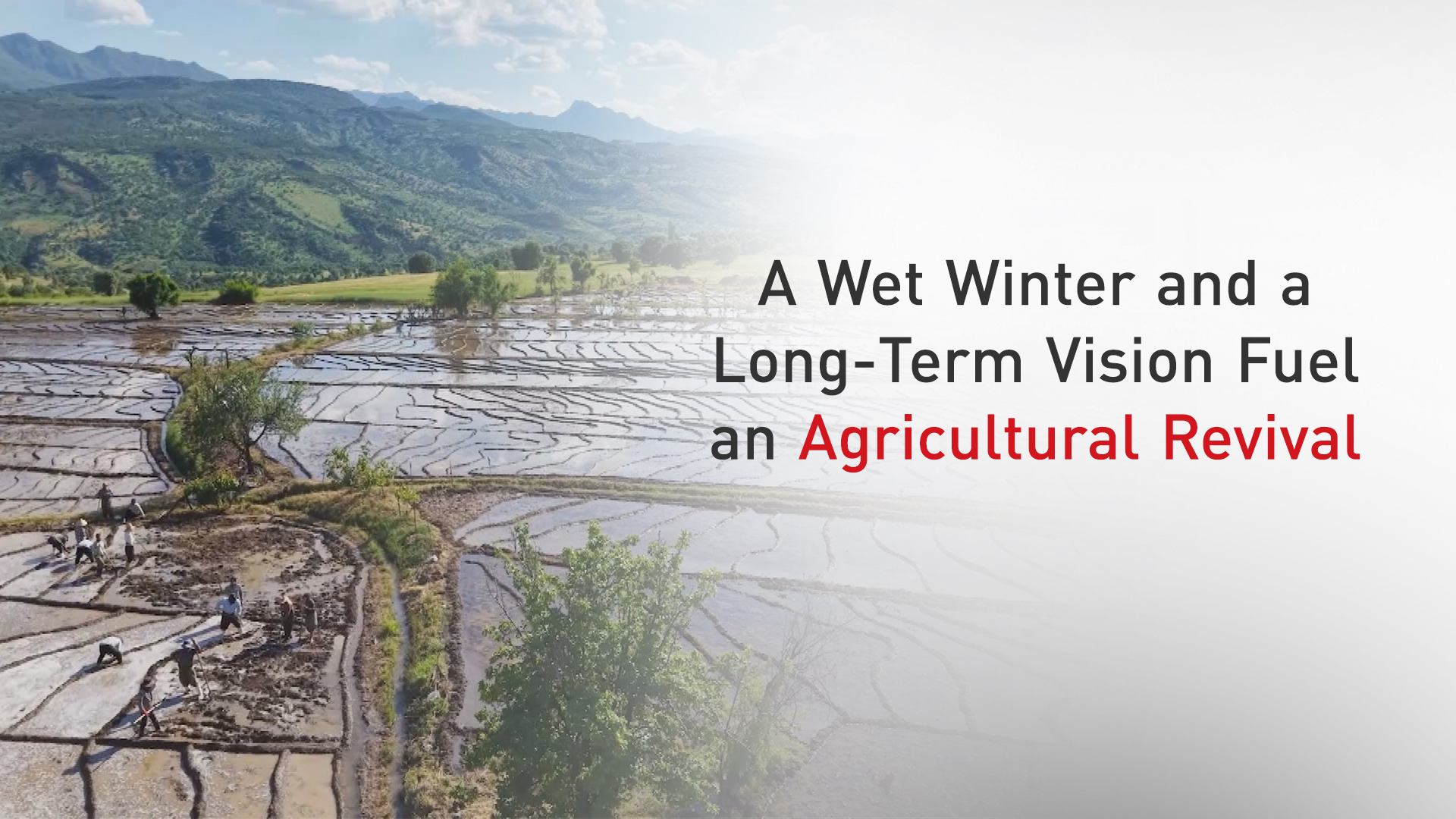
ERBIL (Kurdistan24) - In the village of Guherze, nestled within the Amedi district of Duhok province, the agricultural season has begun with a renewed sense of possibility. Farmers wade through freshly flooded paddies, planting rice and sesame with an optimism that had been absent during recent years of severe drought. A remarkably generous winter of snow and rain has replenished local water sources, setting the stage for what many anticipate will be a record-breaking harvest.
Yet, this agricultural resurgence is not solely the result of favorable weather. It is the product of a deliberate, multi-year strategy by the Kurdistan Regional Government (KRG) to modernize irrigation, support local farmers, and transform the region into an agricultural powerhouse.
Returning to the Land
For farmers like Mohammed Salih, the contrast between this year and the recent past is stark.
Salih told Kurdistan24 that previous seasons were defined by acute water scarcity, compounded by climate volatility and the inefficiencies of traditional, water-intensive flooding methods.
Many farmers were forced to scale back or abandon cultivation altogether. However, the abundant winter precipitation has fundamentally altered the landscape, encouraging growers to rapidly expand their paddies.
The impact of the weather has been amplified by strategic government intervention.
Hakar Hamid, the Director of Agriculture for Amedi, confirmed to Kurdistan24 that the KRG has constructed critical water management infrastructure, including extensive concrete irrigation channels.
These projects have dramatically improved water delivery, reduced waste, and successfully incentivized farmers to return to their lands with greater confidence, reversing earlier declines caused by drought and well-water restrictions.
"The projects have given us the security we need," Hamid explained, emphasizing that reliable water access is the foundation of agricultural growth.
Cultivating Heritage and Quality
In Guherze, farmers are primarily focused on cultivating two highly prized local rice varieties: Riteke and the "Six-Month" (şeş heyivî) rice.
Ahmed Guherze, a local farmer, explained that these specific varieties are renowned across the region for their distinct aroma, flavor, and superior quality, distinguishing them from cheaper, mass-produced imports.
"With further government support for irrigation infrastructure, we could significantly increase production and supply other regions within Iraq and beyond," he told Kurdistan24.
This focus on quality is yielding substantial economic dividends.
Amedi has already seen remarkable growth; in 2024, the district dedicated 1,650 dunums (approximately 407 acres) to rice and sesame, doubling its year-over-year production to 637 tons of rice and 240 tons of sesame seeds.
Read More: Kurdistan Region Expands Domestic Agriculture to Achieve Self-Sufficiency, Ministry Says
The local processing industry has expanded to match, with the district now operating 10 specialized rice mills and 31 sesame mills producing tahini to meet both domestic and international demand.
Read More: Local agriculture flourishes in Amedi as sesame, rice production doubles
Across Duhok province, the expansion is even more pronounced.
Official figures indicate that over 32,000 dunams are under rice cultivation this season, up substantially from 21,468 dunams in 2024. In fertile areas like Akre, yields range from 860 to 1,200 kilograms per dunam.
The cultural significance of these harvests cannot be overstated; in some districts, Kurdish rice remains a staple in up to 90 percent of daily meals.
A Broader Economic Transformation
The surge in Amedi's rice production is a localized manifestation of a sweeping regional transformation.
Under the Ninth Cabinet, led by Prime Minister Masrour Barzani, the KRG has prioritized agriculture as the "main foundation" of a diversified economy, seeking to break the region's historical dependence on oil and position Kurdistan as Iraq's "food basket."
Read More: Golden Harvest, Global Ambition: Duhok's Rice Fields Cultivate Kurdistan's Future
Central to this strategy is the Kurdistan Agriculture Export Initiative (KAEI), launched in 2022.
The program facilitates modern packaging under the "Made in Kurdistan" label, aggressively opening international markets to local producers. The success of this initiative is tangible: premium rice from Akre and Amedi, along with tahini, has already been exported to the United Kingdom, Germany, Sweden, Finland, the Netherlands, and the United States.
Simultaneously, the KRG is expanding domestic logistics, developing cold storage facilities, processing plants, and major infrastructure like a 23,000-ton corn-drying factory in Duhok.
The government also enforces a protective "agricultural calendar," restricting specific imports during peak domestic harvest seasons to shield local farmers from external price dumping.
The Climate Challenge and Modernization
While this year's strong performance has generated considerable optimism across the agricultural sector, the Kurdistan Regional Government (KRG) is also taking steps to ensure the long-term sustainability of farming in the face of evolving climate challenges.
Through continued investment in modern irrigation infrastructure, water management, and agricultural innovation, the Region is working to strengthen resilience against drought, rising temperatures, and shifting rainfall patterns.
As part of these efforts, agricultural experts and KRG institutions are actively promoting more efficient cultivation methods that can enhance productivity while conserving natural resources.
Recent field trials and agricultural forums in Erbil and Sulaimani have highlighted the potential of the System of Rice Intensification (SRI), an approach that is attracting growing interest among farmers and policymakers alike.
By employing alternate wetting and drying techniques, younger seedlings, and wider spacing, SRI has demonstrated the ability to significantly reduce water consumption while increasing crop yields.
Such innovations complement the KRG's broader investments in irrigation networks and agricultural development programs aimed at strengthening food security and supporting rural communities.
As regions around the world seek to produce more food with fewer resources, the combination of modern farming practices and upgraded irrigation infrastructure is positioning the Kurdistan Region to remain competitive and resilient in the years ahead.
For the farmers of Guherze, this season represents more than a successful harvest, it reflects the growing impact of strategic agricultural investments and a renewed confidence in the future of local farming.
Backed by KRG infrastructure projects, expanding export opportunities, and favorable seasonal conditions, Amedi's rice growers are demonstrating how traditional heritage crops can serve as the foundation of a modern, sustainable, and export-oriented agricultural economy.
|
Summary Abundant rainfall and new KRG irrigation infrastructure have sparked a resurgence in rice cultivation in Amedi. The revival underscores a broader regional strategy to strengthen food security, expand agricultural exports, and diversify Kurdistan's economy through sustainable water management. |