Kirkuk's Christian Neighborhoods Empty as Migration to Erbil Continues
As families look toward Erbil and Europe, an ancient community confronts the reality of empty homes and silent churches.
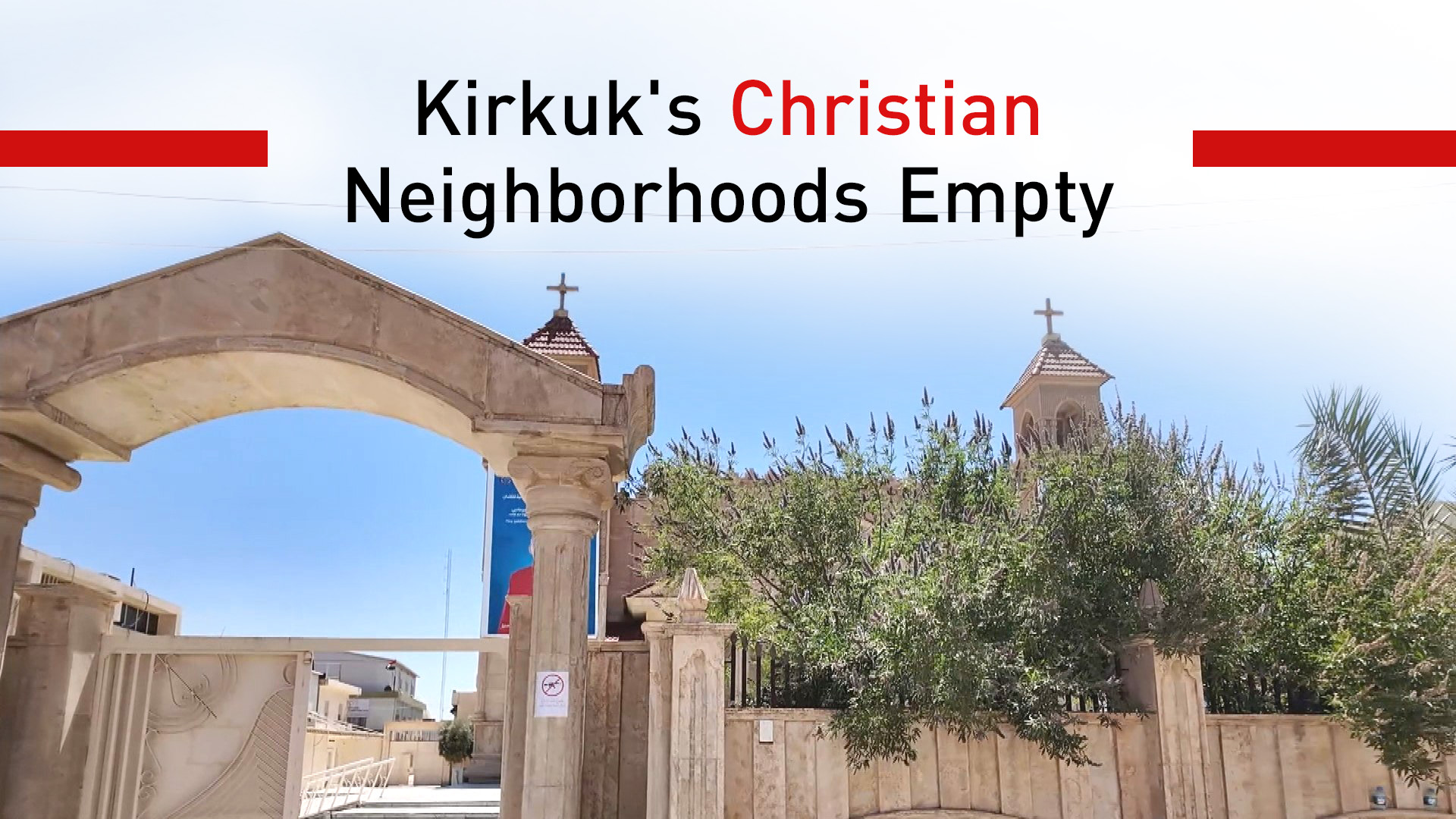
ERBIL (Kurdistan24) - In the Christian neighborhoods of Kirkuk, an unsettling silence has gradually settled over streets that once anchored one of Iraq's most historic religious communities. Behind locked gates and shuttered windows, a slow but steady exodus is hollowing out the district.
For those who remain, the physical erosion of their neighborhoods carries a profound psychological weight, sparking fears that the city's ancient churches may soon stand as quiet museums rather than living sanctuaries of faith.
According to recent reporting by Kurdistan24 correspondent Soran Kamaran, the demographic shift in Kirkuk is striking.
Driven by a complex combination of regional instability, economic uncertainty, and systemic challenges, Christian families are increasingly abandoning their ancestral homes.
The migration follows two distinct trajectories.
A significant number of families are opting for internal relocation, seeking the relative security and stability of the Kurdistan Region, with the capital city of Erbil serving as the primary destination. Others are looking further afield, undertaking the arduous journey to rebuild their lives in Europe.
Father Ayad Sliwa, the priest of the Three Wells (Se Kanyan) Church in Kirkuk, underscored the severity of the demographic decline in an interview with Kurdistan24.
"External migration has significantly depleted our numbers," Father Sliwa noted, highlighting the dual pressure facing the community.
He estimated that alongside those who have emigrated internationally, between 300 and 400 Christian families from Kirkuk have recently relocated to the Kurdistan Region alone.
This latest wave of departures is part of a much broader, decades-long contraction of Iraq's Christian population.
Across the country, conflicts, political instability, and economic hardship have repeatedly fractured indigenous communities. In this landscape of uncertainty, the Kurdistan Region has consistently functioned as a critical sanctuary, offering displaced families a stable environment to preserve their faith and culture.
Yet, in Kirkuk, the physical evidence of this exodus is becoming impossible to ignore. A growing number of homes in the Christian districts now stand empty, marking a visible decline in the city's pluralistic fabric.
Despite the diminishing numbers, some residents remain fiercely committed to their neighborhoods. Fatin Rahim, who continues to live in Kirkuk with her family, spoke to Kurdistan24 about the profound emotional attachment that binds many to the city.
"We have sacrificed so much. We are resilient and hope that these hardships for our country will finally come to an end," she said, expressing a determination shared by the remaining congregants who refuse to abandon their heritage.
The tension between resilience and reality, however, is palpable. While the Christian community remains an essential component of Kirkuk's cultural and historical identity, the ongoing migration presents an existential challenge.
If the current trajectory remains unaltered, local leaders fear that the vibrant communal life that once defined these quarters will vanish entirely, leaving the city's historic churches as architectural echoes of a community that was slowly, quietly compelled to leave.
|
Summary Driven by instability, Kirkuk's Christian community is facing a steady exodus, with hundreds of families relocating to Erbil and Europe. As neighborhoods empty and congregations shrink, the remaining residents fear their historic churches may soon become silent architectural relics. |