Kirkuk Wheat Procurement: A Double Standard for Farmers
Despite cultivating the same strategic crop within the same province, a two-tiered government procurement system rooted in unresolved land disputes is costing Kurdish and Turkmen growers hundreds of millions of dinars.
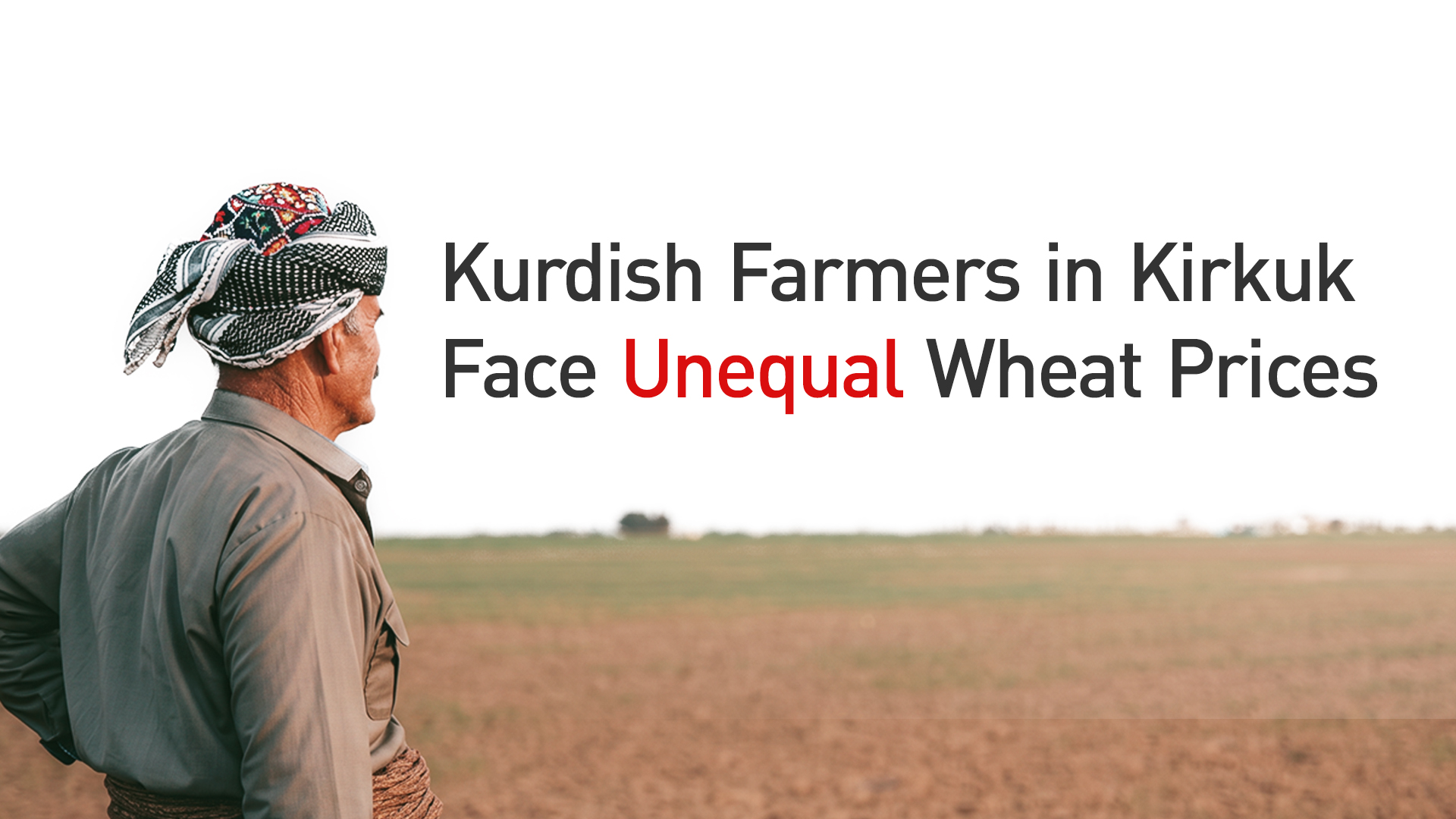
ERBIL (Kurdistan24) - Across the sunbaked expanses of Kirkuk province, the culmination of the agricultural calendar is marked by the rhythmic churn of combine harvesters and the steady procession of heavy trucks rolling toward government silos. Yet beneath the seemingly uniform landscape of golden wheat lies a profound administrative fracture.
Although farmers here cultivate the exact same strategic crop within the same provincial borders, a stark two-tiered procurement system is currently dictating their livelihoods. Depending entirely on whether a farmer's plot falls within the federal government's recognized agricultural plan, their harvest is valued at dramatically different rates.
It is a bureaucratic distinction that translates into a devastating economic reality for thousands of Kurdish and Turkmen families, transforming the simple act of selling wheat into a reflection of Iraq's deepest unresolved institutional legacies.
For nearly four weeks, the federal Ministry of Trade has been receiving the annual wheat harvest at silos distributed throughout Kirkuk.
The procurement season, which officially commenced on the first of June, initially appeared robust, with authorities absorbing more than 250,000 tons of grain at the state-subsidized rate of 700,000 Iraqi dinars per ton.
However, a recent investigation by Kurdistan24 correspondent Soran Kamaran revealed that this lucrative official rate is largely inaccessible to a massive segment of the region's agricultural community.
The investigation exposes a procurement ecosystem where Arab farmers, particularly those situated in the Hawija district and the sub-districts of Zab, Abbasi, Rashad, Dubz, and Daquq, reap the full benefits of state agricultural planning.
Conversely, Kurdish growers in villages such as Topzawa, Sargaran, and the Salayi region, alongside numerous Turkmen farmers and some cultivators in Dubz and Daquq, find their harvests systematically excluded from the primary federal purchasing framework.
The scale of this exclusion is not marginal. Kurdish-produced wheat accounts for nearly half of Kirkuk province's total annual harvest, a yield estimated at approximately one million tons.
In response to mounting protests from disenfranchised agrarian communities, the Iraq's Ministry of Trade recently issued a concession, announcing that provincial silos would begin accepting what it categorizes as "outside-plan" wheat. Yet this administrative compromise carries a staggering financial penalty.
Government facilities are purchasing this excluded wheat at merely 500,000 dinars per ton. For the farmers compelled to accept this rate, the classification effectively erases 200,000 dinars of value from every ton they produce, amounting to a twenty-nine percent reduction in gross revenue that threatens to erode entire seasons of capital investment.
Faced with these steep government discounts, many cultivators are driven toward the volatility of the private market.
Market analysts note that the depreciated state rate for outside-plan wheat is barely competitive with local commercial prices, where grain generally trades between 350,000 and 450,000 dinars per ton. Despite the lower ceiling, a significant number of Kurdish and Turkmen farmers actively choose these commercial buyers over the state.
The private market offers immediate liquidity, allowing farmers to bypass the federal government's notoriously cumbersome electronic queuing system and the protracted delays associated with cashing official state checks.
Yet this reliance on private liquidation only underscores the broader failure of a national procurement strategy designed to secure domestic food supplies and stabilize rural economies.
The origins of this unequal treatment extend far beyond contemporary bureaucratic oversight. The financial hemorrhage currently endured by Kirkuk's Kurdish and Turkmen agriculturalists is deeply intertwined with Baghdad's chronic inability to effectively implement its own parliamentary legislation.
At the heart of the crisis is the legacy of Ba'ath-era demographic engineering and land expropriation. On January 21, 2025, the Iraqi Parliament took a historic legislative step by formally annulling Revolutionary Command Council Resolutions No. 1018 of 1982 and No. 554 of 1983.
These decrees had served as the legal architecture for the systematic confiscation of vast tracts of agricultural land in Kirkuk.
The parliamentary annulment was widely heralded as a definitive restoration of property rights for the original Kurdish and Turkmen landowners whose fields were expropriated under the guise of agricultural reform decades ago.
However, a year and a half after these dictatorial decrees were legislatively struck down, the promise of restitution remains largely theoretical. The restored lands, and crucially, the farmers who work them, continue to be excluded from the federal agricultural plan.
This gap between parliamentary enactment and executive enforcement highlights a persistent structural paralysis within the Iraqi state.
Mohammed Amin, a prominent representative of Kurdish farmers in Kirkuk, explained to Kurdistan24 that the targeted agricultural lands remain technically seized under a labyrinth of outdated legal pretexts, leaving the cultivators without formal restitution or integration into the modern state economy.
The historical accounting detailed by Amin paints a staggering picture of agricultural disenfranchisement. He noted that the annulled Ba'ath Revolutionary Command Council decrees accounted for 300,000 dunams of seized property.
A further 500,000 dunams were historically confiscated by the Northern Affairs Council, while an additional 400,000 dunams of contracted farmland saw their property rights abruptly revoked during successive waves of displacement between 1925 and 1975, and later during the 1980s.
Out of this massive inventory of approximately one million dunams of contested land, Amin estimates that roughly 800,000 dunams remain stranded entirely outside the federal government's contemporary agricultural plan.
The consequences of this administrative exile are immense. Because these 800,000 dunams lack formal recognition within the state's planting quotas, Amin estimates that upward of 700,000 tons of wheat could be forced into the depreciated, outside-plan market during this harvest cycle alone.
The economic drain on Kirkuk's rural infrastructure is consequently measured in the hundreds of millions of dinars. Amin pointed to the enduring failure of Law No. 29 of 2012, which originally mandated the return of the 300,000 dunams confiscated by the Ba'ath leadership.
He informed Kurdistan24 that the Iraqi Council of Ministers has yet to issue the necessary executive guidelines to implement the law, noting that this executive inertia is exactly what forces distressed farmers to liquidate their harvests at severe losses in the open market, sometimes fetching as little as 300,000 to 350,000 dinars per ton.
When administrative progress does occur, it is often frustratingly piecemeal. Amin highlighted that while new implementation guidelines for land restitution were finally issued after a fourteen-year delay, their scope proved astonishingly narrow.
The recent directives apply only to forty-seven villages situated in the Qara Hanjeer and Shwan areas. For the remaining three hundred villages scattered across the Kirkuk province, the legal and economic limbo endures unchanged.
This selective application of justice means that the overwhelming majority of affected farmers must continue to navigate a procurement system that structurally penalizes their output.
Beyond the staggering statistics and convoluted legal histories lies a narrative of profound human endurance. The financial depreciation of this year's harvest compounds nearly a decade of extraordinary hardship for these rural communities.
Since the political and military upheavals of October 2017, Kurdish farmers in contested zones like Sargaran have operated in an environment defined by acute vulnerability. For nine consecutive years, they have plowed their soil, sown their seed, managed complex irrigation networks, and brought their crops to harvest under the persistent shadow of armed conflict.
They have consistently reinvested in their ancestral lands despite routine military pressure and campaigns of violent intimidation orchestrated by imported settlers seeking to displace them.
The failure to equitably integrate these farmers into the national procurement framework threatens far more than individual household incomes; it jeopardizes the foundational principles of Iraq's agricultural sustainability.
Wheat procurement is arguably the most critical agricultural policy instrument at the federal government's disposal.
The state's purchasing price is specifically engineered to incentivize domestic production, ensure rural stability, and secure the national food supply against global market volatility. By artificially devaluing the output of half the province's agrarian workforce based on unresolved bureaucratic classifications, the state is effectively discouraging future cultivation.
When farmers are forced to absorb catastrophic losses, their capacity to purchase fertilizers, maintain machinery, and secure quality seed for subsequent seasons is severely diminished.
The current harvest in Kirkuk lays bare the enduring friction between administrative policy and historical justice.
As long as ownership questions remain unresolved and executive guidelines fail to reflect parliamentary mandates, the agricultural potential of one of Iraq's most fertile provinces will be deliberately suppressed.
The disparity at the silo scales is not merely a temporary administrative oversight; it is an ongoing reflection of an institutional system that continues to marginalize key communities.
Until a comprehensive and equitable implementation of agricultural policy is achieved, thousands of farmers will remain tethered to a double standard, watching the wealth of their fields heavily discounted by the very state institutions designed to protect them.
|
Summary Despite cultivating the same strategic crop, thousands of Kurdish and Turkmen farmers in Kirkuk are forced to sell their wheat harvest at a massive state discount. A deeply rooted bureaucratic disparity, tied to unresolved land disputes, is costing these rural communities millions of dinars. |
Kurdistan24 correspondent in Kirkuk, Soran Kamaran, contributed to this report.