Muqtada al-Sadr Backs Iraq's Anti-Corruption Drive, Says Arrests Have Restored Public Hope
Muqtada al-Sadr backs Iraq's anti-corruption campaign, urging peaceful demonstrations as nationwide investigations expand under judicial oversight.
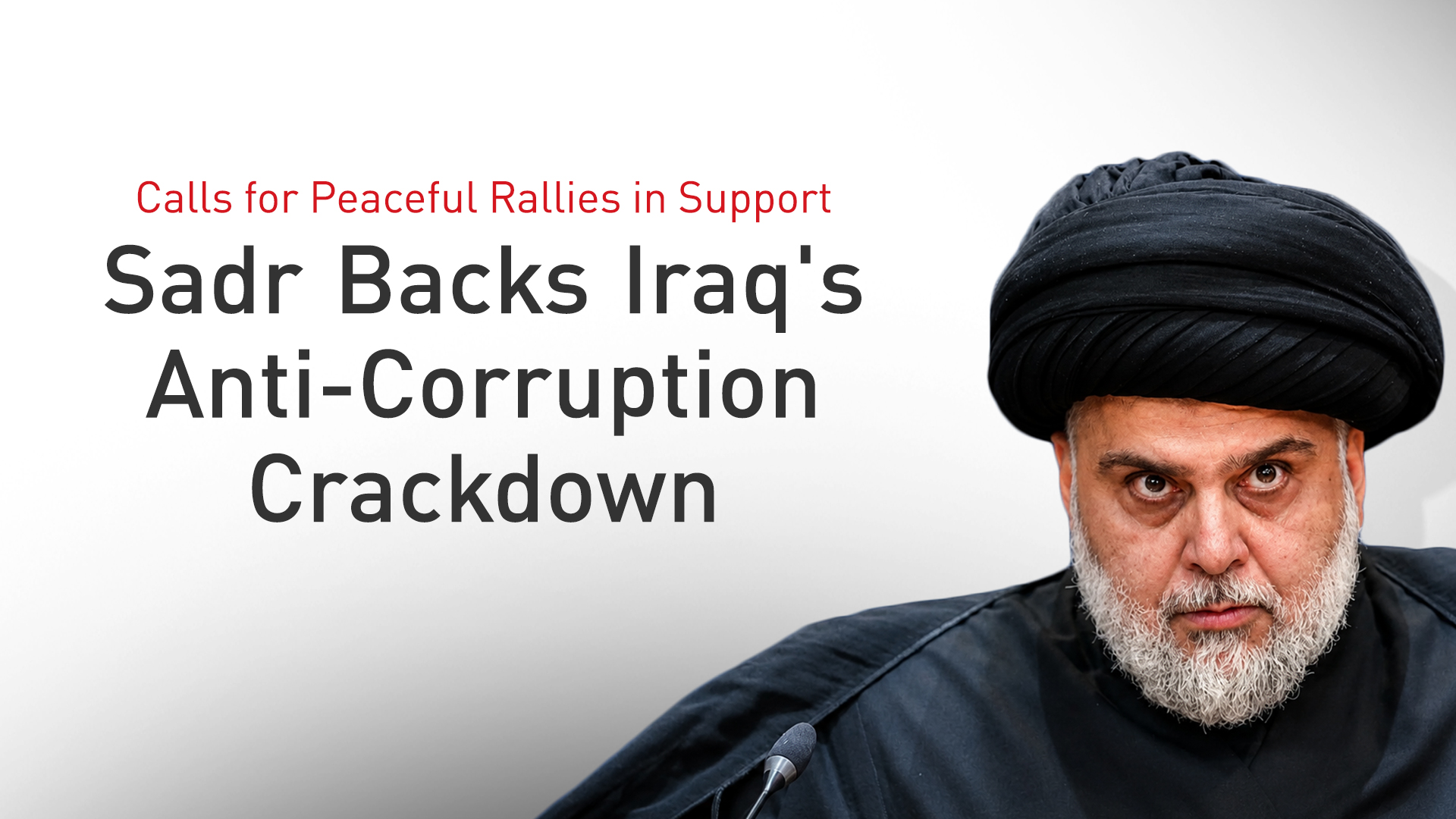
ERBIL (Kurdistan24) - Muqtada al-Sadr's endorsement of Iraq's expanding anti-corruption campaign has added a significant political dimension to one of the country's most far-reaching institutional investigations in recent years, with the influential Shiite leader arguing that the arrests of senior officials have rekindled hope among Iraqis after years of public frustration over corruption.
Al-Sadr's intervention comes at a pivotal stage of the nationwide campaign, as judicial authorities, oversight institutions and security agencies continue to pursue investigations into allegations of financial misconduct involving prominent political and administrative figures.
His remarks do not alter the legal nature of the investigations, but they underscore the broader political resonance of a campaign that has rapidly become one of Iraq's defining governance initiatives.
In a formal statement, the leader of the National Shiite Movement expressed support for the ongoing anti-corruption effort and called on his followers to participate in peaceful demonstrations on Friday in support of institutional reform.
He described the recent arrests as evidence that accountability measures were beginning to restore confidence among citizens who had grown increasingly disillusioned by years of corruption and the perceived misuse of public resources.
Rather than urging a partisan mobilization, al-Sadr sought to frame the demonstrations as expressions of national solidarity behind lawful reform efforts.
He instructed supporters that participants should carry only the Iraqi national flag alongside the banner of Imam Hussein, "Sayyid al-Islah," while refraining from displaying political party flags, factional symbols or other slogans.
That guidance reflects an emphasis on presenting the demonstrations as support for constitutional institutions rather than for any individual political movement. By limiting the symbols used during the marches, al-Sadr appeared to encourage a message centered on national unity and institutional accountability instead of partisan competition.
He also praised the Iraqi judiciary, the Counter-Terrorism Service (CTS), anti-corruption bodies and other state institutions responsible for implementing judicial decisions.
Read More: Iraq Prime Minister Vows No Mercy in Stage One of Corruption Crackdown
His comments highlighted the role of multiple branches of government in carrying out the investigations, reinforcing the official portrayal of the campaign as a coordinated institutional effort operating through legal mechanisms rather than a politically driven initiative.
The public endorsement carries particular weight because of al-Sadr's longstanding influence within Iraq's political landscape.
Although political leaders have frequently spoken about combating corruption, explicit support for an active nationwide judicial campaign from one of the country's most prominent Shiite figures represents a notable political development, particularly as investigations continue to expand.
His statement also arrives during a period of heightened public attention surrounding the scope of the anti-corruption operation itself.
According to security sources, Iraqi authorities arrested 67 individuals during the first 24 hours of the campaign.
Those detained reportedly include current and former lawmakers, senior civil servants, business executives and investors who are under investigation over allegations including financial corruption, embezzlement of public assets, illicit enrichment and money laundering.
Read More: Massive Anti-Corruption Drive in Iraq Nets 67 Officials in 24 Hours
Officials have described the operation as only the initial phase of a broader institutional campaign.
While future arrests remain subject to judicial procedures, authorities have indicated that additional investigations are expected as part of a sustained strategy aimed at recovering public funds, strengthening oversight of state institutions and reinforcing the implementation of the rule of law through constitutional mechanisms.
The breadth of the campaign has been accompanied by extensive security measures intended to safeguard ongoing investigations.
Elite security formations, including the CTS, have been deployed at strategic locations in Baghdad, while authorities have tightened monitoring at airports and border crossings to prevent suspects under investigation from leaving the country before legal proceedings are completed.
Read More: Exclusive - Iraq Anti-Corruption Sweep Expands: Key Arrests Revealed
Throughout the operation, the federal government has consistently presented the investigations as the product of coordination among the judiciary, oversight bodies, security agencies and other constitutional institutions.
Officials have emphasized that the objective is to strengthen governance through lawful accountability while preserving judicial independence and due process.
In keeping with Iraq's legal framework, those detained remain under investigation, and the allegations against them will be examined through the courts. The presumption of innocence continues to apply unless and until judicial proceedings establish criminal liability.
The campaign has also highlighted cooperation between Baghdad and the Kurdistan Regional Government (KRG) within Iraq's federal constitutional system.
Following formal requests from the federal government and the Federal Integrity Commission, Kurdish security forces detained three suspects residing in Erbil who were wanted in connection with corruption investigations. After completing the required legal procedures, the individuals were transferred to federal authorities at the Sherawa checkpoint.
As previously reported by Kurdistan24 correspondent Hoshmand Sadiq, Kurdish security personnel remained at the crossing until all administrative and judicial transfer procedures had been completed, illustrating the emphasis placed on lawful coordination between regional and federal institutions.
Read More: Kurdistan Region Arrests Three Corruption Suspects, Hands Them Over to Baghdad
The handover has become one of the clearest practical examples of intergovernmental cooperation during the current campaign.
Rather than suggesting a transfer of political authority, it demonstrates how the Kurdistan Region and federal authorities can operate within Iraq's constitutional framework when responding to judicial requests involving criminal investigations.
This institutional cooperation has unfolded alongside repeated official assertions that the anti-corruption campaign is intended to protect public resources, reinforce accountability and strengthen confidence in state institutions through constitutional processes.
Against that backdrop, al-Sadr's endorsement assumes broader political significance. By encouraging peaceful public participation while simultaneously praising the judiciary, the CTS and other institutions implementing judicial decisions, he aligned his public message with the government's stated emphasis on legal accountability rather than political confrontation.
His insistence on limiting demonstrations to national and religious symbols further sought to separate expressions of public support from partisan competition, presenting the marches as civic rather than political gatherings.
Whether the campaign ultimately produces lasting institutional change will depend on the outcomes of ongoing investigations and subsequent judicial proceedings.
Nevertheless, the convergence of expanding legal action, cooperation between Baghdad and the Kurdistan Regional Government, and public support from one of Iraq's most influential political figures has added new momentum to a campaign that authorities describe as a sustained effort to reinforce governance, protect public funds and strengthen confidence in the rule of law.
|
Summary Muqtada al-Sadr has endorsed Iraq's expanding anti-corruption campaign, saying recent arrests have renewed hope among Iraqis. His call for peaceful demonstrations comes as judicial authorities, security agencies and the Kurdistan Region continue coordinating through constitutional procedures. |