Fuad Hussein: Economy, Security Led Iraq-U.S. Talks During Washington Visit
In an exclusive interview with Kurdistan24, Iraq's foreign minister says energy investment, regional security, and the planned U.S. troop withdrawal defined Baghdad's discussions in Washington.
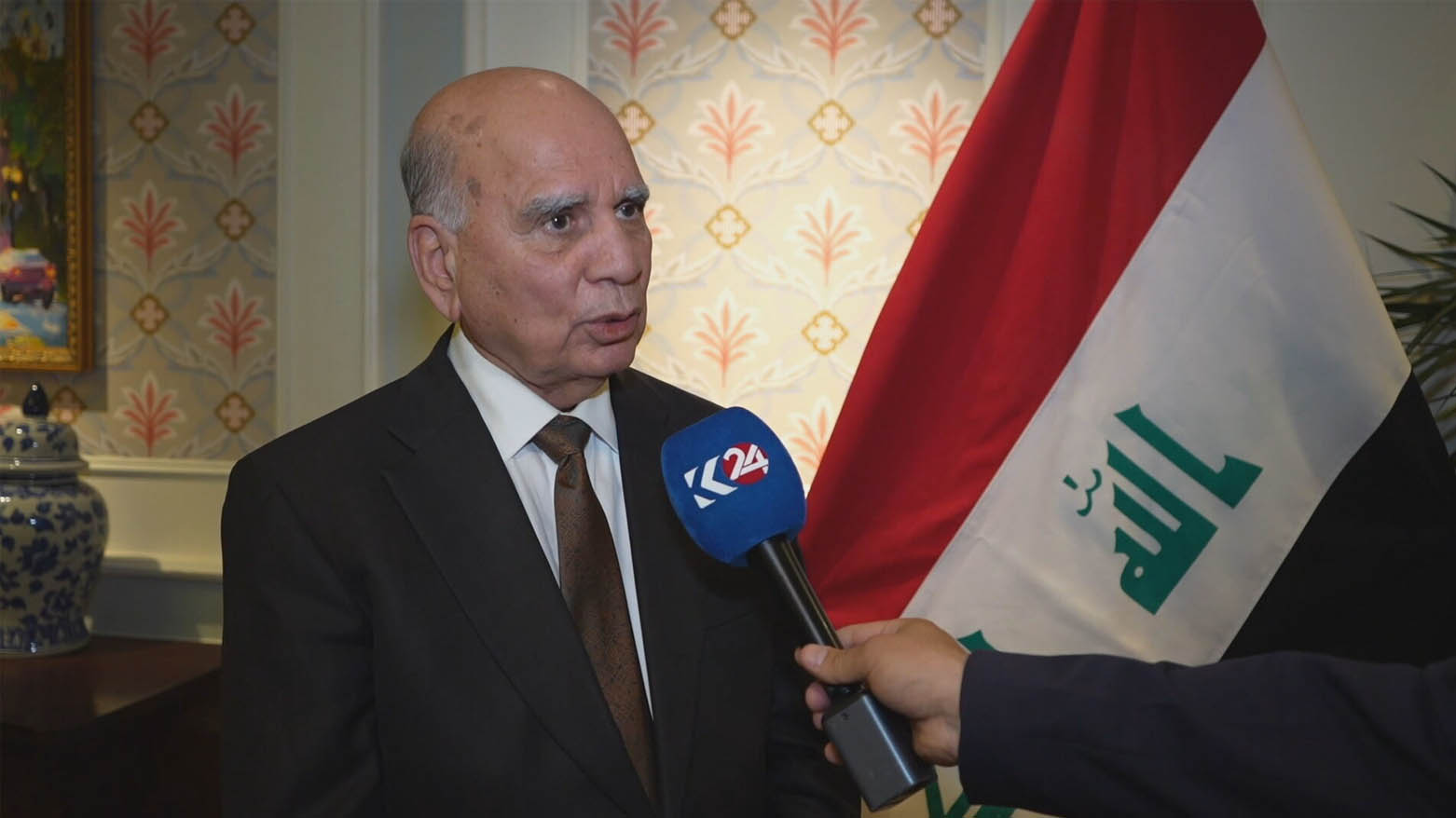
ERBIL (Kurdistan24) - Economic cooperation emerged as the central objective of Iraq's high-level meetings in Washington, with security coordination closely intertwined, according to Foreign Minister Fuad Hussein, who described the discussions as laying the groundwork for the next phase of relations between Baghdad and the United States.
Speaking exclusively to Kurdistan24 on Friday, Hussein said President Donald Trump reaffirmed his support for Iraq's current government during meetings held as part of Prime Minister Ali al-Zaidi's visit to the United States.
He added that the political backing was accompanied by tangible economic initiatives, with several agreements involving American companies expected to be concluded in key sectors including energy, oil, natural gas, and electricity.
Hussein's remarks portray Baghdad's strategy as one that seeks to translate diplomatic engagement into long-term economic partnerships while addressing the security conditions necessary to attract sustained foreign investment.
Rather than viewing economic development and national security as separate policy tracks, the foreign minister presented them as mutually reinforcing priorities.
He said commercial cooperation was the principal focus of the visit, reflecting Iraq's effort to strengthen its energy sector through partnerships with U.S. firms while broadening opportunities for investment in critical infrastructure.
That agenda, however, was accompanied by extensive discussions on Iraq's internal and regional security environment.
According to Hussein, talks examined the challenge posed by weapons outside state authority and the impact such issues have on national stability and investor confidence.
He reiterated the Iraqi government's position that all arms should remain under state control, describing security as an essential prerequisite for economic growth.
He noted that Prime Minister Ali al-Zaidi has consistently emphasized creating a stable environment in which international companies can operate with confidence, arguing that lasting investment depends not only on commercial opportunities but also on reliable security conditions.
The minister also warned that Iraq's economic prospects remain closely tied to developments beyond its borders.
He cautioned that any expansion of regional conflict would carry serious consequences for Iraq, pointing specifically to the Strait of Hormuz, through which the country's oil exports depend on uninterrupted maritime access.
A disruption to shipping in the strategic waterway, he said, would prevent Iraq from exporting crude oil and could trigger a severe economic crisis, underscoring the country's vulnerability to wider geopolitical instability.
Against that backdrop, Hussein highlighted another project that reflects Baghdad's broader economic ambitions beyond immediate investment agreements.
Discussing the proposed Kirkuk-Baniyas oil pipeline, he revealed that the initiative was raised during his recent visit to Damascus in talks with Syrian President Ahmed al-Sharaa.
According to Hussein, Syrian officials expressed interest in investing in the project, though significant financial resources would be required before construction could move forward.
The pipeline, if realized, would represent a strategic addition to Iraq's regional energy infrastructure, although Hussein stressed that funding remains one of the principal obstacles to implementation.
His comments suggest Baghdad continues to pursue longer-term projects aimed at expanding export options and strengthening regional economic integration while balancing immediate priorities tied to security and investment.
The interview concluded with Hussein reaffirming one of the most closely watched elements of Iraq's relationship with Washington: the future of the U.S. military presence.
He confirmed that Baghdad and Washington remain committed to the previously agreed timetable under which American forces will withdraw from Iraq and the Kurdistan Region by the end of September 2026.
Hussein described the timeline as a key objective of the Iraqi government, indicating that the agreement remains in place despite broader regional tensions.
Taken together, Hussein's assessment presents Iraq's engagement with the United States as an effort to align political support, economic development, and security policy within a single strategic framework.
As Baghdad pursues major energy partnerships while navigating a fragile regional environment, the success of that approach may depend on its ability to preserve stability at home while managing the uncertainties surrounding the wider Middle East.
|
Summary In an exclusive interview with Kurdistan24, Foreign Minister Fuad Hussein said economic cooperation and security dominated Iraq's talks in Washington, highlighting planned U.S. energy agreements, concerns over regional instability, the Kirkuk-Baniyas pipeline, and the planned U.S. troop withdrawal by September 2026. |