US “concerned” over Turkish attacks on Kurds in Syria
The US has “concerns” about Turkey’s shelling of areas in the self-declared Kurdish canton of Afrin in northern Syria, Col. Ryan Dillon, spokesman for the US-led coalition against the Islamic State (IS), told Pentagon reporters.
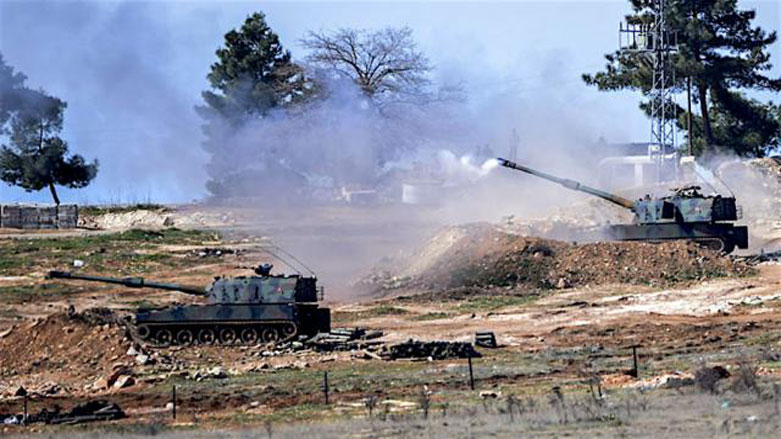
WASHINGTON DC, United States (Kurdistan24) – The US has “concerns” about Turkey’s shelling of areas in the self-declared Kurdish canton of Afrin in northern Syria, Col. Ryan Dillon, spokesman for the US-led coalition against the Islamic State (IS), told Pentagon reporters on Thursday.
Dillon explained that the US does not want anything to distract America’s partner force, the Kurdish-led Syrian Democratic Forces (SDF), from their offensive to liberate Raqqa, now in its third week and making “very good progress,” according to Dillon.
Turkey views the Kurdish People’s Protection Units (YPG), which provides the leadership of the SDF, as an arm of the Kurdistan Worker’s Party (PKK), which both the US and the European Union, as well as Turkey, consider to be a terrorist organization.
However, the US regards the YPG as a crucial ally in the fight against IS in Syria.
On Wednesday, Turkish Deputy Prime Minister Veysi Kaynak warned, “For Turkey's border security, for the region to stabilize, Afrin should be cleansed from terrorists and terrorist elements.”
Kaynak’s threat followed Turkish military movements along the Syrian border, where troops and armored vehicles that could serve as an invasion force have concentrated. The SDF has warned it will confront the Turkish forces “if they go beyond the known lines.”
Kurdistan24 asked Dillon whether the US had communicated its concerns to Ankara, but the spokesman replied that he had no specific knowledge.
US Secretary of Defense James Mattis met Turkey’s Defense Minister, Fikri Isik, at a NATO meeting in Brussels on Wednesday. Syria was among the topics they discussed, according to Mattis’ press secretary. Presumably, Mattis conveyed US concerns to Isik then.
Dillon was asked whether the US would defend the SDF against a Turkish invasion. “I don’t want to speculate,” he responded. “We will continue to support our SDF partners in the fight against [IS] in Raqqa and perhaps elsewhere after that.”
Dillon also hailed IS’ imminent defeat in Mosul, where he judged that a “few hundred” IS fighters remain in the western part of the city.
Nearly 200,000 residents have already returned to the eastern half of Mosul, but the older, western side has been more thoroughly destroyed and making it habitable again will require significantly more work, he said.
He also explained that the Shiite militias formally affiliated with the Iraqi government, some of which are actually under the control of Tehran, will not be part of the force that maintains security in Mosul after IS’ defeat.
The “hold force” will consist of tribal mobilization forces, the Iraqi army, and police elements.
Dillon had recently met the Nineveh police chief, who described the tribal elements as “the sons of the city, who know the area.”
“They know who lives in and amongst these areas,” and “they’ve played an integral role in identifying people who are not from that area and stopping attacks before they happen," the police chief explained.
Kurdistan 24 also asked Dillon whether he thought the forthcoming referendum on Kurdish independence would have any impact on the fight against IS, particularly as the terrorist organization is so close to defeat.
He responded that the referendum “is something that we definitely want to have the government of Iraq address.” But “we will continue to train Iraqi Security Forces, and an element of the Iraqi Security Forces are the Peshmerga.”
“To date, we have trained more than 20,000 Peshmerga forces,” who have been “critical” and “vital in the defeat of [IS] in Iraq,” Dillon said.
Editing by G.H. Renaud