Russia: US is in Syria illegally
Russian Foreign Minister Sergei Lavrov on Friday declared that the US was in Syria "illegally."
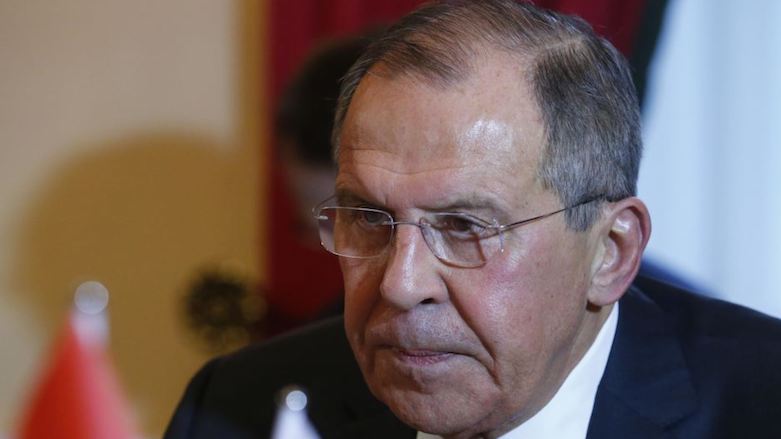
WASHINGTON DC, United States (Kurdistan 24) – Russian Foreign Minister Sergei Lavrov on Friday declared that the US was in Syria “illegally.”
While attending the Munich Security Conference, Lavrov spoke to Euronews, a media service based in France, covering news from a European-wide perspective.
In a sign of the increasing tensions between Moscow and Washington, Lavrov complained that for the past three years, “almost for the whole period” that the US-led coalition has been on the ground in Syria, the US has been there “illegally, without any invitation from Damascus, or without any mandate of the UN Security Council.”
Lavrov suggested that the US was planning an indefinite presence in Syria, and elsewhere too.
The US “probably” has “a strategy to settle in Syria forever, with its armed forces, just as they want to do in Iraq and Afghanistan,” Lavrov said.
“When they settle forever in Syria,” which they are doing now, Lavrov continued, “they isolate a huge piece of Syrian territory, in infringement of the sovereignty of the Syrian Arab Republic.”
The Russian Foreign Minister seemed to play on tensions between Ankara and Washington over US support for the Kurdish-led Syrian Democratic Forces (SDF), which is strongly opposed by Turkey.
The US seeks to create “some kind of quasi-local authority” in eastern Syria, Lavrov stated, “and in every way possible try to create there an autonomous unit with the support of the Kurds.”
Last month, the US announced it would remain in eastern Syria for the indefinite future, as leverage to support the UN-led diplomacy on Syria, as well as to contain Iran.
The US relies on its partner force, the SDF, led by the Kurdish People’s Protection Units (YPG), to maintain security in and to administer that part of Syria, roughly one-quarter of the country.
The surprise US announcement prompted opposition from all of Damascus, Moscow, Tehran, and Ankara.
One immediate consequence was that Russia—which had troops in Afrin and which controlled the airspace there—gave Turkey a green light to attack the isolated Kurdish canton.
That, in turn, had another consequence: last week’s attempted assault on an SDF headquarters in Deir al-Zor, where US Special Forces were also stationed.
Damascus thought the diversion of SDF fighters to Afrin might have significantly weakened the SDF position in the oil-rich governorate.
However, that calculation proved wrong. The coalition watched as the attacking force—which included Russian T-54 and T-72 tanks—mobilized. When that force began to assault the SDF post, the US led the counter attack—with what The Washington Post columnist David Ignatius described as “devastating firepower, from AC-130 ground-attack planes to armed drones.”
The engagement lasted nearly eight hours: from 10:00 p.m. on Feb. 7 to 5:30 the next morning. The Pentagon estimated that approximately 20 percent of the attacking force had been killed—100 out of 500 men, with just one casualty on the coalition side: an SDF soldier was wounded.
Before the assault began, both US officers and the Kurdish commander, “Hassan,” who described these events to Ignatius, contacted Russian forces in Syria (Hassan identified himself only by his first name).
As Hassan explained, he had advance intelligence that an attack was coming. At 9:30 p.m. on Wednesday, some 30 minutes before the assault began, he called his Russian military contact in Deir al-Zor, “hoping to avoid a battle.”
The Russian replied, “There is nothing happening,” Hassan said.
The attack followed, as did the counter-attack. Hassan’s Russian contact officer then called him some hours later, “asking for a pause to collect the dead and wounded—from an attack he had earlier denied was coming.”
Reports subsequently emerged that over 100 Russian private contractors may have been killed in the counter-attack, although Moscow characterized the high figures as “distorted data” and “erroneous information.”
“It’s funny that a superpower doesn’t know what their forces are conducting on the ground,” Hassan told Ignatius.
Hassan also explained the timing of the attack: “the regime thinks we are weak,” because SDF fighters have moved north to help defend Afrin.
But, the post was, nonetheless, well-defended. As Hassan concluded, “We don’t trust Russia anymore.”
Editing by Karzan Sulaivany