Iran's Khamenei Sets Conditions for Any Future U.S. Cooperation
Ayatollah Khamenei stated Iran would only consider cooperation with the U.S. if it ends support for Israel, withdraws from the region, and ceases interference.
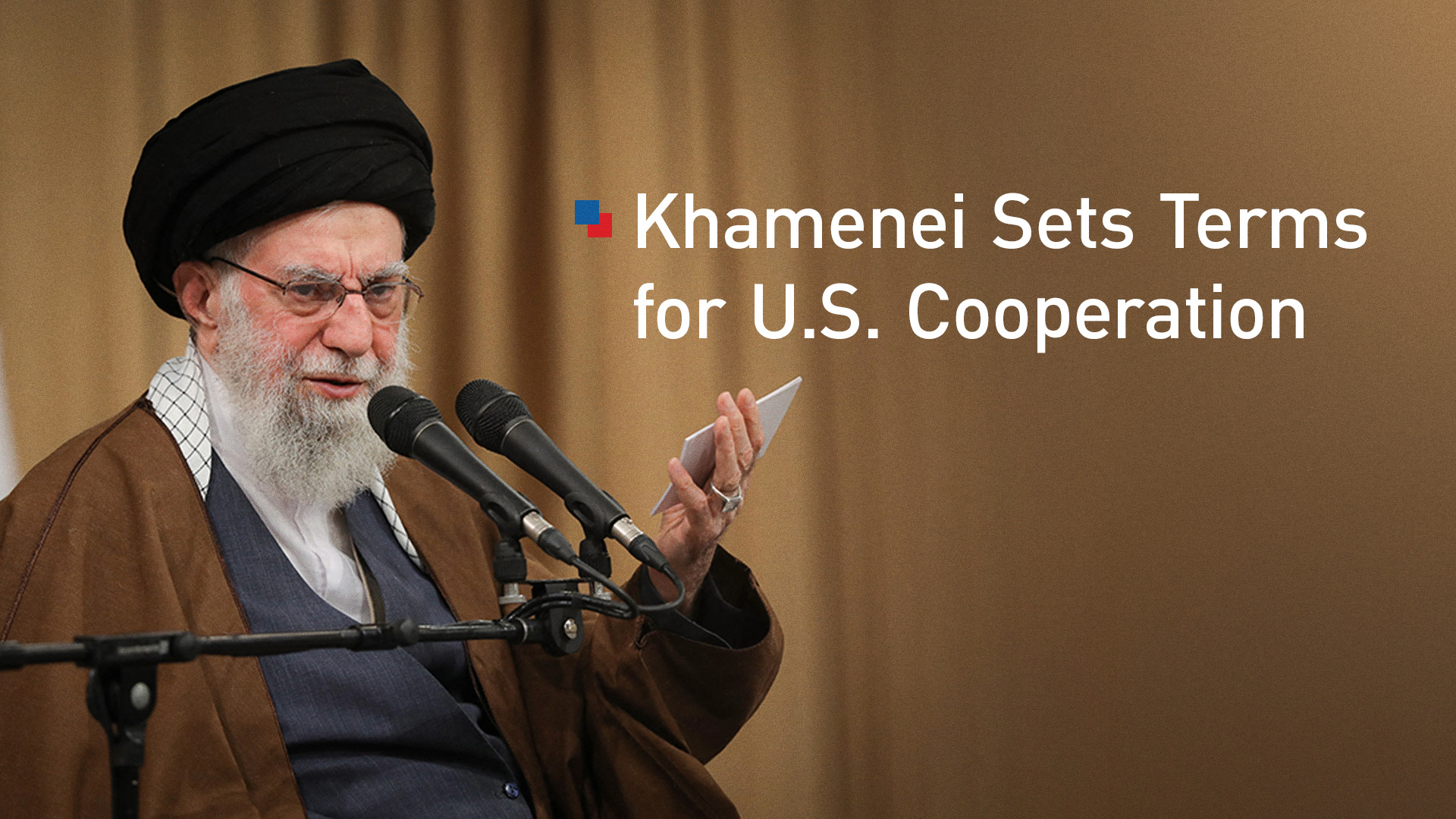
ERBIL (Kurdistan24) – In an address that laid out a series of non-negotiable demands, Iran's Supreme Leader, Ayatollah Seyed Ali Khamenei, has declared that any American request for cooperation with the Islamic Republic will only be considered after the United States completely ceases its support for Israel, dismantles all of its military bases in the region, and ends what he termed its interference in regional affairs.
The hardline speech, delivered to a group of students in Tehran, represents a forceful rejection of any potential near-term rapprochement with Washington and underscores a fundamental clash of interests that, in Tehran's view, can only be resolved by a radical reordering of the American posture in the Middle East.
This declaration from the center of the Iranian establishment, as reported by the IRGC-affiliated Tasnim News Agency, comes at a moment of intense regional volatility and finds a striking, if more diplomatically phrased, echo in the recent pronouncements from one of its few close allies in the region, Iraq.
The convergence of messaging from both Tehran and Baghdad, explicitly linking regional stability and the resolution of internal security challenges to a withdrawal of American military power, sets the stage for a period of heightened tension and a direct ideological and strategic confrontation with the United States and its allies, who are simultaneously escalating their own pressure campaign to curb Iranian influence and dismantle its network of armed proxy groups.
'A Fundamental Conflict of Interests'
Speaking on Monday to an audience of school and university students on the occasion of Iran's "National Day of Fighting against Global Arrogance," Ayatollah Khamenei framed the conflict with the United States not as a recent political dispute, but as a deep-seated historical and ideological struggle.
He explained that U.S. hostility toward the Iranian nation dates back to the CIA-backed coup of 1953, which overthrew then–Prime Minister Mohammad Mosaddegh, restored the monarchy, and has remained a defining feature of bilateral relations ever since.
Khamenei dismissed as a "distortion of history" the claim that the popular Iranian slogan "Death to America" was the cause of this enmity, arguing instead that the "real issue between the U.S. and the Islamic Republic is their inherent incompatibility and conflict of interests."
It was in this context that he laid out his stark preconditions for any future engagement.
He noted that "only if the U.S. completely ends its support for the Zionist regime, withdraws all its military bases from the region, and refrains from interfering in regional affairs, could any American request for cooperation with Iran be considered, not in the near future but in later times."
The statement effectively shuts the door on any immediate dialogue, placing full responsibility on Washington to radically revise its long-standing regional alliances and military posture before talks can even be contemplated—a demand that remains highly unrealistic from Tehran.
Addressing the question of whether Iran would ever normalize relations with the United States, the Supreme Leader was unequivocal, characterizing the American position as one that demands complete submission.
"The inherently arrogant nature of the U.S. accepts nothing but submission," he stated. "Every U.S. president desired this, though some did not state it openly; the current president has expressed it explicitly, revealing the U.S.’s true nature.”
He asserted that expecting a nation with Iran's capabilities, history, and "vigilant and motivated youth" to submit is "meaningless." Instead, he offered a different path forward for his country: strength. "We cannot predict the distant future," he concluded, "but at present, all must know that the solution to many problems lies in becoming stronger"—through managerial, scientific, and military capability.
A Striking Echo from Baghdad
This hardline stance from Tehran, explicitly making a U.S. withdrawal a prerequisite for regional stability, finds a remarkable parallel in the recent statements of Iraqi Prime Minister Mohammed Shia al-Sudani.
In a carefully worded but equally significant declaration, Sudani asserted that his government's pledge to bring all weapons under the control of the state can only be fulfilled once the U.S.-led international coalition has completely withdrawn from Iraq.
This stark linkage effectively frames the continued American military presence as the primary obstacle to disarming the powerful, often Iran-backed, armed factions that challenge the state's authority.
As long as these groups can portray the coalition as an "occupying force," Sudani argued, the political conditions for their disarmament will remain out of reach.
"There is no ISIS. Security and stability? Thank God it's there," the Prime Minister stated in an interview, questioning the continued justification for the U.S. presence. "So give me the excuse for the presence of 86 states."
It is only after this "excuse" is removed, he contended, that his government can implement a "clear program to end any arms outside of state institutions."
This position, while presented as a pragmatic sequencing of events, creates a dangerous diplomatic impasse, a chicken-and-egg scenario where the U.S. will not leave until the threat from the militias is neutralized, and, according to the Iraqi Prime Minister, the militias cannot be neutralized until the U.S. leaves.
A Converging Narrative Amid Escalating Pressure
While the rhetoric from Tehran is ideological and confrontational, and the language from Baghdad is diplomatic and procedural, a remarkable symmetry has emerged in their core strategic diagnosis: both governments are publicly asserting that the primary source of instability in the region, and the main impediment to their own internal security objectives, is the continued military presence of the United States.
This converging narrative, however, is being met with a coordinated and increasingly assertive campaign of pressure from Washington and its allies, who view the situation in precisely the opposite terms.
For them, it is not the U.S. presence, but the proliferation of Iran-backed militias that is the root cause of instability.
This American impatience has recently manifested in a series of direct and unambiguous warnings. U.S. Secretary of War Pete Hegseth delivered a "final notice" to his Iraqi counterpart, threatening direct U.S. military action if armed factions interfere with planned American operations.
This was followed by a powerful inaugural statement from the new U.S. Special Envoy to Iraq, Mark Savaya, who, under the banner of "MAKE IRAQ GREAT AGAIN," declared that "there is no place for armed groups operating outside the authority of the state" and that a sovereign Iraq must be "free from malign external interference, including from Iran and its proxies."
This American pressure is amplified by growing security concerns from its key regional ally, Israel.
Israeli intelligence sources have warned of a "developing threat" from Iraq, stating that Iran is pouring significant resources into its proxy militias there, turning the country into a potential launchpad for attacks against Israel.
The IDF and Mossad are reportedly actively preparing for these scenarios. This means that the actions—or inactions—of the Iraqi government regarding these factions are now being watched with intense interest not only in Washington, but also in Tel Aviv.
Complicating the situation even further is the urgent strategic recalibration underway in Tehran. The commander of Iran's elite Quds Force, Brigadier General Esmail Qaani, made a quiet, low-profile visit to Baghdad just last week.
His mission was not one of aggression, but of preservation: to mend the "ferocious rivalries" within Iraq's ruling Shiite Coordination Framework and prevent the splintering of what has become the last reliable cornerstone of Tehran's battered "axis of resistance."
Qaani's visit comes at a moment of acute vulnerability for Iran.
With its proxies severely degraded in Lebanon and Gaza, and its key state ally in Syria having fallen, Iran's strategic depth has eroded dramatically. Iraq, as one analysis from Al-Monitor put it, remains its "only theater to recalibrate its regional axis."
For Tehran, preserving its influence in Baghdad, primarily through the armed factions Sudani is being pressured to disarm, is no longer just about projecting power; it is about survival.
This context makes it highly unlikely that Iran would stand by and allow its most critical remaining strategic asset to be dismantled, placing Prime Minister Sudani in an even more impossible position.
His promise to disarm the factions post-withdrawal is also fundamentally challenged by the stark reality of the Iraqi state's own internal weakness. With an estimated seven million weapons operating outside of government control, a recent Interior Ministry registration program managed to register a mere 125,000 firearms.
This raises a critical question: even if the U.S. were to withdraw, does the Iraqi state possess the actual power to confront and disarm these powerful militias?
The positions of Tehran and Baghdad, while presented differently, have created a unified diplomatic front against the continued U.S. military presence in the region.
Ayatollah Khamenei's speech was a maximalist declaration of ideological principle, while Prime Minister Sudani's was a pragmatic argument about political sequencing.
Both, however, lead to the same conclusion and the same demand: for regional stability to be achieved, the United States must leave. As this shared narrative solidifies, and as American pressure continues to mount, Iraq finds itself, once again, at the epicenter of a dangerous and unpredictable showdown between its two most powerful allies.