KRG Ministry of Electricity: Nearly 4.5 Million Citizens Now Have 24-Hour Power Supply
The KRG Ministry of Electricity announced that nearly 4.5 million citizens now receive 24-hour continuous power under the Runaki program. The initiative has decommissioned over 3,200 private generators, reduced emissions by 600,000 tons annually, and cut electricity costs by up to 80% for households
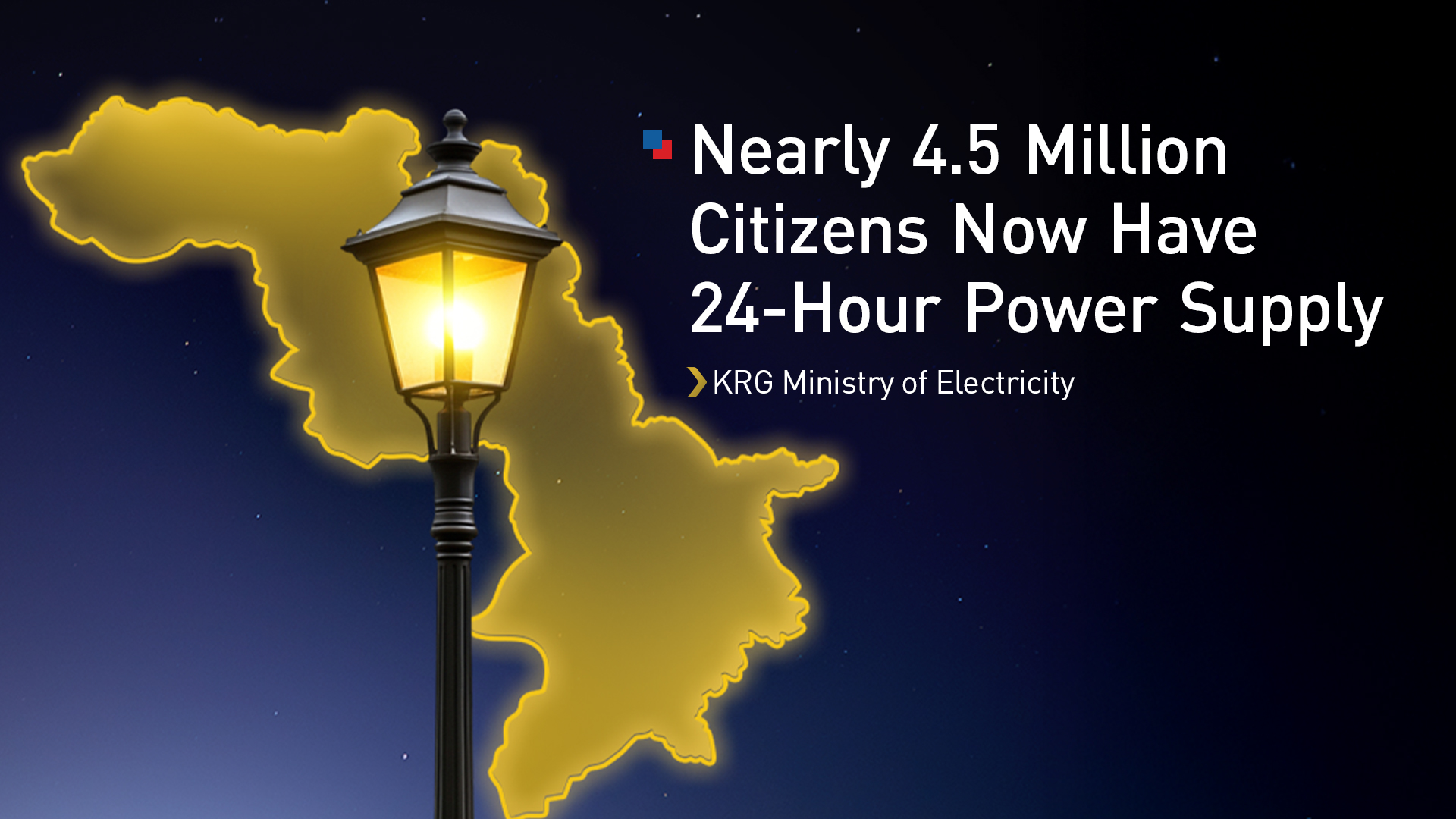
Erbil (Kurdistan24) – The Kurdistan Regional Government’s (KRG) Ministry of Electricity announced on Wednesday that nearly 4.5 million residents across the Kurdistan Region now benefit from uninterrupted, 24-hour national power.
According to the ministry’s official statement, as of Nov. 5, 2025, a significant portion of the Region’s population enjoys continuous electricity around the clock, marking a milestone in the government’s long-term energy reform agenda.
The announcement highlights that citizens in multiple provinces and districts now receive stable power both day and night, without interruptions—a direct outcome of the KRG’s flagship Runaki program.
The Runaki program, launched in October 2024 by Kurdistan Region Prime Minister Masrour Barzani, aims to ensure full 24-hour electricity coverage for all homes and commercial areas across the Kurdistan Region by the end of 2026.
Under the leadership of Prime Minister Barzani, the Runaki program has steadily expanded to major cities including Erbil, Sulaimani, Duhok, Halabja, Zakho, Soran, and Ranya, transforming the Region’s energy landscape.
In Ranya city center, the program was launched earlier this week, benefiting more than 135,000 citizens in the Raparin Independent Administration. With this rollout, over 100 diesel generators were decommissioned, reducing fuel dependency and emissions.
Similarly, Zakho and Soran have transitioned to uninterrupted electricity, a shift that represents a major milestone in modernizing the Region’s power infrastructure and ending decades of reliance on unstable local generators.
Kamal Mohammed Salih, the KRG Minister of Electricity, said during a recent press conference that the program has “effectively solved a 30-year electricity problem,” delivering stability and affordability to millions of citizens.
“The Runaki project was not just a convenience—it was a necessity of this era,” he said. “Our goal has been to meet growing demand with sustainable solutions, and we have achieved this in coordination with the Prime Minister’s Office.”
He added that despite financial challenges, the Ninth Cabinet’s strategy—focused on clean energy expansion, smart metering, and grid modernization—has allowed the Region to meet rising demand efficiently.
One of the program’s most visible effects has been the shutdown of more than 3,200 private generators, significantly improving air quality and public health. The Kurdistan Region’s Environment Board confirmed that harmful particle emissions in Erbil have been halved, while visibility has improved from six to ten kilometers.
Officials estimate that these efforts have reduced carbon emissions by over 600,000 tons per year. The Ministry of Education also reported that continuous electricity has enabled the installation of smart boards and digital projectors in classrooms, modernizing learning environments across the Region.
In parallel, the program’s progressive tariff system has cut household electricity costs by up to 80 percent, offering major financial relief. Citizens from Erbil and Sulaimani told Kurdistan24 that their monthly bills are now a fraction of what they previously paid for unreliable power.
Prime Minister Masrour Barzani’s pledge to provide 24-hour electricity to every home and business has now become a reality for nearly 4.5 million people, representing more than half of the Kurdistan Region’s population.
As the program continues expanding, the KRG Ministry of Electricity confirmed that by the end of 2026, every city, district, and village in the Region will have continuous, reliable national power.
The Runaki program now stands as one of the most transformative public service achievements in the Kurdistan Region’s modern history—reducing pollution, enhancing health and education, boosting economic productivity, and delivering on a promise that has reshaped daily life for millions.