PM Barzani’s Warning 'Proved Right': Khor Mor Attack Exposes Iraq’s Deepening Energy Fault Lines
Khor Mor attack exposes Iraq’s energy fragility, validating PM Barzani’s warnings amid political tensions and stalled security reforms.
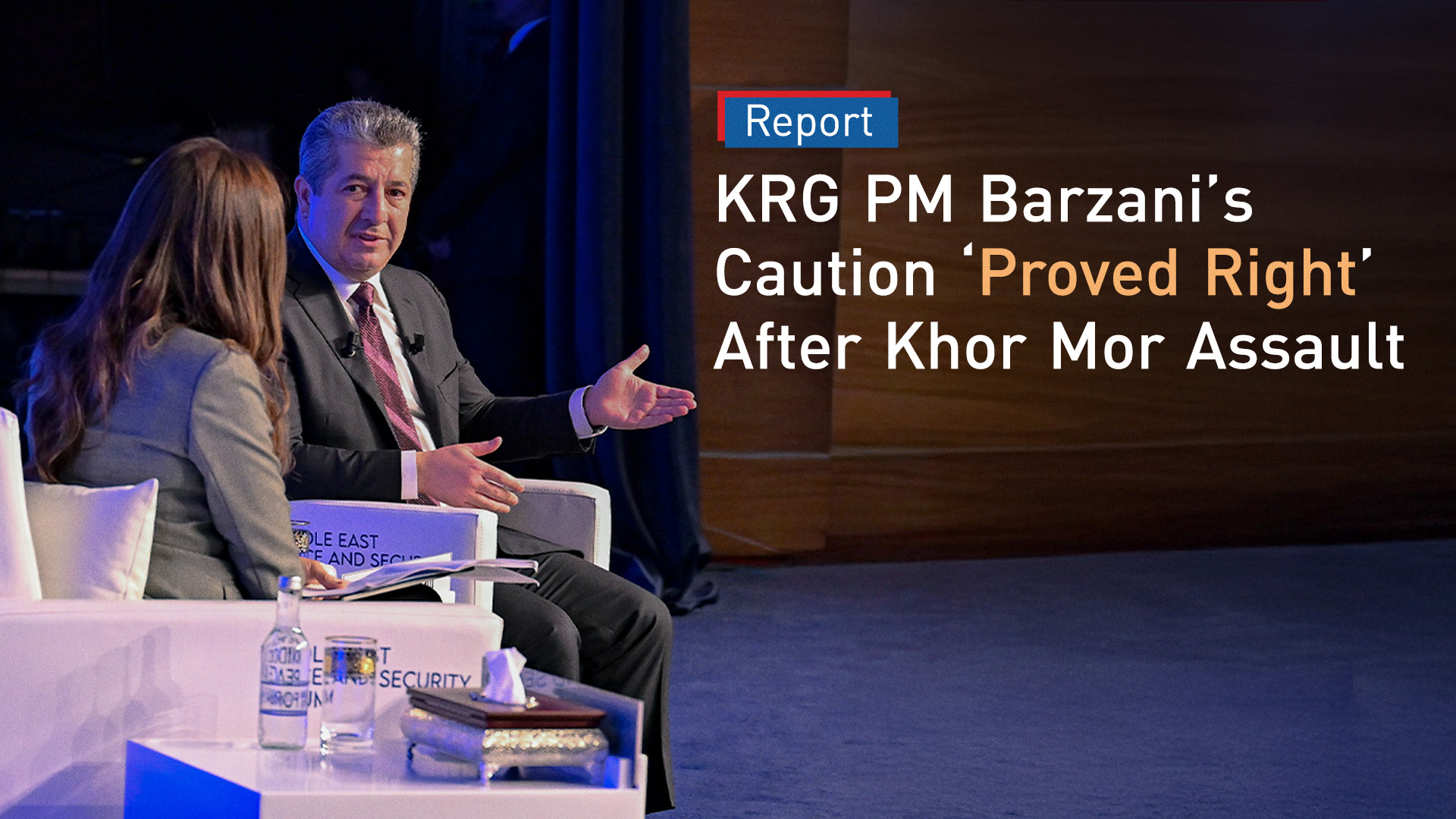
ERBIL (Kurdistan24) – A devastating rocket and drone strike on the Khor Mor gas field once again targeted the Kurdistan Region's energy infrastructure, days after Prime Minister Masrour Barzani warned that federal inaction and the release of perpetrators involved in previous assaults would invite further attacks. He was proven correct with chilling precision.
The blast, which triggered an immediate shutdown of gas flows and widespread electricity cuts, has laid bare the structural frailties of Iraq’s authority to rein in the extralegal militia groups, reviving urgent questions about security, accountability, and the political forces that continue to weaponize essential infrastructure.
The Attack on Vital Energy Infrastructure
The latest attack on the Khor Mor gas field, reported by The National, demonstrated both its strategic importance and its fragility. The blast struck a major condensate storage tank, forcing the UAE-based operator Dana Gas to halt production for safety checks.
While no employees were harmed, the consequences were immediate and severe: power plants across the Kurdistan Region, heavily dependent on Khor Mor’s gas supply, fell silent.
The Khor Mor facility is not an ordinary industrial installation—it is the central artery of the Kurdistan Region’s power ecosystem, supplying roughly 80 percent of the gas needed for five major power plants.
Only weeks earlier, the site had celebrated the completion of the KM250 expansion project, lifting output to 750 million standard cubic feet per day. This milestone was expected to usher in an era of 24-hour electricity—the first in the region’s modern history.
A Pattern of Violence, a Crisis of Accountability
Attacks on Khor Mor are not new. As The National notes, at least nine strikes—ranging from rockets to precision-guided drones—have hit the facility since 2023. The deadliest occurred in April 2024, killing four workers and forcing a prolonged shutdown.
Joint Kurdish–federal Iraqi investigative committees previously linked debris from multiple attacks to Iranian-made components, a finding that strengthened suspicions among regional officials that Iranian-aligned militias were responsible.
This week’s strike followed a familiar trajectory.
According to The National, Kurdish authorities privately attributed the attack to militia factions based in federal Iraqi territory—groups that have long opposed Kurdish efforts to build a self-sufficient energy sector. Their motivations remain a matter of debate, but analysts and political insiders cite two underlying drivers.
First, some view the attacks as retaliation for Kurdish parties performing unexpectedly well in recent Iraqi elections. Second—and more plausibly—the strikes aim to prevent the Kurdistan Region from achieving energy independence, which would reduce Iraq’s reliance on Iranian gas supplies.
By attacking expansion projects and undermining investor confidence, as explained by The National, militias can slow or halt the region’s progress toward becoming an alternative supplier to federal Iraq.
The absence of meaningful accountability has only emboldened the perpetrators.
PM Barzani’s Forewarning: “More Attacks Will Come”
Only days before the latest strike, Prime Minister Masrour Barzani, during the annual MEPS2025 forum, warned that federal authorities had arrested individuals linked to previous attacks but later released them on bail. In remarks given to The National's Amena Bakr during the Middle East Peace & Security Forum, he cautioned that such leniency would invite further violence.
His prediction materialized almost immediately.
PM Barzani also expressed concern that federal Iraq could once again attempt to halt oil exports through the pipeline to Türkiye—an avenue that had only recently reopened after a two-year closure. He attributed the risk of another stoppage to “political reasons,” underscoring how energy flows have become deeply entangled with partisan and geopolitical agendas.
These remarks reflect broader Kurdish frustration: while energy infrastructure remains at the center of Baghdad–Erbil disputes, the consequences of attacks disproportionately fall on ordinary citizens who lose access to power, water, and basic services.
Energy as a Political Battlefield
“What’s clear is that energy infrastructure has become one of Iraq’s most politically contested battlefields,” The National wrote. Those who can interrupt electricity supply wield influence far beyond their territorial reach.
For Iranian-aligned groups, as underlined by the National's report, attacks serve multiple purposes: they project power, signal dominance, and remind both Baghdad and Erbil of their capacity to unsettle the country’s stability at will.
Within the Kurdistan Region, the frustration is palpable. Officials are urging the United States and international partners to support efforts to protect critical infrastructure.
Yet even this request is complicated by Iraq’s political structure: military hardware intended for the Kurdistan Region must pass through federal authorities, who have shown reluctance to approve advanced defensive systems for Erbil.
Aziz Ahmad, deputy chief of staff to Prime Minister Barzani, voiced the region’s growing exasperation in a message posted on X: “How many attacks must happen before the US government simply allows the KRG to purchase kinetic anti-drone equipment for us to defend our skies and critical infrastructure?”
The usual terrorists on the federal government’s payroll have once again attacked our critical Khor Mor gas field, leading to blackouts in neighbourhoods across the Kurdistan Region.
— Aziz Ahmad (@azizkahmad) November 26, 2025
Electricity exports to the rest of Iraq — roughly 10% of the country’s entire generation — have…
Immediate Impact: Electricity Crisis and Human Consequences
In his analysis published in Forbes Magazine, Paul Iddon highlights the scale of the disruption. The attack reduced electricity output from 4,000 megawatts to just 1,000—a staggering 75 percent drop. With public generators recently phased out as part of PM Barzani’s Runaki initiative, many residents were left entirely without power for extended periods.
Runaki—meaning “light” in Kurdish—was launched to deliver uninterrupted 24-hour power by the end of 2026. The initiative had already yielded significant improvements. Major cities saw public generators shut down as the central grid demonstrated new reliability. Air quality improved. Small businesses reduced operating costs. Public confidence grew.
The Khor Mor strike reversed much of that progress in a single night.
According to Forbes, the outage was among the most severe the region has endured in decades. For many residents, the sudden return to diesel-generator dependency, noise, and pollution was both disruptive and demoralizing.
Calls for Defense Support Intensify
Khor Mor’s location leaves it acutely exposed. Positioned near the line dividing the Kurdistan Region from federal Iraqi territory, it sits within easy range of militias that operate with considerable freedom.
The latest strike follows a familiar pattern, with previous attacks also traced to areas controlled by Iranian-backed factions.
In his analysis for Forbes magazine, Iddon explains that the Kurdistan Region still lacks modern air-defense systems capable of intercepting drones, rockets, or missiles. U.S. Patriot batteries deployed to Erbil have been temporary and limited to protecting American personnel.
Iddon adds that Baghdad, meanwhile, has Russian Pantsir-S1 systems that could be stationed at Khor Mor, but Forbes argues federal authorities have shown “a lack of political will.” More advanced KM-SAM systems expected in 2026 are likewise unlikely to be allocated to the region.
This leaves Iraqi Kurdistan dependent on Western partners, despite being unable to procure high-end defenses independently. Analyst Paul Iddon urges allies to accelerate support, stressing that any system provided would be “better late than never.” Prime Minister Barzani has echoed these appeals, underscoring the urgent need to protect vital infrastructure.
Forbes notes Washington could supply shorter-range systems suited to countering drones, such as adapted APKWS units, though none have yet been delivered. Until such defenses arrive, key installations will remain vulnerable.
Iraq’s Precarious Political Environment
The attack occurs amid persistent political volatility in federal Iraq.
According to the Atlantic Council, structural tensions continue to shape an environment in which non-state armed groups operate with relative impunity. Many of Iraq’s most disruptive actors are aligned with transnational agendas and function outside electoral politics, retaining both the means and motivation to undermine state authority when political outcomes threaten their interests.
These pressures are compounded by Iraq’s chronic deficit of institutional accountability.
The political system often depends on elite bargains rather than constitutional mechanisms, leaving key decisions to informal networks. Ministries frequently serve patronage interests instead of operating as professional institutions—conditions that render national infrastructure vulnerable to broader power struggles and erode investor confidence.
This instability directly shapes Baghdad–Erbil relations.
The strike highlights the sensitive balance between the Kurdistan Region’s pursuit of energy autonomy and Baghdad’s centralized oversight.
Baghdad’s hesitation to authorize advanced air defenses for the region further deepens mistrust, renewing debates over Iraq’s energy governance and the distribution of authority between federal and regional institutions.
How Energy Became Iraq’s Leverage Point
Energy in Iraq is more than a resource; it is a political instrument.
As The National highlights, whoever controls electricity controls bargaining power. Militias understand this leverage well. By turning “light into darkness,” they interfere with the daily lives of millions, projecting power more effectively than through traditional military means.
This weaponization of energy has broad implications:
- It undermines the Kurdistan Region’s developmental ambitions.
- It preserves Iraq’s reliance on Iranian gas imports.
- It destabilizes foreign investment, slow-walking growth.
- It exacerbates public frustration and erodes trust in state institutions.
Each attack compounds these effects.
The attack on Khor Mor was predictable—a fact that underscores the systemic problems at the heart of Iraq’s energy and security environment. Prime Minister Barzani’s warning was not merely an assessment of risk; it was a statement of reality in a country where armed groups continue to operate with impunity and where political decisions too often supersede the rule of law.
The Kurdistan Region has already restored electricity in the days following the strike. Engineers repaired the damage, operators resumed production, and households once again received power from the grid. But without accountability—for the perpetrators, for the networks enabling them, and for the authorities failing to confront them—the cycle will continue.
As The National, Forbes, and the Atlantic Council collectively illustrate, Iraq’s energy sector has become a battleground on which broader political, economic, and geopolitical struggles play out. Until this environment changes, neither progress in the Kurdistan Region nor stability for Iraq as a whole can be guaranteed.