Iraqi FM Labels Khor Mor Attack a ‘Terrorist Act from Within’; Warns U.S. Will Isolate Sanctioned Parties
FM Fuad Hussein labeled the Khor Mor attack "terrorist," confirmed US won't deal with sanctioned parties, and urged state control over all weapons.
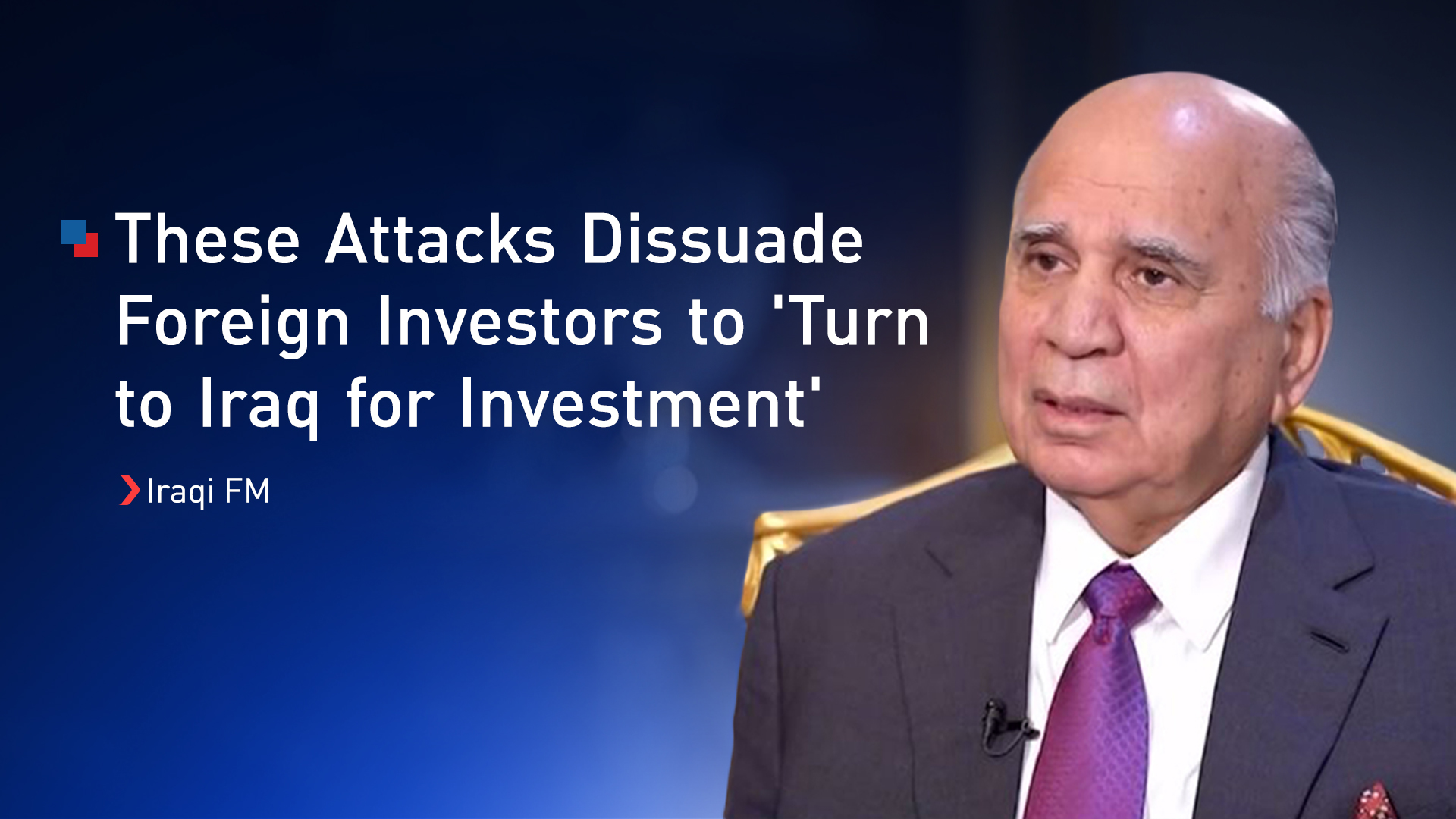
ERBIL (Kurdistan 24) – Iraqi Foreign Minister Fuad Hussein has unequivocally labeled the recent assault on the Khor Mor gas field as a "terrorist act," revealing that preliminary intelligence indicates the attack originated from within Iraqi territory.
In a wide-ranging televised interview with al-Sharqiya, the Foreign Minister addressed the fragility of the nation's security infrastructure, the imperative of state control over weaponry, and the stark red lines drawn by the United States regarding the inclusion of sanctioned groups in the future Iraqi government.
Investigation into Energy Infrastructure Attacks
Addressing the recent volatile security situation, Foreign Minister Hussein confirmed that a specialized investigation committee had been formed to probe the rocket attack on the Khor Mor gas field in the Kurdistan Region. While the committee is still conducting its inquiries, Hussein offered a grim assessment of the initial findings.
"It is clear that the act is terrorist, and according to initial information, the attack was from within," Hussein stated. He emphasized that the government is currently awaiting the committee's final report to take appropriate action.
However, the Foreign Minister expressed frustration regarding the transparency of previous investigations into similar assaults on the Kurdistan Region’s oil and gas sectors.
He noted that reports regarding prior attacks are complete and contain detailed findings, yet they have been withheld from the public. "Unfortunately, it has not been announced. I urge that it be announced," Hussein urged, highlighting that transparency is vital given the severe consequences these security breaches have on the nation's economy.
Hussein detailed the cascading effects of targeting energy hubs, explaining that the damage goes far beyond the immediate blast site.
"The attack on the Khor Mor field means the loss of gas, and when gas is gone, there is no electricity," he said. He stressed that these disruptions have a "clear impact on the lives of citizens," noting that the Kurdistan Region has worked to provide 24-hour electricity, a progress now threatened by violence.
The Foreign Minister rejected the notion that these are isolated strikes against the Kurdistan Regional Government (KRG). Instead, he characterized them as assaults on the Iraqi people as a whole.
"For example, a portion of that electricity is exported to Mosul and Kirkuk. So it will have an impact on other areas as well. This is a destructive act," Hussein said.
He warned that targeting the stability and security of cities like Erbil, Sulaimani, Mosul, and Kirkuk dissuades foreign capital, making investors hesitant to "turn to Iraq for investment."
The Struggle for the Presidency
Shifting to the ongoing political deadlock in Baghdad, Hussein provided insight into the negotiations surrounding the presidency of Iraq.
He observed that while the Shiite political house appears to have reached a consensus on a candidate for the premiership, the Kurdish and Sunni blocs remain in internal discussions regarding their representation.
Hussein advocated for a unified Kurdish front, suggesting that presenting a single candidate would strengthen the Kurdish position in Baghdad.
"If the political parties of Kurdistan reach an understanding among themselves and agree on one candidate, then that candidate will be strong because he will represent the entire component," he explained.
He warned against repeating the scenario of fielding multiple candidates, which would force the Iraqi parliament to decide the outcome, potentially weakening the mandate of the victor.
Emphasizing the significance of the role, Hussein reminded all parties that the President is "the guardian of the constitution and the external face of Iraq," requiring broad support to function effectively. He reaffirmed that, by political convention, "The post of President of Iraq is the share of the Kurds and they will decide it."
US Sanctions and Government Formation
In one of his most significant disclosures, the Foreign Minister addressed the implications of US sanctions on Iraqi armed groups and political figures, particularly concerning the formation of the next government. Hussein acknowledged the tangible weight of American financial and political pressure.
"Of course, these US sanctions have an impact. When a country imposes sanctions on an institution or personality of another country, it has an impact," he said. While he noted that the Iraqi government would contest allegations of money smuggling if they were proven false, he was blunt about the political reality facing sanctioned entities.
Hussein clarified that the United States has communicated a strict policy of non-engagement with any party listed on their sanctions roster. "They said that the parties on the sanctions list, they will not deal with them. They start from American law. And American law does not allow dealing with a sanctioned party," Hussein stated.
This policy complicates the inclusion of certain armed factions in the future governance of Iraq. Hussein referenced statements by Mark Savoye, the US Special Envoy for Iraq, who recently asserted that "there is no place for militias in Iraq." Hussein interpreted this as a definitive reflection of Washington's current stance. "I think it expresses the current position of American policy," he added.
While Hussein admitted he could not predict the final composition of the future government due to ongoing negotiations, he warned that Iraqi leaders must navigate these external constraints carefully. They must find a way to "create a balance between the country's interest and the interest of the party or the factions."
State Monopoly on Weapons and Relations with Iran
Underpinning his comments on security and politics was a firm defense of the Iraqi constitution and the state's exclusive right to the use of force. Hussein argued that the existence of armed groups operating outside the state command is incompatible with Iraq’s parliamentary democracy.
"We are a state that relies on the constitution; the constitution is very clear that the security and military file must be in the hands of the state. The movement of parties outside the constitution is not possible," he declared.
Hussein warned against the danger of the country moving in "two directions"—one led by the state and another led by non-state actors—asserting that this duality weakens national sovereignty and breeds internal opposition.
He called for a dialogue grounded in the constitution to integrate these factions into the political process, urging them to transition from armed groups into legitimate political parties, as many have done in other nations.
"Is taking up arms for self-defense or for a goal outside the state? A goal outside the state is the responsibility of the state itself," Hussein argued.
He dismissed the idea that disarming militias is merely an American demand, framing it instead as an urgent internal necessity for the sake of the "sons of Iraq."
Finally, regarding Iraq’s complex relationship with Iran, Hussein called for a shift in mindset. While acknowledging deep historical, religious, and economic roots with Tehran, he emphasized the need for a relationship based on mutual statehood rather than revolutionary ideology.
"We cannot go in two directions, the direction of the state and the direction of the revolution," Hussein said, drawing a distinction between the two nations' political evolutions. "Iran has passed the stage of revolution and has become a state, and we must also act as a state."