Trump Awarded FIFA’s New Peace Prize at 2026 World Cup Draw in Washington
President Trump received FIFA's inaugural Peace Prize at the World Cup draw, a move by ally Gianni Infantino breaking the body's non-political tradition.
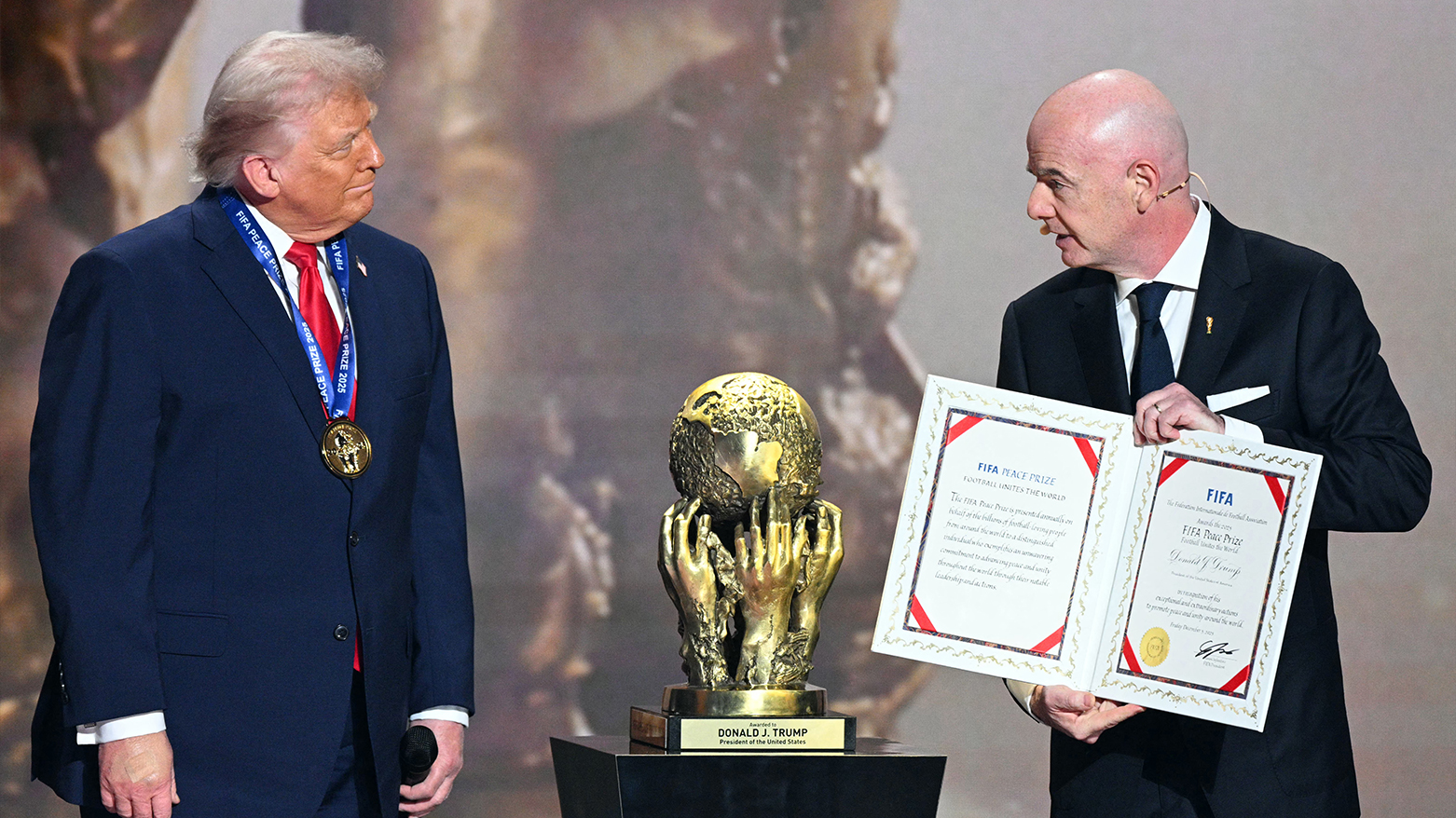
ERBIL (Kurdistan24) – In a spectacle that blurred the traditional boundaries between high-stakes global diplomacy and the world of international sport, the John F. Kennedy Center for the Performing Arts became the backdrop for an unprecedented geopolitical statement on Friday evening.
Amid the glitz and anticipation of the 2026 World Cup draw, the governing body of global soccer, FIFA, orchestrated a moment that will likely define the narrative of the upcoming tournament.
In a move that signals a profound departure from its historical mandate of political neutrality, FIFA awarded its newly established "Peace Prize" to United States President Donald Trump, a gesture that solidifies the deepening embrace between the organization and the Republican leader.
According to detailed reporting by the Associated Press (AP) and Agence France-Presse (AFP), the ceremony was ostensibly convened to determine the matchups for the quadrennial soccer tournament, which the United States is set to co-host alongside its North American neighbors, Mexico and Canada.
However, the evening quickly pivoted from athletic logistics to political theater.
The event, which determines the fate of 48 national teams, was imbued with what the AP described as an unmistakable "Trumpian flair," culminating in FIFA President Gianni Infantino presenting the inaugural award to the American president in front of a global audience of dignitaries, sports legends, and political figures.
The award itself appears to be custom-tailored for the current geopolitical moment and the specific persona of the recipient.
AFP reports that the official citation for the prize states its purpose is to "recognize the enormous efforts of those individuals who unite people, bringing hope for future generations."
Furthermore, FIFA has described the accolade as one designed to reward "individuals who have taken exceptional and extraordinary actions for peace and by doing so have united people across the world."
This language suggests a significant expansion of FIFA's operational philosophy, moving the federation well beyond the pitch and into the complex arena of international relations and conflict resolution.
The dynamic between President Trump and FIFA President Gianni Infantino was central to the evening’s proceedings.
The two men are known to be close allies, a relationship that was on full display on the stage in Washington. Infantino, who has frequently championed the concept of soccer as a "unifier" for the world, did not mince words when handing the trophy to the U.S. leader.
"This is your prize, this is your peace prize," Infantino declared, a direct and personal endorsement that underscores the alignment between the sports body and the Trump administration.
This alignment is rooted in specific geopolitical developments.
The AP highlights that Infantino had previously made it clear that he believed President Trump deserved the Nobel Peace Prize, specifically citing Trump's efforts to broker a ceasefire in Gaza.
By creating and awarding this new FIFA prize, Infantino appears to be rectifying what he perceives as an oversight by the Nobel Committee, granting the American president a level of international recognition that mirrors the prestige of the Scandinavian award.
President Trump’s reaction to the honor evolved throughout the evening. Upon his arrival at the Kennedy Center, before the ceremony had fully commenced, he engaged with reporters in a manner that sought to downplay his personal ambition while emphasizing his policy goals.
"I don’t need prizes. I just want to save lives," Trump told the press, affecting a tone of humility regarding the prospect of the award. However, following the presentation, his stance shifted to one of profound appreciation.
AFP reports that after receiving the accolade, Trump characterized the FIFA Peace Prize as "one of the great honors of my life," a statement that reflects the high value he places on such global validation.
The timing of the award is particularly notable given the President’s public history regarding international accolades.
As noted by the AP, Trump has openly campaigned for the Nobel Peace Prize in the past, making his desire for such recognition a matter of public record.
While the Nobel Committee ultimately chose a different path this year, the FIFA award serves as a significant alternative, provided by an organization with arguably equal global reach, if not the same political history.
The narrative of the evening was further complicated by the broader context of the Nobel Peace Prize itself. The AP reported that this year’s Nobel was eventually awarded to Venezuelan opposition leader Maria Corina Machado.
In a twist that ties the two awards together, Machado stated shortly after receiving her prize that she was dedicating it in part to President Trump. She cited "his decisive support of our cause" as a primary reason for her gesture, linking her victory to Trump’s foreign policy in South America.
This interplay between the Nobel and the FIFA prize paints a picture of a U.S. administration deeply entwined with the shifting political tides of the Americas.
However, the bestowal of a "Peace Prize" upon President Trump has not occurred in a vacuum, and the timing presents a series of stark contrasts.
The AP points out that the ceremony took place during a week in which the Trump administration has been under intense scrutiny for its aggressive use of force and hardline policies.
Specifically, the administration has faced questions regarding lethal strikes launched against alleged drug boats in the Caribbean, actions that represent a militarized approach to counternarcotics operations.
Furthermore, the award comes as President Trump continues to harden his rhetoric against immigrants, a domestic policy stance that stands in tension with FIFA's stated ideals of unity and bringing people together.
These contradictions highlight the departure from tradition that this award represents. For decades, FIFA has attempted, with varying degrees of success, to position itself as a politically neutral entity focused solely on the governance of association football. By wading into the contentious waters of American politics and international conflict resolution, the organization is signaling a new era of engagement.
The decision to honor a sitting Republican president who is actively implementing controversial security policies suggests that FIFA is prioritizing its relationship with the host nation's leadership over its traditional stance of neutrality.
The setting of the award—the World Cup draw—also serves to integrate the political message with the tournament itself.
By linking the "Peace Prize" to the 2026 World Cup, which is a collaborative effort between the United States, Mexico, and Canada, FIFA is framing the upcoming tournament not just as a sporting event, but as a vehicle for the kind of diplomatic unity the prize purports to recognize.
The presence of the award ceremony within the draw suggests that the 2026 World Cup will be heavily influenced by the personality and policies of the American president, giving the entire "soccer spectacle," as the AP termed it, a distinctive political flavor.
The award's criteria—recognizing "exceptional and extraordinary actions for peace"—will likely be debated by observers and analysts.
While Infantino points to the ceasefire in Gaza as the primary justification, the administration’s critics will undoubtedly point to the concurrent lethal strikes in the Caribbean and the divisive immigration rhetoric as evidence to the contrary. Nevertheless, within the halls of the Kennedy Center on Friday, the narrative was controlled and celebratory.
The creation of this prize by FIFA raises questions about the future of the organization's awards.
It remains to be seen whether this "Peace Prize" will become a regular fixture of FIFA's honors system or if it will remain a unique gesture tailored for this specific presidency and this specific tournament. What is clear, however, is that under Gianni Infantino’s leadership, the governing body of soccer is willing to embrace political figures in a way that its predecessors were not.
As the attendees left the Kennedy Center, the focus shifted from the groups and brackets of the World Cup to the symbolism of the night.
President Trump, a figure who has long sought validation on the world stage, secured a trophy that validates his foreign policy in the eyes of the world's most popular sport. For FIFA, the night represented a bold, if risky, step into the geopolitical arena, tying its brand to the fortunes and reputation of the Trump administration.
With the World Cup still months away, the "Trumpian flair" that defined the draw is likely to be a persistent theme, ensuring that the 2026 tournament will be remembered as much for its political context as for the games played on the field.