Hamas Ready to Yield Weapons to Palestinian Authority if 'Occupation Ends'
Hamas offers to disarm to a Palestinian state if Israel's occupation ends, as mediators in Doha push for Israeli withdrawal and a stabilization force.
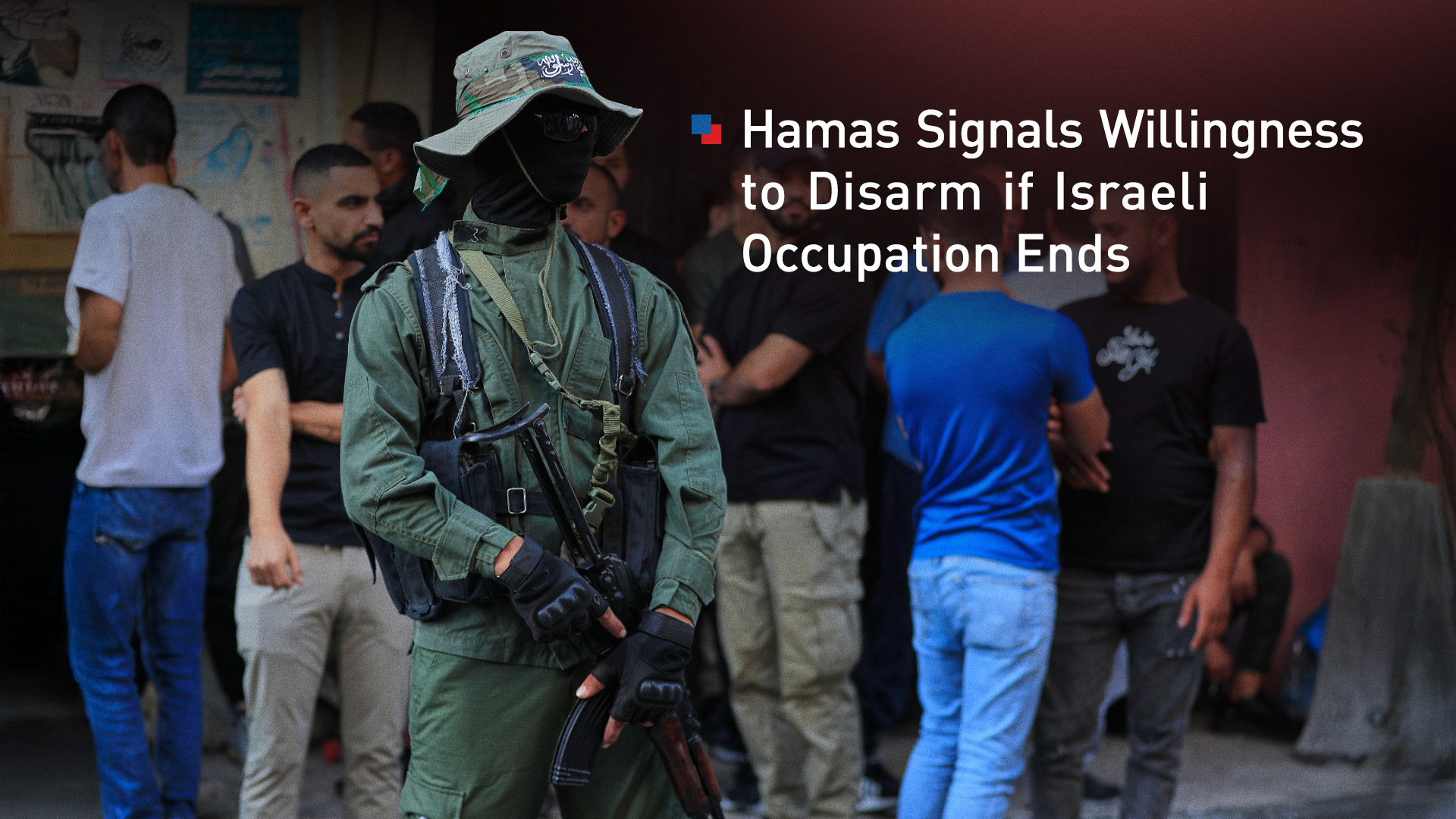
ERBIL (Kurdistan24) – In a potentially pivotal development for the long-stalled peace process in the Middle East, Hamas on Saturday declared its readiness to hand over its arsenal to a Palestinian authority, but only on the strict condition that the Israeli military occupation of Gaza is brought to a complete end.
This conditional offer, articulated by a senior Hamas negotiator, comes as regional mediators Qatar and Egypt intensify pressure on the international community to enforce the next phase of the fragile ceasefire, calling for the immediate withdrawal of Israeli troops and the deployment of a multinational stabilization force to secure the enclave.
The statement from Hamas represents a significant shift in rhetoric for the militant group, which has historically rejected calls for disarmament.
Khalil al-Hayya, the group’s chief negotiator and Gaza leader, framed the possession of weapons as a direct response to Israeli aggression. "Our weapons are linked to the existence of the occupation and the aggression," al-Hayya said in a statement released on Saturday.
He elaborated, asserting, "If the occupation ends, these weapons will be placed under the authority of the state." When pressed for clarification by Agence France-Presse (AFP), Hayya’s office confirmed that the "state" in question refers to a prospective sovereign and independent Palestinian nation, rather than the existing Palestinian Authority in its current form.
This declaration aligns with the complex diplomatic maneuvering currently underway in Doha, where key guarantors of the ceasefire convened to chart a path forward.
According to AFP, Qatari Prime Minister Sheikh Mohammed bin Abdulrahman Al Thani told the Doha Forum that the peace process has reached a "critical moment."
He emphasized that the current pause in fighting cannot evolve into a lasting peace without decisive action. "A ceasefire cannot be completed unless there is a full withdrawal of the Israeli forces and there is stability back in Gaza," Sheikh Mohammed stated, underscoring the fragility of the truce that took effect in October.
The peace plan, endorsed by the UN and backed by the United States, envisions a phased resolution to the conflict.
The initial phase has seen a partial pullback of Israeli troops behind a "yellow line" and the release of hostages held by Hamas. However, the transition to the second phase—which involves total Israeli withdrawal, the establishment of a transitional "Board of Peace," and the deployment of an international stabilization force—has been mired in disagreement.
A central point of contention remains the disarmament of Hamas, a requirement outlined in the 20-point plan proposed by U.S. President Donald Trump. While Hamas has previously rejected this, Saturday’s statement suggests a window for negotiation, contingent on political sovereignty.
Egypt’s Foreign Minister Badr Abdelatty echoed the urgency of the moment at the Doha Forum.
He called for the rapid deployment of international monitors, citing repeated violations of the truce by Israeli forces. "We need to deploy this force as soon as possible on the ground because one party, which is Israel, is every day violating the ceasefire," Abdelatty said.
His comments highlight Cairo’s frustration with the slow pace of implementation and the continued instability along its border. Abdelatty also clarified Egypt’s stance on the Rafah crossing, insisting it will not become a "gateway for displacement" of Palestinians but must function strictly as an entry point for humanitarian aid.
Turkish Foreign Minister Hakan Fidan brought a pragmatic perspective to the discussions, warning against unrealistic expectations regarding disarmament.
Speaking to the forum, Fidan argued that prioritizing the disarmament of Hamas before establishing a secure political structure is neither realistic nor doable. "We need to put things in their proper order," he said, suggesting that the primary goal of the stabilization force should be to separate the combatants.
Fidan revealed that talks on the force’s composition are ongoing, with critical questions remaining about its command structure. He also urged the U.S. to exert pressure on Israeli Prime Minister Benjamin Netanyahu, warning, "If they don't intervene, I'm afraid there is a risk the plan can fail."
The proposed international stabilization force faces significant hurdles.
As previously covered by Kurdistan24, Arab and Muslim nations have expressed reluctance to contribute troops, fearing they could be drawn into direct conflict with Palestinian militants.
Hamas itself has signaled a nuanced position on this force. While al-Hayya expressed acceptance of UN forces acting as a "separation force" to monitor borders, he explicitly rejected the idea of an international mission tasked with disarming the group, reinforcing the conditionality of their offer.
The diplomatic push in Doha reflects a broader regional anxiety that the window for a durable solution is closing.
The ceasefire, while largely holding, is marred by daily accusations of breaches. Israel has announced plans to open the Rafah crossing exclusively for the exit of Gazans, a move Egypt and other nations have condemned as an attempt to expel the Palestinian population.
Meanwhile, U.S. President Trump’s administration continues to advocate for a transitional authority in Gaza, arguing it is essential for Israel’s long-term security and regional integration.
As mediators scramble to operationalize the next steps, the conditional offer from Hamas places the ball firmly in the court of the international community and Israel.
Whether Tel Aviv will accept a pathway to Palestinian sovereignty in exchange for disarmament, and whether Washington can marshal the necessary stabilization force, remains the central question defining the future of Gaza and the stability of the entire Middle East.