President Barzani Receives Hungarian CG Who Wrote Master’s Thesis on Kurdistan
Hungary’s new Consul General, who wrote his master's thesis on Kurdistan, met President Barzani to discuss trade, government formation, and regional peace.
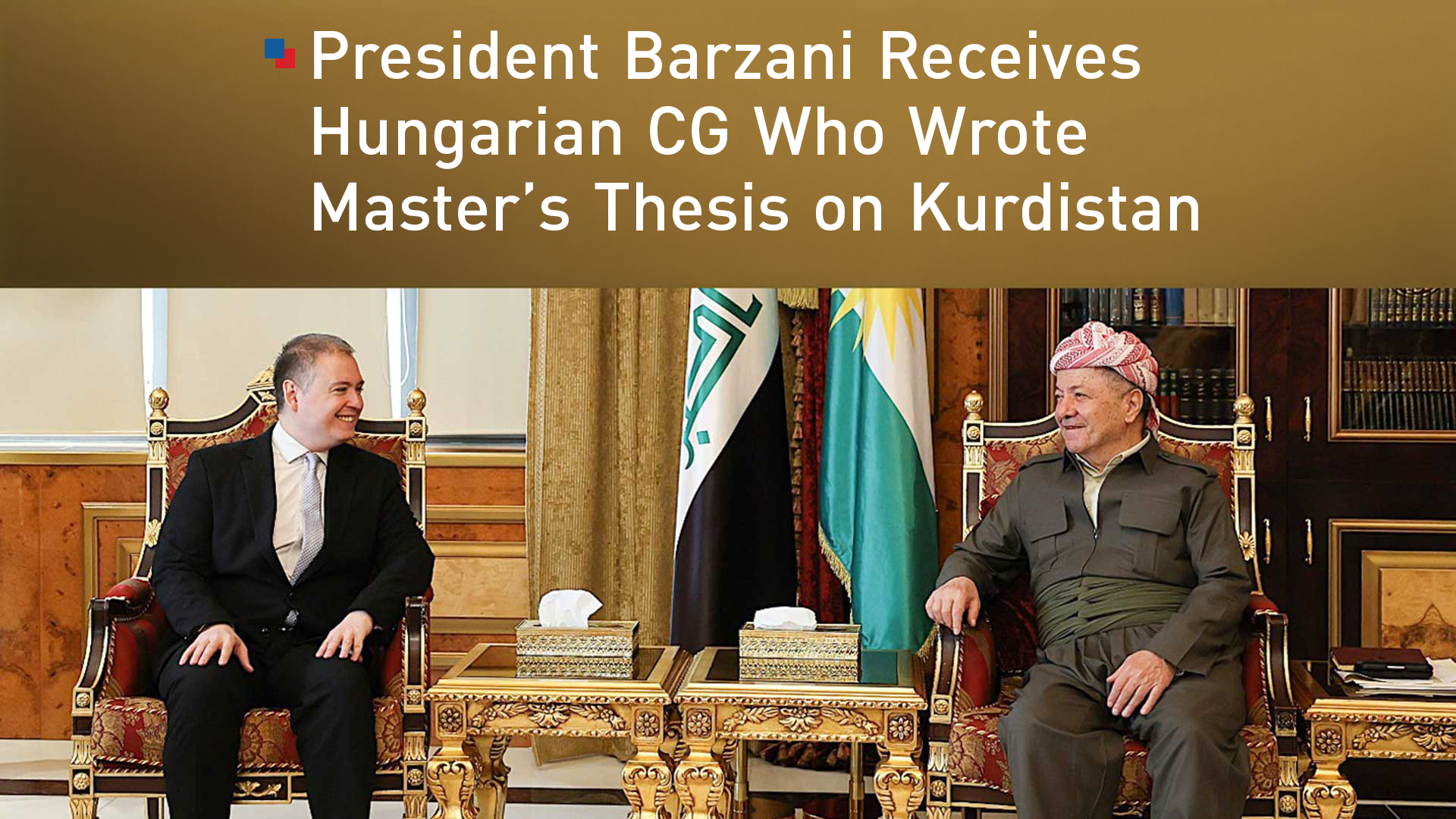
ERBIL (Kurdistan24) – In a convergence of academia and high-level diplomacy that signals a deepening of European engagement with the Kurdistan Region, President Masoud Barzani on Wednesday received Gergely Tivadar Takács, the newly appointed Consul General of Hungary.
The meeting, held at the Barzani Headquarters in Pirmam, was distinguished not merely by the customary exchange of diplomatic credentials, but by the revelation that the new envoy possesses a profound, scholarly connection to his host nation, having dedicated his master’s thesis to the study of Kurdistan.
This unique background sets the stage for a diplomatic tenure informed by a rigorous understanding of the region’s complex historical and political tapestry.
The reception on December 10, 2025, served as both an introductory encounter and a substantive strategic dialogue.
According to a detailed statement released by the Barzani Headquarters following the session, Consul General Takács expressed his distinct pleasure at meeting President Barzani, a figure central to the modern history of the Kurdish movement.
However, the envoy moved quickly beyond pleasantries to highlight his personal and intellectual investment in the region. Takács stated that his understanding of the history, culture, and the intricate political evolution of the Kurds is not merely the product of recent briefings but the result of academic research.
By noting that he wrote his master's thesis on Kurdistan, the Consul General signaled to the Kurdish leadership that he arrives in Erbil equipped with a nuanced perspective on the "current and past politics" of the area, a qualification that is relatively rare among the rotating cast of international diplomats stationed in the Middle East.
During the meeting, the Hungarian diplomat leveraged this historical perspective to contextualize the current standing of the Kurdistan Region. He offered extended thanks to President Barzani, specifically citing his pivotal role and enduring stances in the region's turbulent history.
Takács praised the President for the efforts he has exerted over decades to foster peace and stability, not just within the Kurdish territories but across the broader region. This acknowledgment reflects a European recognition of the Kurdistan Region as a stabilizing anchor in a neighborhood frequently beset by volatility.
Furthermore, the Consul General extended formal congratulations to President Barzani on the success of the recent election process and the electoral victory of the Kurdistan Democratic Party (KDP), interpreting these results as a validation of the party's continued relevance and public mandate.
The agenda of the meeting in Pirmam was comprehensive, touching upon the critical political transitions currently unfolding in both Erbil and Baghdad.
The two sides engaged in a detailed discussion regarding the steps being taken by Iraqi political parties to form a new federal government. This inclusion of federal politics highlights the role of the Kurdistan Region as a kingmaker and essential partner in the governance of Iraq.
Simultaneously, the dialogue addressed the internal political process within the Kurdistan Region itself, specifically focusing on the ongoing negotiations and procedures required to form the new cabinet of the Kurdistan Regional Government.
The interest of a European envoy in these domestic mechanisms underscores the international community's stake in ensuring that the KRG remains a functional and effective administrative entity.
Beyond the political sphere, the conversation pivoted to the tangible aspects of the bilateral relationship between Hungary and the Kurdistan Region. Both President Barzani and Consul General Takács reached a consensus on the necessity of advancing and improving ties across all fields.
While security cooperation has historically been a component of international relations in the region, this meeting placed a specific and heavy emphasis on the economic and trade sectors.
The agreement to bolster these areas suggests a mutual desire to transition the relationship from one defined by security assistance to one driven by investment, commerce, and development.
For Hungary, the Kurdistan Region represents a growing market and a strategic entry point into the Middle Eastern economy; for Erbil, Budapest remains a reliable partner within the European Union.
The meeting also served as a forum for high-level geopolitical analysis, utilizing President Barzani’s experience and the envoy’s academic background to assess the shifting dynamics of the Middle East.
The statement from the Barzani Headquarters indicated that the discussions covered the general situation in the region, with a specific focus on two of the most pressing external files facing the Kurdish leadership: the peace process in Turkey and the situation in Syria.
The mention of the "peace process in Turkey" is particularly significant, suggesting that international observers are keen to understand Erbil’s perspective on the renewed efforts to resolve the Kurdish question in neighboring Turkey.
Similarly, the inclusion of the Syrian file in the discussion points to the ongoing concern regarding the future of the Kurdish population in northeast Syria and the broader stability of the Levant.
By engaging on these topics, Takács and Barzani reinforced the perception that the road to understanding and potentially resolving these transnational issues often runs through Pirmam.
As Gergely Tivadar Takács assumes his duties, his tenure promises to be defined by a level of "cultural fluency" that could facilitate more effective communication between Budapest and Erbil. His academic immersion in the subject matter of his diplomatic posting suggests that Hungary is prioritizing a knowledgeable and historically grounded approach to its relations with the Kurds.