Israel Says Hamas Leader Killed in Gaza, Testing Fragile Truce
Israel killed Hamas commander Raed Saad, citing truce violations and rearming efforts, as plans for an international force involving Italy emerge.
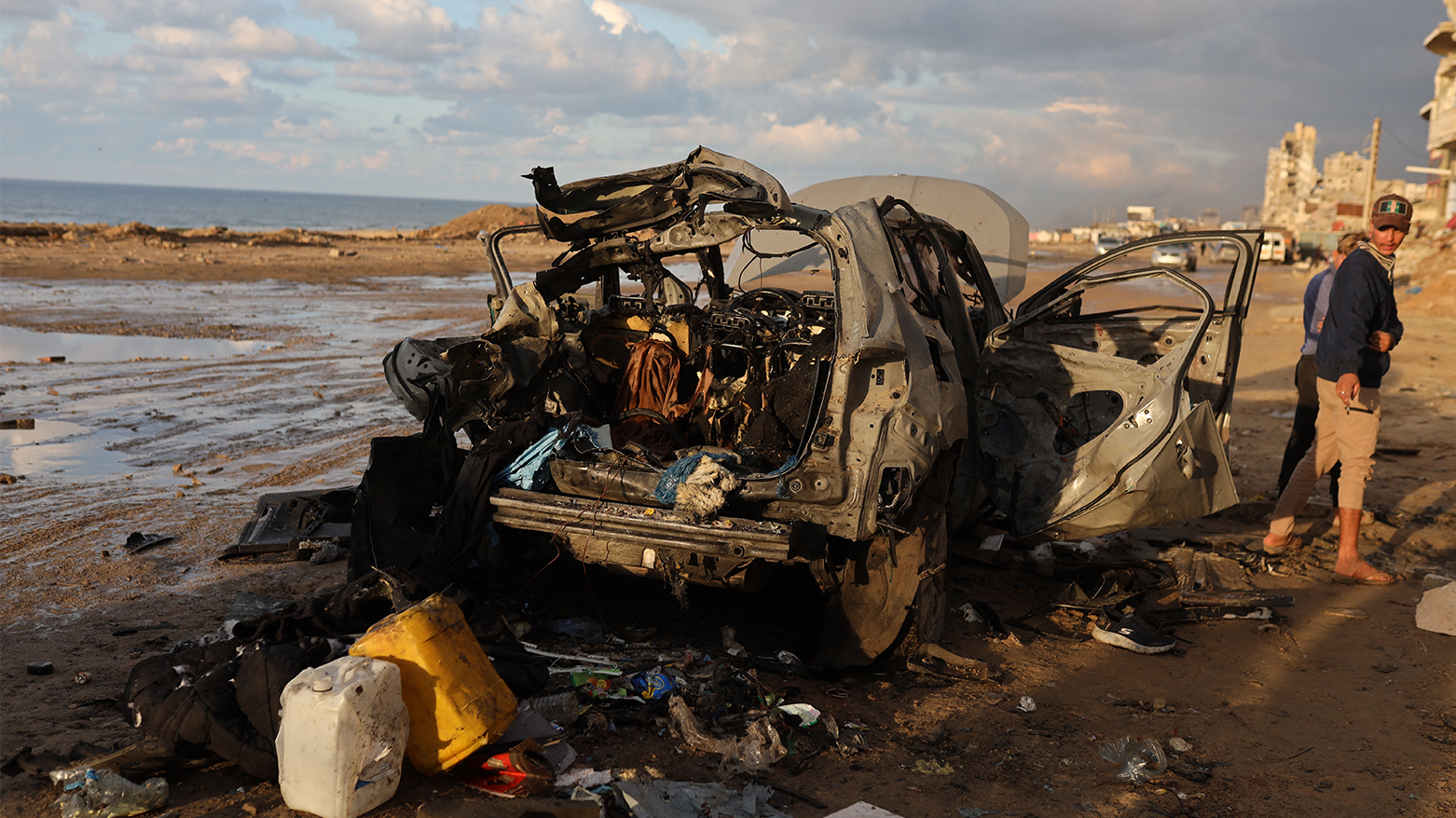
ERBIL (Kurdistan24) – The Israel Defense Forces (IDF) announced on Saturday the targeted assassination of Raed Saad, a top-tier Hamas commander described as one of the principal architects of the October 7 massacre. The strike, authorized directly by Israel's Prime Minister Benjamin Netanyahu and Defense Minister Israel Katz, marks the most significant enforcement action taken by Israel since the United States-brokered truce came into effect, underscoring the volatility of a diplomatic arrangement that is struggling to hold amidst mutual accusations of violations and renewed violence.
According to reporting by The Washington Post, the operation targeted a civilian vehicle traveling west of Gaza City, eliminating Saad in what Israeli officials described as a precise and necessary measure to prevent the rearmament of the militant group.
The Israeli military identified Saad as the head of operations and production for Hamas’s armed wing, the Izzedine al-Qassam Brigades.
The Washington Post further noted that Saad had previously survived an assassination attempt in June 2024, highlighting his long-standing status as a high-value target for Israeli intelligence.
The IDF’s justification for the strike was rooted in intelligence suggesting that Saad was actively working to reestablish Hamas’s military capabilities and weapons manufacturing infrastructure, activities that Israel asserts constitute a "blatant violation" of the ceasefire terms.
The Hill provided additional context regarding the specific allegations against the slain commander, reporting that the IDF characterized Saad as a central figure within the organization’s military leadership who was responsible for the deaths of numerous soldiers through the use of explosive devices manufactured under his supervision.
In a statement posted on the social platform X, the IDF asserted that Saad was "leading the way in Hamas’s efforts to re-arm and do it again," referring to the October 7 attacks. Lt. Col. Nadav Shoshani, a spokesman for the IDF, emphasized that the elimination of Saad was "part of the agreement that promises — no more of Hamas’ terror," framing the strike not as a breach of the truce, but as an enforcement of its underlying security mandates.
The timing of the strike was precipitated by kinetic events on the ground.
The Washington Post reported that the assassination was, in part, a retaliation for the detonation of an explosive device earlier on Saturday that injured Israeli troops operating within Gaza.
The IDF confirmed that two soldiers were "lightly injured" in that incident, which prompted a swift and lethal response from the highest echelons of the Israeli government.
A joint statement from Netanyahu and Katz cited by The Washington Post and The Hill clarified that the strike was directed because Saad was "engaged in rearming for acts of terrorism" instead of promoting the demilitarization envisioned by the current peace framework.
Hamas reacted with immediate condemnation, accusing Israel of a "blatant violation" of the ceasefire. While the group did not officially confirm Saad’s identity in their initial statements, The Hill reported, citing the Associated Press, that the strike on the vehicle killed four people and injured three others.
This incident has deepened the diplomatic chasm between the two sides as pressure builds to transition the truce into its second, more complex phase.
The broader geopolitical implications of this escalation are tied to the "President Trump plan," a roadmap for peace that envisions the total disarmament of Hamas and the restructuring of Gaza’s governance.
The Hill noted that the attack comes ahead of an anticipated transition to the second phase of this plan, slated for early 2026. President Trump and Prime Minister Netanyahu are expected to meet on December 29 to discuss these next steps.
Netanyahu has publicly expressed optimism that this phase, which necessitates the dismantling of Hamas, could commence before the end of December, drawing historical parallels to the demilitarization of Germany and Japan. "It can be done in Gaza, too, but of course Hamas has to be dismantled," Netanyahu told reporters last week.
However, the path to such a transition remains fraught with lethal obstacles.
The United Nations human rights chief, Volker Türk, highlighted the severe humanitarian cost of the current stalemate.
As reported by The Hill, Türk noted on Wednesday that Israel has shifted its "yellow-line boundary" that splits Gaza, causing confusion and sparking clashes that have killed 360 Palestinians and left 922 injured.
These grim statistics illustrate the fragility of the status quo, where "shaky" ceasefires are frequently punctuated by deadly violence.
Despite the violence, diplomatic channels regarding disarmament remain nominally open.
Bassem Naim, a member of Hamas’s political bureau, offered a rare glimpse into the group’s internal deliberations.
According to The Hill, Naim stated that Hamas is prepared to discuss "freezing or storing" its weapons, or potentially surrendering them to a future Palestinian state following a truce lasting five to ten years, provided there are guarantees against continued war.
This position, while far from the immediate disarmament demanded by Israel, suggests a potential, albeit narrow, avenue for negotiation.
Parallel to the military and diplomatic maneuvering, planning for the post-conflict security architecture of Gaza is quietly evolving. A report by Ynetnews revealed significant shifts in the composition of the proposed international stabilization force.
Citing a senior Israeli official, Ynetnews reported that contrary to initial intentions, the force will not consist solely of Muslim and Arab countries.
In a notable development, Italy has expressed a willingness to deploy soldiers to the enclave. However, the report indicates that American officials are not satisfied with this commitment alone and are actively seeking additional nations to contribute troops.
The logistical challenges of assembling such a force are immense.
Ynetnews highlighted that while various nations have offered assistance in the form of training, guidance, and funding, there remains a deep-seated reluctance to send soldiers due to fears of direct confrontation with Hamas remnants.
The current operational plan involves deploying the international force initially in areas where Hamas’s presence has been significantly degraded or where the civilian population does not submit to the group's authority.
This phased deployment strategy underscores the international community's recognition that stabilizing Gaza will require a robust and multi-national military footprint capable of filling the power vacuum left by the weakening of Hamas’s administrative and military control.
As the region braces for the fallout from Saad’s assassination, the diverging narratives presented by The Washington Post, The Hill, and Ynetnews paint a picture of a conflict at a crossroads.
Israel views the strike as a necessary preemption to safeguard the ceasefire’s integrity, while Hamas views it as an act of aggression that undermines the truce.
With the December 29 meeting between Trump and Netanyahu looming, the events of Saturday serve as a violent reminder that the transition from a temporary halt in fighting to a sustainable peace will likely be forged through both diplomatic negotiation and targeted military force.