Printing Houses in Erbil Met Growing Demand for Kurdistan Flags for Flag Day
Local printers produce high-quality flags in various sizes, reflecting rising patriotic sentiment across the Kurdistan Region.
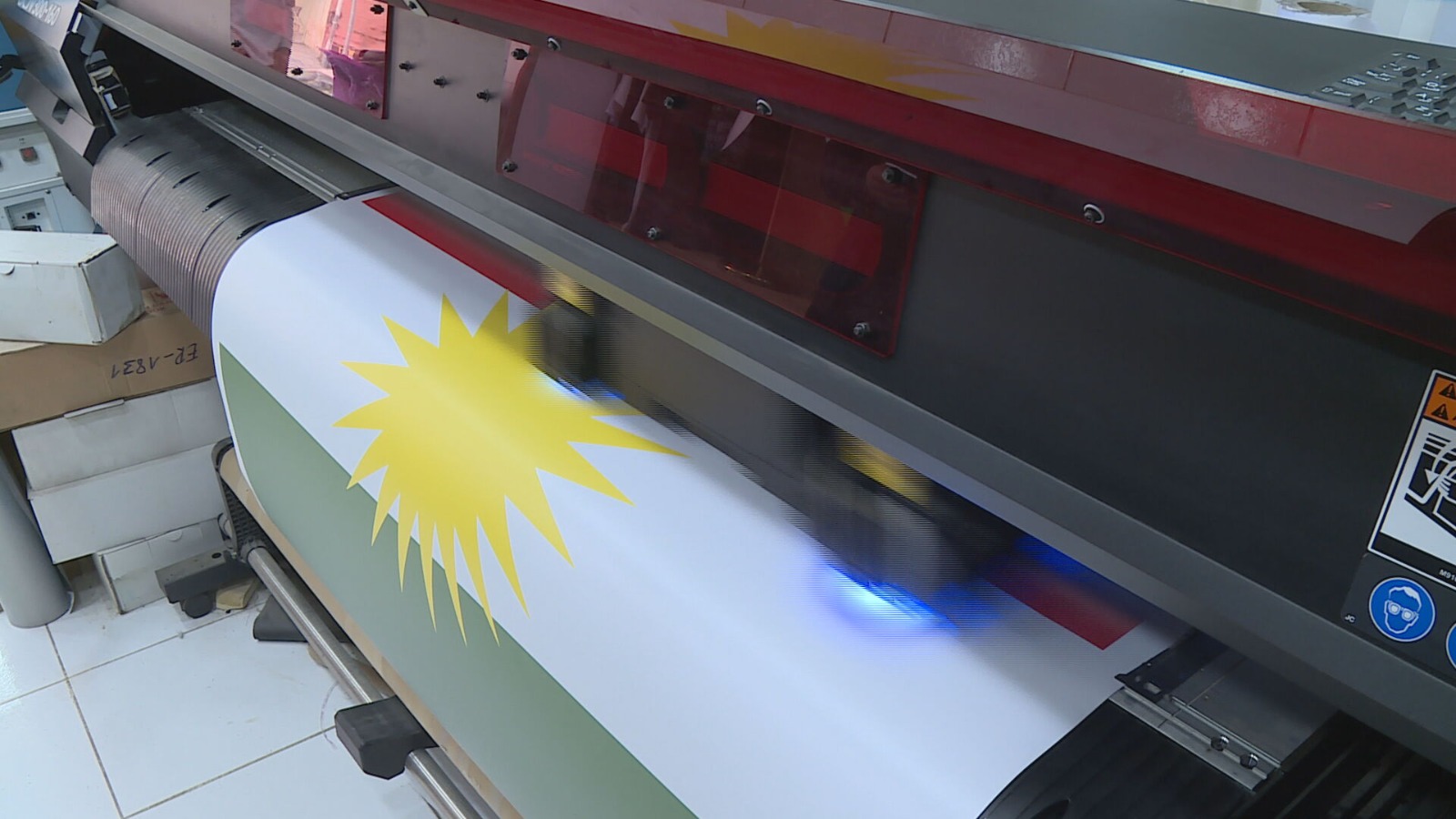
ERBIL (Kurdistan24) — As Kurdistan Flag Day is being celebrated on Wednesday, printing houses in Erbil are playing a crucial role in meeting the high demand for the Kurdish flag, producing high-quality flags in multiple sizes for citizens, schools, and government institutions across the Region.
Speaking to Kurdistan24, the owner of one Erbil printing house said, “Today, as Kurdistan Flag Day is observed, the demand for flags is at its highest. Every day we receive requests to produce flags in different sizes, and the price depends on the size of the flag. On this day, patriotic sentiment drives even more citizens to request flags.”
He added, “Now we can produce Kurdistan flags locally with the best quality. Depending on customer requests, we can create various sizes. The requests are daily, but on national and patriotic occasions—especially on Flag Day, Newroz, and during elections—the demand grows significantly.”
Previously, many Kurdish flags were imported from abroad. However, local printing houses in the Kurdistan Region now have the capacity to produce large quantities of flags in a variety of sizes, ensuring faster delivery and superior quality.
The printer explained, “Prices are determined by the size of the flag. For instance, a large flag costing nearly one million dinars can now be produced locally, while smaller sizes are cheaper. In all cases, local production is more cost-effective and of better quality than imported flags.”
Each printing house is estimated to produce around 6,000 Kurdistan flags annually. These flags are used widely by schools, government offices, and private institutions. Prices range from 2,000 dinars for smaller flags to nearly one million dinars for the largest sizes.
As the Kurdistan flag is being raised across schools, government buildings, and public spaces, the surge in demand and production highlights the enduring patriotic spirit of the people and the flag’s central role as a symbol of unity, identity, and pride throughout the Kurdistan Region.
On Wednesday, the Kurdistan Region marked Kurdistan Flag Day, observed annually on Dec. 17, with ceremonies and activities across schools, government institutions, and public spaces, reaffirming the flag’s role as a central symbol of Kurdish national identity and collective memory.
The Kurdistan Parliament formalized the flag’s legal status in a landmark session on Nov. 11, 1999, passing Law No. 4, which officially recognized the Kurdistan Region’s flag. This was followed by Parliamentary Decision No. 48 on June 19, 2009, designating Dec. 17 of each year as Kurdistan Flag Day.
The choice of Dec. 17 is rooted in history. On this date in 1945, the Kurdish flag was lowered from official buildings of the Republic of Kurdistan in Mahabad following its collapse, marking a moment of loss that later became a symbol of perseverance and renewal for the Kurdish cause.
In more recent decades, particularly after the Kurdistan flag was raised on the frontlines during the war against terrorism (ISIS), starting in 2014, it has gained global recognition as a symbol of resistance and the sacrifices of the Peshmerga forces.
The flag has since appeared on international platforms as an emblem of Kurdish resilience and the fight against extremism.