Russia Condemns U.S. Action in Venezuela as JD Vance Warns Trump “Means What He Says”
Moscow demands clarification over Maduro’s fate as Washington defends the operation as enforcement against drugs and oil theft.
ERBIL (Kurdistan24) — Russia sharply condemned the U.S. military action in Venezuela on Saturday and demanded immediate clarification over the fate of President Nicolás Maduro, as U.S. Vice President JD Vance defended the operation by warning that President Donald Trump had made clear his red lines and was prepared to enforce them.
In a statement issued Saturday, Russia’s Foreign Ministry accused the United States of committing an “act of armed aggression” against Venezuela, calling the development “deeply concerning and condemnable.”
The ministry said reports that Maduro and his wife had been forcibly removed from the country following U.S. strikes were “extremely alarming” and insisted on urgent clarification.
“The pretexts used to justify such actions are untenable,” the ministry said. “Ideological hostility has triumphed over businesslike pragmatism.”
Moscow emphasized that Venezuela, its most important ally in South America, must be allowed to determine its own future without military interference. While the Kremlin has historically backed Caracas diplomatically and politically, it has stopped short of offering military assistance in the event of a direct confrontation with Washington.
Russia reaffirmed support for Maduro as recently as last month and noted that it was among a small group of countries that congratulated him following his disputed re-election in 2024.
The Foreign Ministry said it would support calls for international discussion of the crisis, including at the United Nations.
In contrast, senior U.S. officials portrayed the operation as a deliberate and justified enforcement action. Vice President JD Vance said the White House had repeatedly warned the Venezuelan leadership before resorting to force.
“The president offered multiple off ramps, but was very clear throughout this process: the drug trafficking must stop, and the stolen oil must be returned to the United States,” Vance said in a statement posted on X. “Maduro is the newest person to find out that President Trump means what he says.”
President Trump earlier announced that Maduro and his wife had been captured by U.S. forces and flown out of Venezuela following overnight strikes on targets in and around Caracas.
The White House said a news conference would provide further details, though questions remained about the legal basis for the operation and whether Congress had been consulted in advance.
The escalation has drawn concern from other international actors, with several European leaders urging restraint and respect for international law, even as Washington framed the move as a decisive blow against what it describes as a criminal regime.
As diplomatic fallout intensifies, Russia’s forceful condemnation and Washington’s uncompromising messaging underscore a widening rift over Venezuela’s future, raising fears of broader geopolitical consequences from one of the most dramatic U.S. interventions in the region in decades.
Explosions rocked Caracas in the early hours of the third day of 2026, with residents reporting at least seven blasts across the capital. The apparent attack lasted less than 30 minutes, according to witnesses, and there was no immediate confirmation of casualties. The U.S. State Department acknowledged reports of explosions in and around Caracas but offered no additional details.
Attorney General Pam Bondi confirmed that Maduro and his wife would face criminal charges in the United States, citing an indictment in New York. Maduro was first indicted in 2020 on narcoterrorism conspiracy charges, accused by U.S. prosecutors of turning Venezuela into a criminal enterprise aligned with drug traffickers and armed groups. It was not previously known that his wife had also been indicted.
Senior U.S. officials framed the operation as a turning point. Deputy Secretary of State Christopher Landau said the seizure of Maduro marked “a new dawn for Venezuela,” declaring that “the tyrant is gone.” Secretary of State Marco Rubio reposted earlier statements asserting that Maduro’s government lacks legitimacy.
Utah Senator Mike Lee said Rubio briefed him that Maduro would be tried in the United States and that no further U.S. military action in Venezuela was anticipated.
Inside Venezuela, reactions were sharply divided. Pro-Maduro supporters gathered in Caracas, with Mayor Carmen Meléndez joining chants demanding the president’s immediate return. Elsewhere, residents described fear and confusion as roads were blocked and communications disrupted.
“Venezuelans woke up scared,” said one Caracas resident, while another denounced the United States as acting as “the police of the world.”
Venezuela’s Vice President Delcy Rodríguez said the government did not know Maduro’s whereabouts and demanded proof of life for both him and the first lady.
The opposition remained largely silent. Spokespeople for opposition leader María Corina Machado declined to comment. Machado was last seen publicly last month after emerging from months in hiding and traveling to Norway, where she received the Nobel Peace Prize.
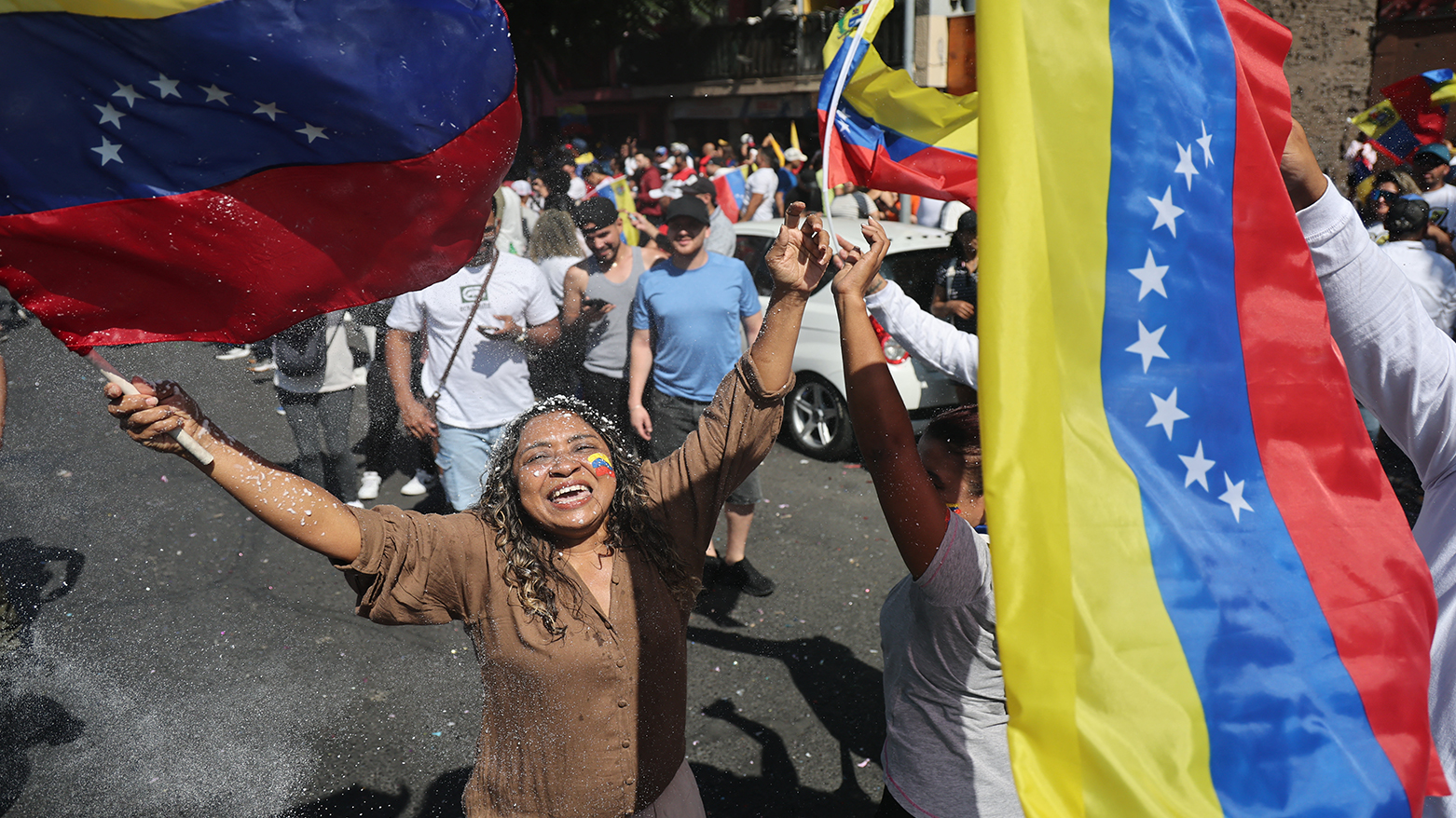
Beyond Venezuela, scenes of celebration erupted among Venezuelan expatriates in South Florida. In Doral, home to the largest Venezuelan community in the United States, crowds waved national flags, played music, and chanted “Liberty! Liberty! Liberty!” at a rally outside a local restaurant.
The U.S. State Department issued a travel alert urging Americans in Venezuela to shelter in place, while reiterating that U.S. citizens should not travel to the country. The U.S. embassy in neighboring Colombia, which operates remotely, said it was monitoring the situation.
The dramatic seizure of a sitting head of state echoed the 1990 U.S. military operation in Panama and the arrest of leader Manuel Noriega, a historical parallel noted by analysts as Washington’s most forceful intervention in Latin America in decades.
As diplomatic fallout continues to unfold, the immediate future of Venezuela — and the broader regional implications — remain highly uncertain.