27 Candidates Registered for Iraqi Presidency with No Kurdish Nominees as Deadline Approaches
27 candidates registered for the Iraqi Presidency as of Jan 4, with no Kurds among them. Nominations close Jan 5. The election follows the Dec 2025 selection of the Parliament Speaker.
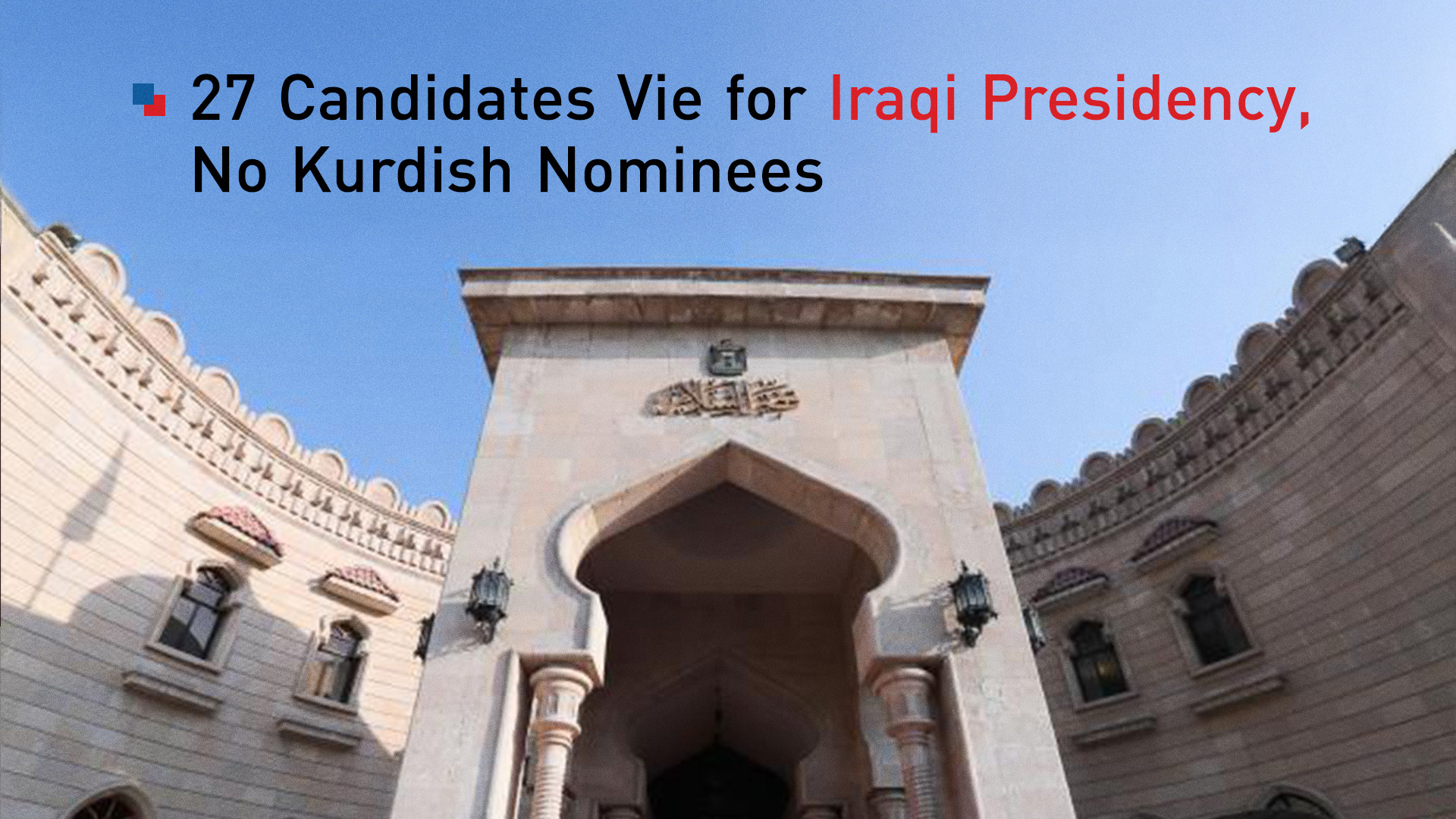
ERBIL (Kurdistan24) — Twenty-seven individuals have formally submitted their candidacy for the presidency of the Republic of Iraq as of Sunday afternoon, though the list currently includes no Kurdish contenders, according to senior parliamentary officials.
The absence of Kurdish nominees for a role that has traditionally been held by a Kurd under Iraq’s post-2003 political customs marks a notable development as the country moves to complete its government formation process following the election of a new parliamentary leadership late last year.
Safwan Basheer Younis Al-Gargari, the Secretary General of the Iraqi House of Representatives, provided the updated figures in a statement to Kurdistan24 on Sunday.
Speaking to correspondent Shevan Jabari, Gargari confirmed that as of 12:00 p.m. local time, the number of applicants had reached 27. Despite the significant number of aspirants seeking the head of state position, Gargari noted the specific demographic absence, stating that "so far, there are no Kurds among them."
The registration window, which officially opened on Wednesday, Dec. 31, 2025, is rapidly drawing to a close. Gargari reiterated that the opportunity for self-nomination will end on Monday, Jan. 5, 2026. He emphasized that there has been no decision issued to extend the nomination period beyond this deadline.
Once the door for self-nomination closes, the House of Representatives will proceed to the vetting phase, during which the names of the candidates will be scrutinized before a final, official list is announced to the public and the legislature.
Constitutional Timeline and Parliamentary Context
The push to elect a new president follows the successful election of the Iraqi Parliament’s Presidency Board during meetings held on Dec. 29 and 30, 2025.
That process marked the commencement of the legislature's sixth term and concluded with the selection of Haibet al-Halbousi as the Speaker of the Iraqi House of Representatives. Adnan Fayhan was elected as the First Deputy, and Farhad Atroshi was chosen as the Second Deputy.
With the legislative leadership now in place, the clock has started on the selection of the executive branch's leadership. Gargari referenced Article 72 of the Iraqi Constitution, which mandates a strict timeline for this transition.
According to the constitutional provision, the House of Representatives is obligated to elect a new President of the Republic within a period of 30 days following the election of the parliamentary Presidency Board.
The role of the president is pivotal in the next phase of Iraq's governance.
Once elected and sworn in, the new President of the Republic is constitutionally tasked with formally asking the candidate of the largest parliamentary faction to form the new federal government.
Gargari noted that, according to established political custom in Iraq, the formation of the cabinet is the share of the Shiite component.
The Election Protocols
The procedure for electing the President of the Republic is a multi-step process governed by strict legal and attendance requirements within the House of Representatives.
Gargari outlined the specific procedural mechanics that the legislature must follow in the coming weeks.
First, the House must convene a special session dedicated to the presidential election.
For this session to be considered legal and for any vote to be valid, a specific quorum must be met. Gargari clarified that two-thirds of the total members of Parliament must be present. With the current parliamentary composition, this requires the attendance of 219 Members of Parliament (MPs).
The voting process itself is divided into potential rounds, as dictated by Article 70 of the Iraqi Constitution.
In the first round of voting, a candidate must secure a two-thirds supermajority of the members present to be declared the winner. Based on the quorum requirement, a candidate would need 219 votes to secure the presidency in this initial stage.
If no single candidate manages to reach this high threshold during the first round, the competition proceeds to a second round. Gargari explained that the field is narrowed significantly at this stage; only the two candidates who received the highest number of votes in the first round are permitted to compete in the runoff.
In this second round, the threshold for victory is lowered to a simple majority. The candidate who obtains the highest number of votes is subsequently declared the new President of the Republic of Iraq.
The Significance of the Presidency
Upon securing the necessary votes, the elected individual will take the constitutional oath to assume office. The term of the presidency is set at four years, and under Iraqi law, the incumbent may renew their term for only one additional four-year period.
Gargari highlighted the symbolic and practical weight of the position. The presidency represents the sovereignty of the country and is charged with the duty to protect the Constitution and the territorial integrity of Iraq.
While the nomination list currently lacks Kurdish representation, the Secretary General acknowledged the historical precedent regarding the distribution of Iraq's top offices.
He noted that the post of the President of the Republic is, "according to political custom," the share of the Kurds.
This power-sharing convention has been a hallmark of Iraqi governance for two decades, designed to ensure high-level representation for the country’s primary ethno-sectarian communities, with the Kurds holding the presidency, Shiites the prime ministership, and Sunnis the parliamentary speakership.
As the Monday deadline looms, political observers in Erbil and Baghdad are watching closely to see if Kurdish candidates will enter the race at the eleventh hour or if the current list of 27 nominees will proceed without them, a scenario that could introduce new complexities to the established political order.
This article was updated on Sunday Jan. 4, 2026, at 12:45pm, adding new information and statements from the Secretary General of the Iraqi House of Representatives.