Turkish Court Sentences Selahattin Demirtaş to Additional Prison Term Over Insult Charges
A Turkish court sentenced Kurdish leader Selahattin Demirtaş to an additional 17 months in prison for insulting the president, ignoring ECHR release orders and complicating potential peace talks.
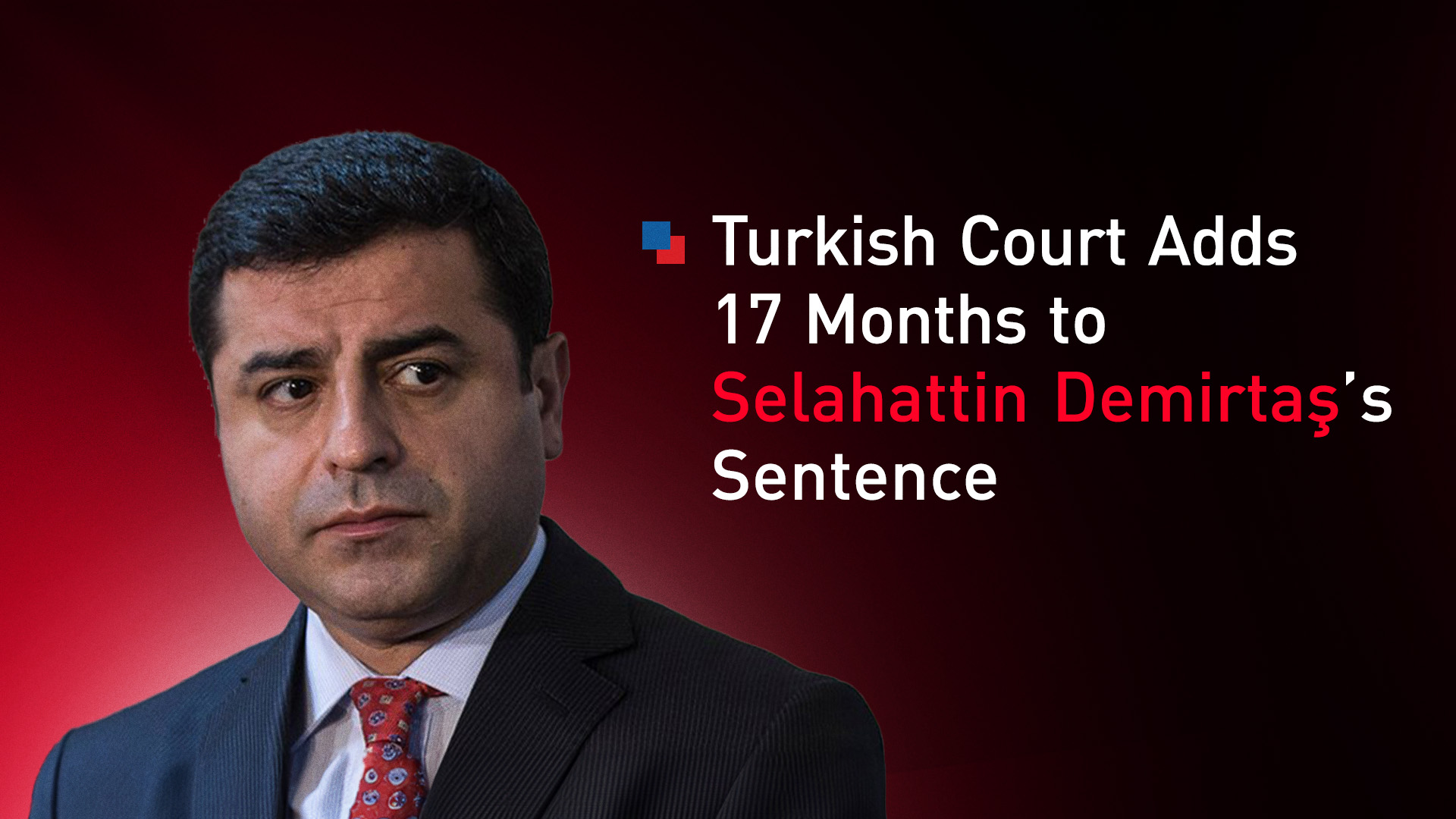
ERBIL (Kurdistan24) — A Turkish court on Tuesday handed down an additional prison sentence to Selahattin Demirtaş, the imprisoned former co-chair of the pro-Kurdish Peoples' Democratic Party (HDP), extending his incarceration by nearly a year and a half on charges of insulting President Recep Tayyip Erdoğan.
The ruling by the 14th High Criminal Court of Mersin adds to the accumulation of sentences against the 52-year-old politician, who has been behind bars for nearly a decade despite international calls for his release.
The court issued a sentence of one year, five months, and 15 days of imprisonment. The conviction stems from charges related to speeches Demirtaş delivered between 2015 and 2016 in the cities of Mersin and Amed.
According to the decision finalized on January 6, 2026, the court determined that the content of those addresses constituted "insults against the President of the Republic."
The legal proceedings on Tuesday were marked by procedural disputes and the physical absence of the defendant.
Demirtaş, who is currently detained in Edirne Prison in northwestern Türkiye, was not permitted to participate in the session in Mersin. Authorities cited "security excuses" for denying his attendance, a decision that left his legal defense team as his sole representation in the courtroom.
During the hearing, lawyers representing Demirtaş requested additional time to prepare a comprehensive defense against the opinion presented by the public prosecutor. However, the presiding judge rejected this request, asserting that the necessary time for preparation had already been granted in previous phases of the trial.
This refusal prompted an immediate objection from the defense, who argued that the court’s conduct constituted a violation of the right to a "fair trial." In response to the judge’s refusal to grant a continuance, the lawyers formally requested a change of judge, but this motion was also summarily rejected by the court.
Ozgur Ozbek, a lawyer for Demirtaş, told Agence France-Presse (AFP) that the case involved merging several charges of insulting the president relating to speeches made at least a decade ago. Ozbek characterized the court’s pace as a rush to judgment driven by procedural deadlines rather than the pursuit of justice.
"The reason the court made such a quick decision was because it was concerned about statue of limitations," Ozbek told AFP. "However, making a decision based on this reasoning before the case is complete is not legally correct."
Ozbek confirmed that the legal team intends to appeal the decision. The defense contends that the court’s haste to beat the statute of limitations compromised the integrity of the proceedings.
This latest sentencing is part of a broader legal campaign against Demirtaş, who was arrested in November 2016 at the height of his political career.
Once a charismatic figure within Türkiye’s Kurdish movement who helped his party briefly break President Erdoğan's grip on parliament, Demirtaş has since faced a litany of "terror-related" charges and other indictments.
The most significant recent development in his ongoing legal battles occurred in May 2024, in the high-profile "Kobani Case."
In that instance, the court imposed a sentence of 42 years of imprisonment upon him. Additionally, in 2021, he was sentenced to three and a half years in jail for criticizing the government's handling of an incident in which the Turkish air force shot down a Russian military jet over the Syrian border in 2015.
The accumulation of sentences comes despite repeated interventions by international legal bodies. The European Court of Human Rights (ECHR) has issued binding rulings demanding his immediate release, most recently in November.
The ECHR has labeled the cases against him as "political messages," a characterization that aligns with the views of several Western governments who regard him as a political prisoner. However, the Turkish government has not adhered to these decisions, continuing to prosecute the former HDP leader on various fronts.
The timing of Tuesday's verdict has also raised questions regarding the domestic political climate in Türkiye.
Reports indicate that a debate regarding the resumption of a new peace process had recently emerged within the country. However, observers note that the continuation of punitive sentences against prominent Kurdish politicians like Demirtaş has created significant doubt regarding the goodwill and viability of any potential reconciliation process.
Despite his years in Edirne Prison, Demirtaş reportedly maintains fierce loyalty among his supporters for his outspoken advocacy for the Kurdish minority. Yet, as his lawyer noted to AFP, the legal pressure remains unrelenting, with the court denying even the basic request for the defendant’s physical presence at his own sentencing on security grounds.
As the legal appeals process begins for this latest conviction, Demirtaş remains incarcerated, facing a decades-long cumulative sentence that effectively removes him from the active political landscape he once helped shape.
The friction between Türkiye's judiciary and the rulings of the European Court of Human Rights continues to define his detention, with no sign of a shift in Ankara’s stance toward the implementation of the ECHR's orders.