KDP and PUK Delegations Meet in Erbil to Discuss Iraqi Presidency and KRG Cabinet Formation
Talks focus on Kurdish consensus in Baghdad, government formation in Erbil, and reactivation of the Kurdistan Parliament amid a sensitive political moment.
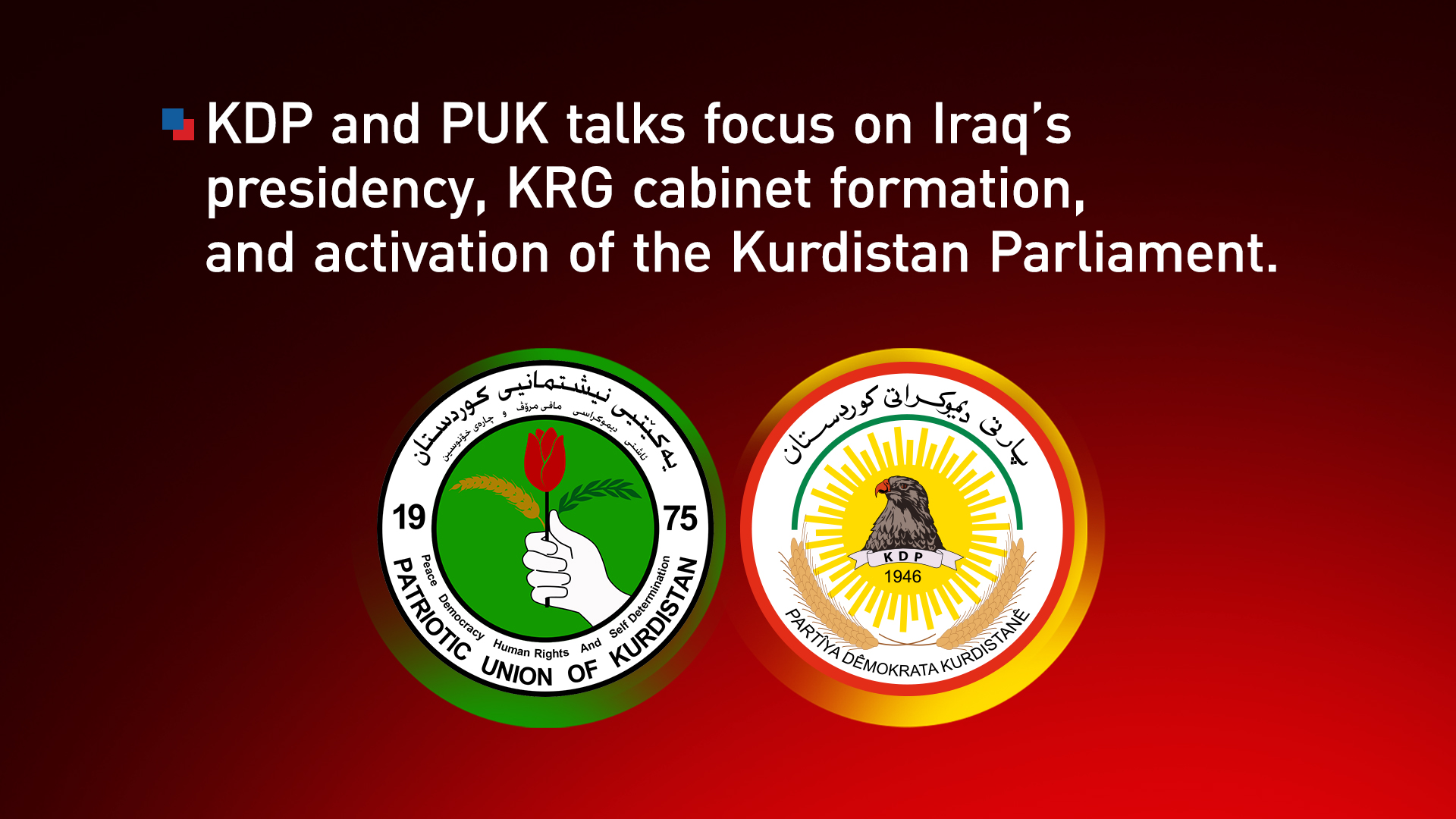
ERBIL (Kurdistan24) — Negotiating delegations from the Kurdistan Democratic Party (KDP) and the Patriotic Union of Kurdistan (PUK) are set to meet in Erbil on Thursday to discuss a range of interconnected political issues, including the nomination of a candidate for Iraq’s next president and the formation of the Kurdistan Regional Government’s (KRG) tenth cabinet.
According to Kurdistan24 sources, the meeting will address three core and highly sensitive files: agreeing on a unified Kurdish candidate for the Iraqi presidency, accelerating talks on forming the next KRG cabinet, and resuming the work of the Kurdistan Parliament.
The discussions come as Iraq and the wider region face heightened political uncertainty, increasing pressure on Kurdish parties to coordinate their positions.
An informed PUK source told Kurdistan24 correspondent Hoshmand Sadiq on Wednesday that the joint meeting between the KDP and PUK negotiating teams is scheduled for Thursday, 11:00 a.m. in Erbil.
The source said the scope of the talks would be broad, reflecting the political linkage between developments in Baghdad and governance arrangements within the Kurdistan Region.
In this meeting, the two sides are also expected to discuss mechanisms for ensuring unity and coordination among Kurdish political forces in the Iraqi capital. Observers say Kurdish consensus in Baghdad is widely seen as a key factor in safeguarding constitutional rights and political gains secured since 2003.
Political analysts note that the recent intensification of meetings between the KDP and PUK reflects a shared recognition that a unified stance is essential at a time when Iraq’s federal institutions are navigating complex internal and regional challenges.
At the same time, the swift formation of the KRG’s next cabinet is viewed as critical to maintaining institutional stability and delivering public services to citizens across the Kurdistan Region.
The Erbil talks come as Kurdish parties step up preparations for the election of Iraq’s next president, a largely ceremonial but constitutionally significant post traditionally held by a Kurd.
The KDP has formally nominated two senior figures—Foreign Minister Fuad Hussein and veteran administrator Nawzad Hadi—for the position, submitting both candidates’ credentials to the Iraqi parliament before the nomination deadline.
The dual nomination is widely interpreted as a tactical move aimed at preserving flexibility in negotiations, both within the Kurdish political arena and with Arab and Shiite blocs in Baghdad.
Fuad Hussein, a seasoned diplomat and former finance minister, is regarded as a consensus-oriented figure with extensive experience in federal governance and international relations. Nawzad Hadi, meanwhile, is best known for his long tenure as governor of Erbil, during which the city saw major infrastructure and development projects.
The race has also attracted other Kurdish candidates. Mala Bakhtiar, a veteran Kurdish politician and former senior figure in the PUK, has entered the contest as an independent. The PUK, for its part, has officially nominated Nizar Amedi, a member of the Politburo and a former Iraqi minister, as its candidate.
With multiple Kurdish contenders now in the field, attention is increasingly focused on whether the KDP and PUK can converge on a single nominee. Failure to do so could complicate negotiations with other parliamentary blocs, particularly given the constitutional requirement for a two-thirds majority in the first round of voting.
Against this backdrop, Thursday’s meeting in Erbil is seen as a critical step toward clarifying Kurdish positions on both federal and regional governance, at a moment when political coordination may prove decisive in shaping the next phase of Iraq’s political process.