President Barzani Calls for Immediate Cessation of Hostilities in Syria
President Barzani called for an immediate halt to Syrian fighting and welcomed the rights decree as a positive step. This follows a summit in Erbil and coincides with SDF Commander Abdi's urgent talks in Damascus.
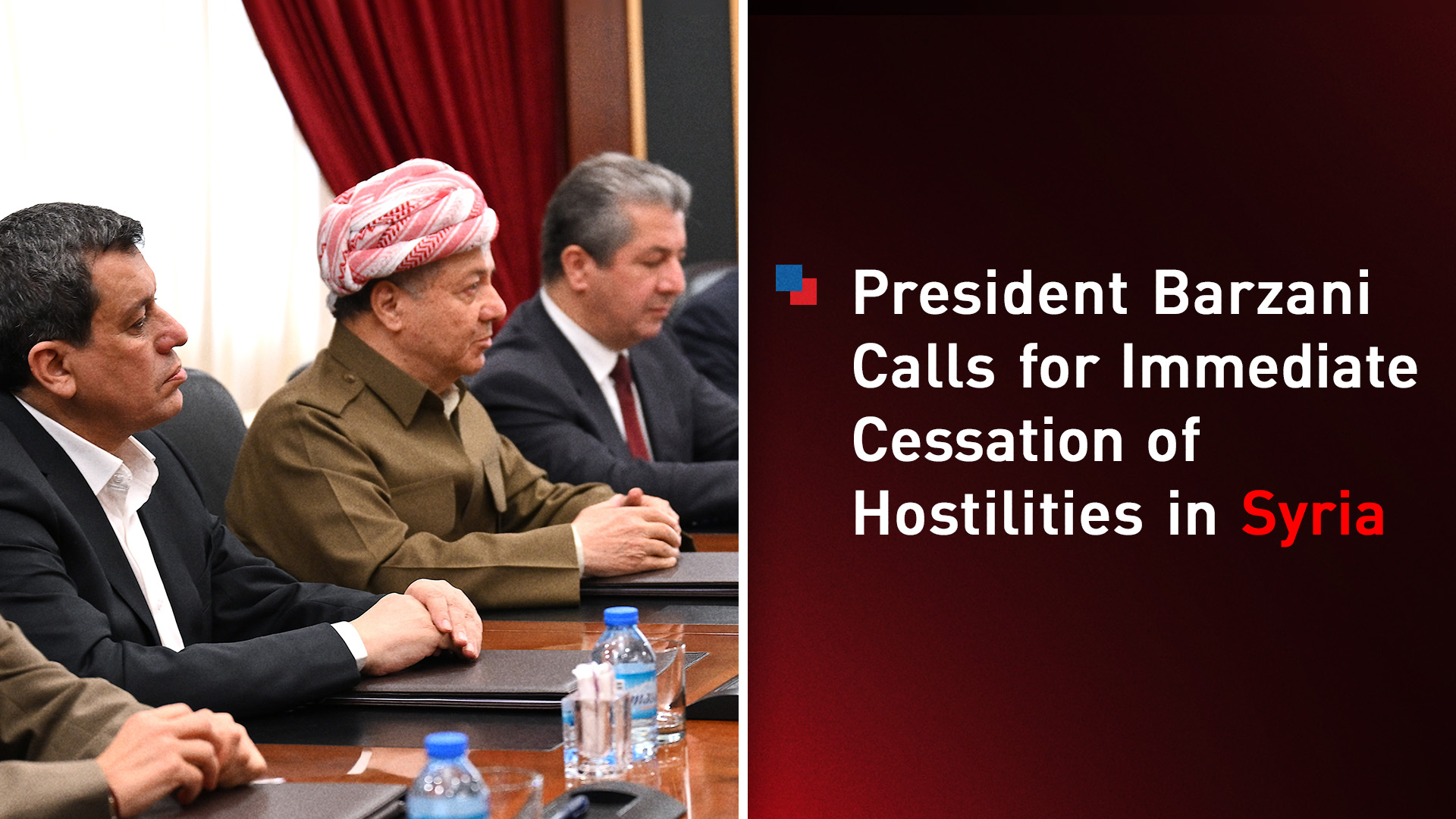
ERBIL (Kurdistan24) - President Masoud Barzani issued a formal message on Sunday calling for an immediate halt to the escalating conflict between Syrian government forces and the Syrian Democratic Forces (SDF), emphasizing that recent political overtures from Damascus regarding Kurdish rights should serve as a foundation for a constitutional settlement.
The statement followed a high-level summit held in the Kurdistan Region aimed at de-escalating a crisis that has seen significant territorial shifts and the seizure of critical energy infrastructure by the Syrian Arab Army.
In his message regarding the latest developments in Syria, President Barzani disclosed that a joint meeting was convened on Saturday involving key stakeholders in the conflict.
The summit included Tom Barrack, the United States President’s Special Envoy for Syrian Affairs; Mazloum Abdi, the General Commander of the Syrian Democratic Forces; and the President of the Kurdish National Council of Syria (ENKS). The gathering was part of a broader diplomatic framework intended to resolve the deepening instability in neighboring Syria.
Addressing the violence that has erupted across northern and eastern Syria, President Barzani expressed a clear desire for a return to the status quo ante.
"We hope that the fighting, turmoil, and tensions currently ongoing between the Syrian government forces and the Syrian Democratic Forces will be halted as soon as possible," the President stated. He urged all parties to return to agreements that were previously concluded to resolve outstanding issues and achieve stability among the various Syrian factions.
Significantly, President Barzani offered a guarded endorsement of recent political moves by the Syrian leadership.
He characterized the issuance of a decree by the Syrian President regarding Kurdish rights as a "positive step" that is in the "right direction." However, he stressed that this decree should not be the endpoint of the political process.
President Barzani expressed hope that the decree would become a "foundation to be enriched with the consent of the relevant parties," ensuring that the guarantee of the Kurdish people's rights is built upon it in a legal and constitutional manner.
The President’s appeal for calm coincides with a critical diplomatic mission in Damascus.
Mazloum Abdi, the General Commander of the SDF, held a phone call with authorities in the Syrian capital on Sunday for an urgent meeting with Syrian President Ahmed al-Sharaa.
According to information obtained by a Kurdistan24 correspondent, this call represented a pivotal attempt to arrest a conflict that the Democratic Autonomous Administration of North and East Syria (DAANES) has formally characterized as an "existential war."
The diplomatic urgency reflects the rapid deterioration of the security landscape in post-Assad Syria. The Syrian Arab Army has pressed a multi-front offensive that has compromised the territorial integrity of the semi-autonomous northeast.
On Sunday, the Reuters news agency reported that government forces had successfully seized control of the Omar oil field and the Conoco gas field in the eastern countryside of Deir ez-Zor Governorate. These facilities represent the economic lifeblood of the autonomous region and were key assets secured by the SDF during the campaign against the Islamic State.
The loss of these energy hubs has precipitated a collapse in local administration in the area.
The Governor of Deir ez-Zor announced the immediate suspension of official duties and issued a directive instructing citizens to remain in their homes, advising against travel unless for absolutely necessary business.
Syrian state media corroborated reports regarding the seizure of the energy fields and indicated that army units had deployed in the villages of Ziban and the areas surrounding Deir ez-Zor city.
Facing these rapid territorial losses, the Autonomous Administration declared a state of emergency and issued a general call to arms on Sunday.
The administration’s statement cited imminent threats to its territory, particularly in the Jazira and Kobani areas, as the catalyst for the mobilization. "We are facing an existential war; to protect our achievements and identity, the only option before us is popular defense," the administration declared.
While General Abdi engages in high-stakes diplomacy in Damascus to secure a ceasefire, he has simultaneously issued directives preparing the population for prolonged conflict.
According to the ANHA News Agency, the General Commander directed an appeal to the people of the region to "rally around their sons among our fighters and to possess the spirit of courage and faith."
He confirmed that while efforts to work toward de-escalation are continuing with the assistance of international parties, the systematic attacks that began on January 6 have continued unabated, expanding from Aleppo to Tabqa and the southern countryside of Raqqa.
The conflict has generated conflicting narratives regarding the control of strategic infrastructure further west. The Operations Command of the Syrian Arab Army announced a "military victory" on Sunday, claiming to have established complete control over the strategic city of Tabqa, the Tabqa Military Airport, and the Euphrates Dam.
Government sources asserted that their troops were positioned only five kilometers from the western entrance of Raqqa city. In contrast, the SDF leadership has denied that Tabqa and the dams have fallen to the Syrian Army, emphasizing that their fighters had repelled the attacks.
The fighting has sparked a severe humanitarian crisis in Raqqa, where the local Media Directorate reported that the city’s drinking water supply had been completely cut off.
Authorities attributed the outage to damage sustained by main water transmission pipelines, alleging SDF shelling was responsible—a claim the SDF categorically denied as "Damascus propaganda."
The breakdown of a previous withdrawal agreement appears to have triggered the current escalation.
On Friday, General Abdi had announced a "decisive decision" to withdraw Kurdish forces toward the east of the Euphrates river as a gesture of goodwill to implement the March 10 agreement. However, the SDF claims that government forces violated this truce by launching offensives before the agreed-upon withdrawal deadline, specifically in the Dabsi Afnan area.
President Barzani’s message on Sunday reinforces the diplomatic groundwork laid during the Saturday summit in Pirmam, Erbil. During that meeting, which included General Abdi and U.S. military officials, President Barzani underscored the necessity of dialogue and coexistence as foundational elements for a "new Syria."
His latest statement reiterates that ensuring the political and cultural rights of the Kurdish people must be a fundamental component of any future settlement, moving beyond temporary military truces to constitutional guarantees.
The push for a negotiated settlement has also received support from Abdullah Öcalan, the imprisoned Kurdish leader. In a meeting with a delegation from the DEM Party on January 17, Öcalan warned that the recent violence was an attempt to "sabotage the peace process."
He urged all parties to resolve the conflict through "dialogue, negotiation, and wisdom," aligning with the sentiments expressed by President Barzani regarding the need for wisdom and a return to agreements.