Iraqi FM Holds Talks With Iran’s President, FM in Tehran
Iraqi FM Hussein met Iranian leaders in Tehran to discuss regional security, trade, and internal stability. Both sides emphasized dialogue, non-interference, and the indivisibility of regional security.
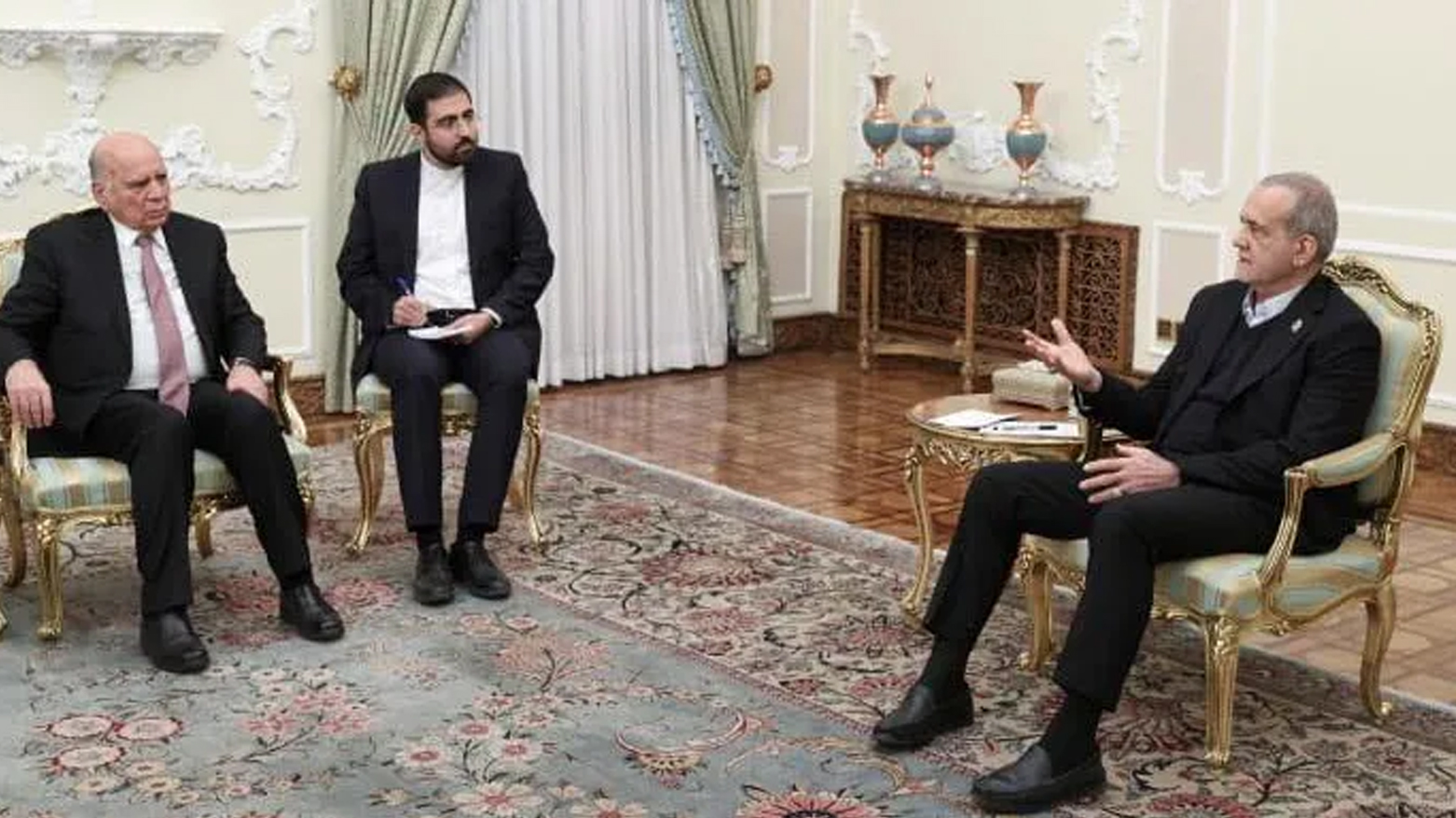
ERBIL (Kurdistan24) - Iraqi Deputy Prime Minister and Foreign Minister Fuad Hussein engaged in high-level talks with the Iranian leadership in Tehran, emphasizing that the security of the Middle East is an "indivisible component" requiring joint diplomatic and security efforts. The Iraqi Foreign Ministry reported that Hussein was received by Iranian President Masoud Pezeshkian and Foreign Minister Abbas Araghchi during an official visit aimed at fortifying bilateral relations and addressing the complex political and security dynamics currently shaping the region.
During his meeting with President Pezeshkian, Minister Hussein conveyed a formal message and greetings from the President of Iraq.
The discussions focused heavily on the interdependence of the two nations' stability. President Pezeshkian highlighted the fraternal and historical relations binding Baghdad and Tehran, asserting that regional stability has a direct and tangible impact on the security and economic development of all parties involved.
Hussein responded by reinforcing the concept of collective security. He indicated to the Iranian President that the security of the region cannot be compartmentalized, arguing that it requires a joint effort to secure a favorable environment for both nations. In addition to regional security architecture, the meeting touched upon Iraq's internal political landscape.
Hussein presented a summary of recent political developments in Baghdad, specifically detailing the approach toward completing the constitutional requirements necessary for electing a new president and forming a government.
Following his audience with the Iranian President, Hussein held a separate, substantive meeting with his Iranian counterpart, Abbas Araghchi. This session covered a broad range of topics, including the development of relations in the trade, energy, and investment sectors. Both ministers discussed mechanisms to enhance these economic ties in a manner that serves the mutual interests of their respective countries.
A significant portion of the dialogue between the foreign ministers addressed the internal situation within the Islamic Republic.
According to the Iraqi Foreign Ministry, Araghchi provided an explanation regarding the recent unrest in his country. The Iranian Foreign Minister indicated that the protests began with economic demands but later resulted in violence. He assured Mr. Hussein that the situation is now moving toward stability.
In response, Hussein reiterated Iraq's stance that Iran's security is an inseparable part of the general security of the region. He also reaffirmed Baghdad's commitment to the principles of neighborliness and non-interference in internal affairs.
At the conclusion of these meetings, both sides agreed that dialogue remains the only viable pathway to resolve challenges and distance the region from escalating tensions.
The diplomatic engagements in Tehran also served as a platform to highlight the evolving security cooperation between the two neighbors, particularly regarding the presence of foreign military forces.
Speaking at a joint press conference held in conjunction with the visit, Araghchi stated that the withdrawal of United States forces from Iraq’s Ain al-Asad airbase is a clear indication of the strengthening security cooperation between Tehran and Baghdad. He underscored what he described as a deepening strategic partnership.
Araghchi elaborated on the nature of this collaboration, noting that Iran and Iraq are actively working toward a comprehensive framework for joint security cooperation while simultaneously enhancing military and security coordination.
"We are striving to reach a shared security cooperation agreement with Iraq, while continuing to strengthen security and military collaboration between our two countries," Araghchi said during the press conference. He added that the U.S. military pullout from Ain al-Asad "is evidence of the growing strength of our security cooperation with Iraq."
Beyond the security realm, Araghchi expressed Tehran’s readiness to expand economic, political, and cultural cooperation with Iraq.
He also praised Iraq’s evolving role in the Middle East, stating that Baghdad has demonstrated its capacity to play an influential part in promoting regional cooperation—an approach the Iranian government views as highly significant.
Hussein arrived in Tehran earlier on Sunday for the official visit. Upon his arrival, he wrote on the social media platform X that he would hold "a number of important meetings with the president of the Islamic Republic of Iran, the speaker of parliament, and the foreign minister."
In addition to President Pezeshkian and Foreign Minister Araghchi, Hussein's itinerary included scheduled meetings with Mohammad Baqer Qalibaf, the Speaker of the Iranian Parliament, and Ali Larijani, the Secretary of the Supreme National Security Council, as well as other senior officials.
Iraqi officials have indicated that Hussein’s talks are focused on a triad of priorities: bilateral relations, regional developments, and the management of ongoing tensions.
The overarching goal of the visit is to reinforce stability and support regional dialogue mechanisms. The discussions occur against a backdrop of shifting regional dynamics and ongoing debates over security arrangements in Iraq, where the future trajectory of foreign military presence remains a sensitive and closely watched issue by both Baghdad and its neighbors.
The consensus emerging from both the private meetings and public statements is a mutual desire to insulate the region from external tensions through tighter bilateral integration. By linking economic development in the energy and investment sectors with a unified security posture, Iraq and Iran appear to be solidifying a partnership that views their national securities as interlinked.
As the visit concludes, the emphasis on dialogue as the primary tool for conflict resolution suggests a continued diplomatic push by Baghdad to maintain equilibrium in its foreign relations while navigating its complex domestic political processes.