PM Barzani Departs for Switzerland to Attend 56th World Economic Forum in Davos
PM Masrour Barzani departed for the Davos World Economic Forum on Monday to discuss regional developments and economic reforms. The forum focuses on five themes, including global cooperation, AI risks, and climate change.
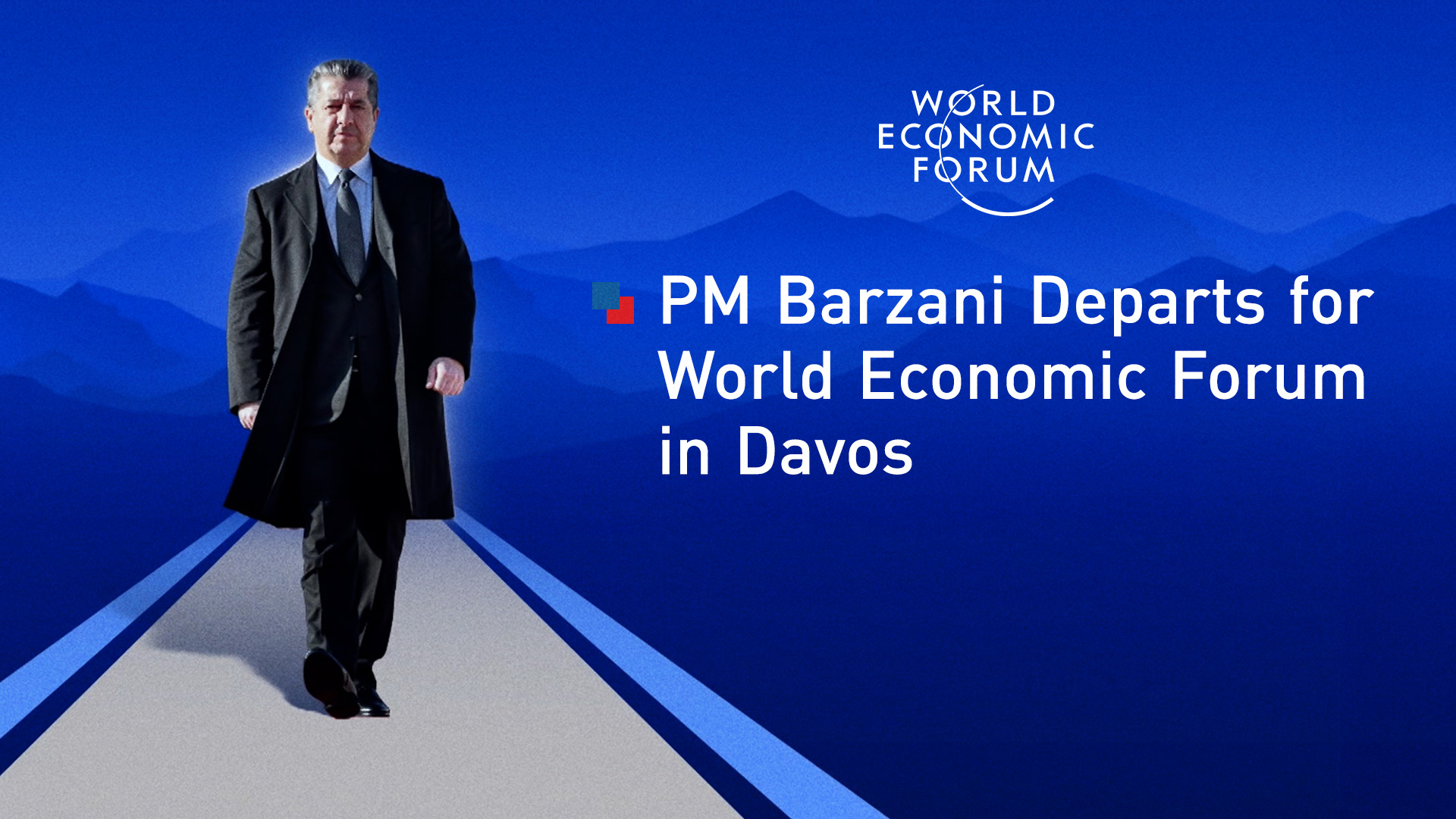
ERBIL (Kurdistan24) - Kurdistan Region Prime Minister Masrour Barzani departed for Switzerland on Monday to head the Kurdistan Regional Government’s delegation at the World Economic Forum in Davos. The visit marks a continued engagement by the Kurdistan Region with global decision-makers at the annual gathering, which brings together political and business leaders to address pressing international challenges.
In a formal statement released on Monday, the Kurdistan Regional Government confirmed the Prime Minister’s departure and outlined the objectives of his participation in the 56th edition of the forum.
According to the statement, Prime Minister Barzani is scheduled to hold a series of high-level meetings and discussions throughout the event. The itinerary includes engagements with presidents, senior national leaders, and owners of major global businesses.
The primary objective of these interactions, as detailed by the government, is to discuss the latest changes and developments affecting the Kurdistan Region, the Federal Republic of Iraq, and the broader Middle East.
Furthermore, the Prime Minister intends to utilize the platform to discuss the Kurdistan Regional Government's ongoing reforms across various sectors. The statement indicated that these reforms are specifically aimed at building a strong economic infrastructure within the Kurdistan Region, a topic that aligns with the forum's broader economic focus.
The 56th World Economic Forum, which commenced on Monday and will continue through Friday, January 23, is taking place with the participation of more than 1,000 presidents, leaders, and country officials.
The forum serves as a venue for participants to present proposals and solutions to confront current global challenges.
Additionally, the event facilitates bilateral and multilateral diplomacy; on the sidelines of the forum, dozens of economic and security agreements are expected to be signed between participating governments and private companies.
The agenda for this year’s forum is structured around five central themes designed to address the complexity of the modern global landscape. The first theme addresses the critical question of how nations and institutions can work cooperatively in a competitive world.
The forum’s literature notes that this discussion comes at a time when world powers are engaged in intense and continuous competition and conflict, striving to change the balance of power and impose hegemony.
Within this context, the forum aims to establish itself as an outlet for cooperative work among companies, governments, and civil society to identify necessary steps and solutions for coexistence and collaboration.
The second major theme focuses on the economic imperative of finding new sources of growth. The organizers emphasize that resolving this issue is of critical importance for companies, governments, and the general population.
This focus is driven by the current geopolitical reality, where the policy of uncertainty among countries and the prevalence of wars in many regions have made trade exchange increasingly difficult.
The forum highlights that countries are now using economic policy not only for commerce but to impose sanctions and as a weapon to confront their adversaries, necessitating new strategies for economic resilience.
A significant portion of the agenda is dedicated to the third theme, which examines the threats posed by technology, specifically Artificial Intelligence (AI). The central question posed is how to better invest in people to advance individual capabilities and talents while reducing the risks of job loss and unemployment.
The forum's internal statistics underscore the urgency of this issue, predicting that in the next five years, 22 percent of jobs globally will undergo changes. The report attributes these shifts mostly to the increasing adoption of Artificial Intelligence by both companies and government entities, highlighting the need for workforce adaptation.
Closely related to the workforce discussion is the fourth theme, which attempts to answer how innovation can be deployed at the necessary scale and in a responsible manner.
The agenda recognizes that the speed of growth and the use of Artificial Intelligence are becoming potential threats to the lives of people and society, as well as drivers of environmental change and shifts in the operational policies of companies and industries.
The text notes that, in response to these challenges, most countries are calling for limitations on Artificial Intelligence's access to data, particularly personal data, to safeguard privacy and security.
Finally, the fifth theme focuses on building prosperity within the framework of Earth's safety boundaries.
This thematic track addresses the reality that climate change has created a direct impact on economic infrastructure, food systems, and the natural ecosystem. Consequently, the forum posits that there is an increased need for environmentally friendly solutions to sustain economic viability while protecting the planet's resources.
As Prime Minister Barzani engages with global counterparts, these five themes will frame the discussions regarding the Kurdistan Region’s role in the global economy and its response to the challenges of security, technology, and climate resilience.
This article was updated on Monday Jan. 19, 2026, at 01:21pm.