Kurdish Sculptor Saman Hidayat Unveils Braid Sculpture Honoring Women’s Resistance
Hidayat explained that the braided form, or kazi, represents strength, identity, and continuity—values deeply rooted in Kurdish culture.
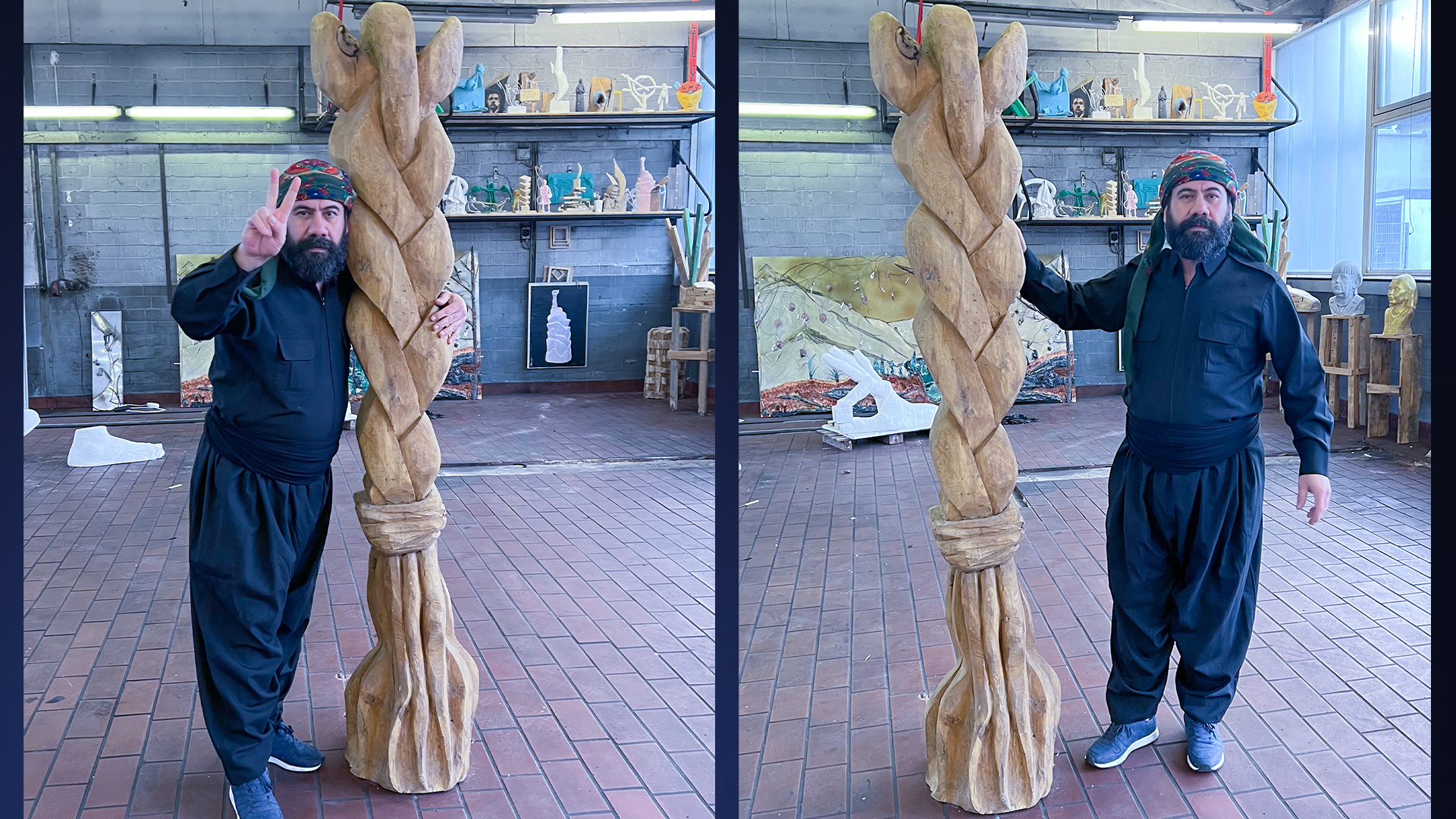
ERBIL (Kurdistan24) – Kurdish sculptor Saman Hidayat has unveiled powerful new artwork celebrating the resilience and resistance of Kurdish women, amid a growing global movement of solidarity led by Kurdish communities.
The sculpture, titled “Kurdish Revolutionary Women Kazi (Braid)”, is carved from oak wood and stands two meters tall with a diameter of 40 centimeters. Speaking to Kurdistan24 on Friday, Hidayat said the piece symbolizes the enduring spirit, dignity, and historical struggle of the Kurdish nation, with a particular focus on the role of women in resistance movements.
Hidayat explained that the braided form, or kazi, represents strength, identity, and continuity—values deeply rooted in Kurdish culture. He noted that the sculpture was inspired by Kurdish women’s steadfast resistance and sacrifice, adding that he is considering casting the work in bronze and mounting it on four large stones to symbolize the four parts of Kurdistan.
A graduate of the Department of Painting at the Erbil Institute of Fine Arts, Hidayat has lived in Germany since 2015, where he continues to produce art in support of what he described as his people’s legitimate cause.
The unveiling of the sculpture coincides with a widespread social media campaign launched by Kurdish women around the world, who have been sharing videos of themselves braiding their hair in a symbolic act of protest and remembrance. The campaign emerged after the circulation of a video showing a Damascus-affiliated militant displaying the cut braid of a deceased Kurdish female fighter; footage that sparked outrage across Kurdish communities.
For many participants, the act of braiding hair has become a message of dignity, resistance, and solidarity with female fighters in Rojava, as well as a condemnation of the reported mistreatment of women killed in ongoing hostilities in Western Kurdistan.
As images of braided hair continue to spread online, Hidayat’s sculpture stands as a lasting artistic tribute—transforming grief and anger into a statement of cultural pride and collective memory, while reaffirming the central role of Kurdish women in the struggle for identity, justice, and freedom.