Kurdish Women Launch Hair-Braiding Campaign to Protest Mutilation by SAA Soldier
Kurdish women launched a hair-braiding campaign to protest a video of a Syrian Arab Army (SAA) soldier desecrating the remains of a Kurdish female fighter, calling it a war crime and a symbol of resistance.
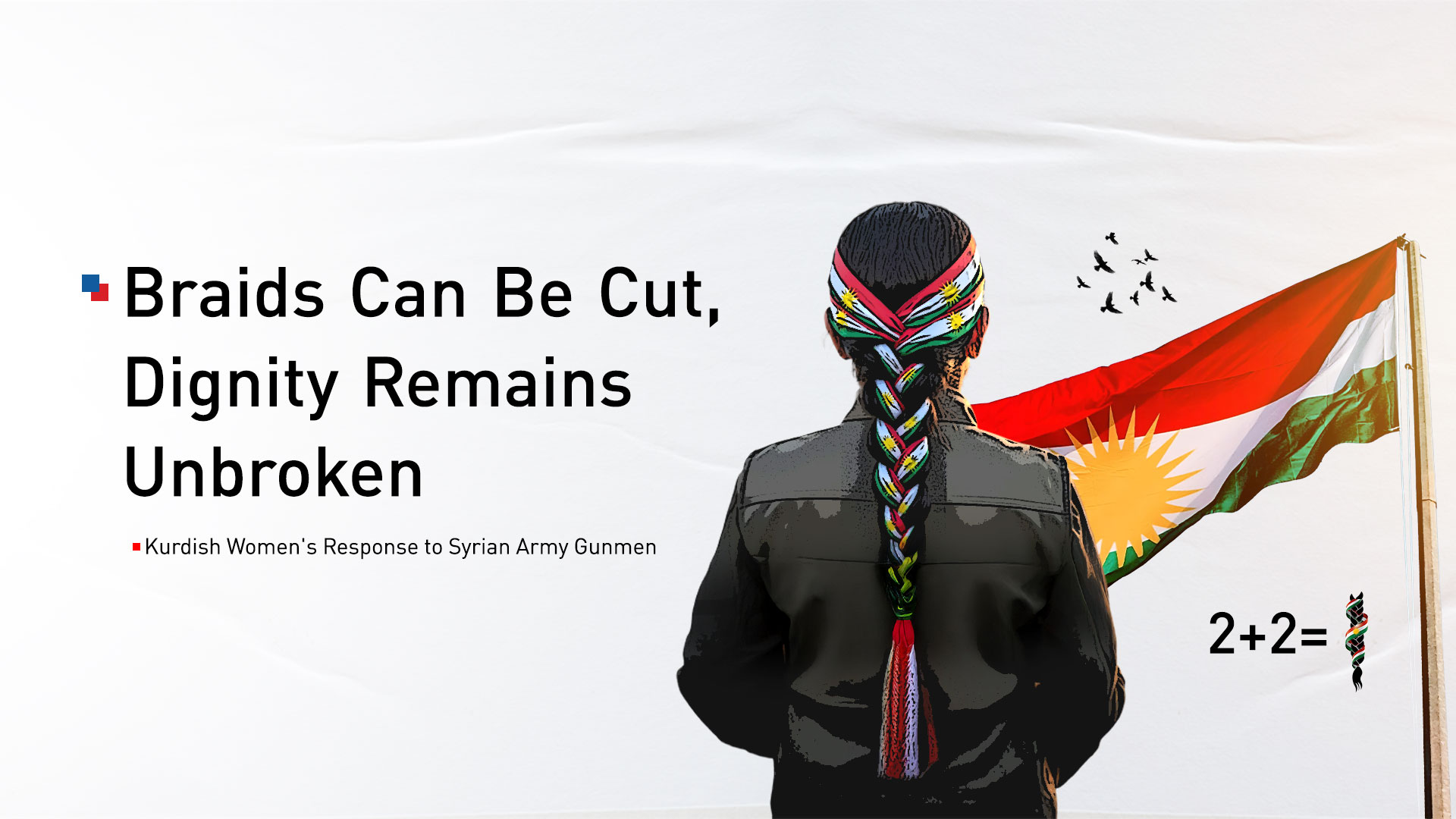
ERBIL (Kurdistan24) – Women across the Kurdistan Region of Iraq and the broader Middle East have initiated a synchronized protest campaign involving the braiding of hair, a cultural symbol of resistance, following the circulation of footage purporting to show a Syrian Arab Army (SAA) soldier desecrating the remains of a Kurdish female fighter.
The demonstrations, which have engaged activists, media professionals, and civilians, emerged in response to a video in which a uniformed man boasts about cutting off a braid from a Kurdish combatant in northern Syria, an act widely interpreted by observers as a calculated attempt at cultural and gender-based intimidation.
According to a report by Agence France-Presse (AFP), the protests began on Friday as dozens of women gathered in Erbil, the capital of the Kurdistan Region, to publicly braid one another’s hair.
The demonstration was organized as a direct rebuttal to the video, which surfaced days after Syrian government troops retook parts of Raqqa from Kurdish-led forces.
The Kurdish autonomous administration in northeast Syria has long emphasized the role of women in its armed forces, making the alleged desecration a particularly potent symbol of the conflict's expanding social dimension.
Vienna Salam, a 31-year-old university lecturer who participated in the Erbil gathering, told AFP that the footage represented a threat not only to Kurds as an ethnic group but specifically to Kurdish women.
She described the act of braiding as a method of demonstrating resilience and power to the global community. “Braiding is our way of fighting back and of representing our identity as Kurdish women,” Salam said.
The controversy centers on a viral video showing a Syrian soldier displaying a severed braid, claiming he had removed it from the head of a female Kurdish fighter.
While AFP noted that the veracity of the claim remains unverified—and the soldier later released a second video claiming the braid was a fake wig found at a restaurant following an online backlash—the imagery ignited immediate outrage.
The Iraqi News Agency (INA) reported that the incident sparked a powerful social media movement dubbed "The Braid Campaign," which has swept through digital platforms in the Arab world and the Kurdistan Region.
The INA report highlighted that the campaign is viewed by participants not merely as a symbolic gesture, but as a "declaration of defiance against attempts to abuse and control the image of women."
Bahar Ali, a Kurdish activist in Erbil, told INA that the braid holds profound anthropological significance within Kurdish society, representing strength, dignity, and steadfastness in the face of oppression.
“Cutting the braid in such contexts is seen not only as a physical act but as a heavy moral blow,” Ali stated.
She characterized the video as an offense to all women, asserting that the campaign delivers a moral stance that dignity cannot be stripped away by violence. “If one braid is cut, thousands of braids will grow to humiliate [the aggressors] and triumph for dignity,” she added.
The symbolism of the braid is deeply rooted in regional history.
According to AFP, braids feature prominently in Kurdish ballads as emblems of beauty and strength, while also serving as markers of mourning; widows have traditionally cut their braids to mark the death of their husbands.
However, in the context of the Syrian conflict, the braid has become synonymous with the Kurdish women's protection units (YPJ) that played a central role in the ground war against the Islamic State (ISIS).
Lafa, a media professional based in Erbil, provided further cultural context to INA, explaining that in Kurdish tradition, the braid is considered a supplication to the Creator rather than mere adornment. She noted that the act of cutting a braid is historically significant in tribal custom.
“Declaring the cutting of a braid is equivalent to a declaration of war,” Lafa told INA. “They do not know that the honor of a Kurdish woman is not in her hair but in her land, her dignity, and her resistance.”
The nature of the alleged act has drawn comparisons to the brutality exhibited by extremist groups during the height of the Syrian civil war.
Syrian writer and journalist Qutaiba Yassin described the incident to INA as "ISIS-like in a different guise," warning that such uncontrolled behavior creates a tragic impression of lawlessness in conflict zones.
Similarly, American investigative journalist Lindsey Snell was cited by INA as categorizing the act under the "barbarism of terrorist factions," noting that it documents deliberate brutality toward the personal symbols of women.
Legal experts have also weighed in on the implications of the footage. Moayad Afana, a legal researcher cited by INA, indicated that the behavior captured in the video represents a "flagrant violation of the Fourth Geneva Convention."
He argued that the act constitutes the moral mutilation of a victim's body and an insult to human dignity, which remains protected under international law even during wartime.
Human rights organizations, including "Syrians for Truth and Justice," have called for the documentation of such systematic violations and urged international bodies to pressure controlling forces to prevent the repetition of such scenes.
The protests have also served as a venue for cross-cultural solidarity.
Hadeer Emad, a journalist in Baghdad, told INA that the "Braid Campaign" represents a civilized response that crosses borders, sending a clear message that Arab and Kurdish women stand together against violence and extremism.
She described the boasting soldier as utilizing a "propaganda tool to spread fear," asserting that the braid has now turned into a witness of condemnation against the brutality of armed groups.
On the streets of Erbil, the mood remained defiant. AFP reported that during the protests, women stood in lines braiding each other's hair while chanting "Women, Life, Freedom," the slogan synonymous with the 2022 anti-government protests in neighboring Iran.
Darin Masoum, a 30-year-old protester with family in northeastern Syria, told AFP that the braids symbolize "courage, beauty, strength and dignity."
As Syrian government troops continue to consolidate control over areas previously held by the Kurdish administration, the visceral reaction to the video suggests that the cultural and social fissures exacerbated by the conflict remain deep.
Activists like Rezan Sheikh Dler told INA that the broad solidarity confirms that attempts at humiliation are being transformed into acts of collective resistance, forcing perpetrators to retreat from their narratives.