European MPs Warn EU Inaction is Fueling Crisis in Western Kurdistan
Four European MPs told Kurdistan24 that EU silence is enabling suffering in Western Kurdistan, urging ceasefire efforts, protection of civilians, and decisive political action amid conflict and siege conditions.
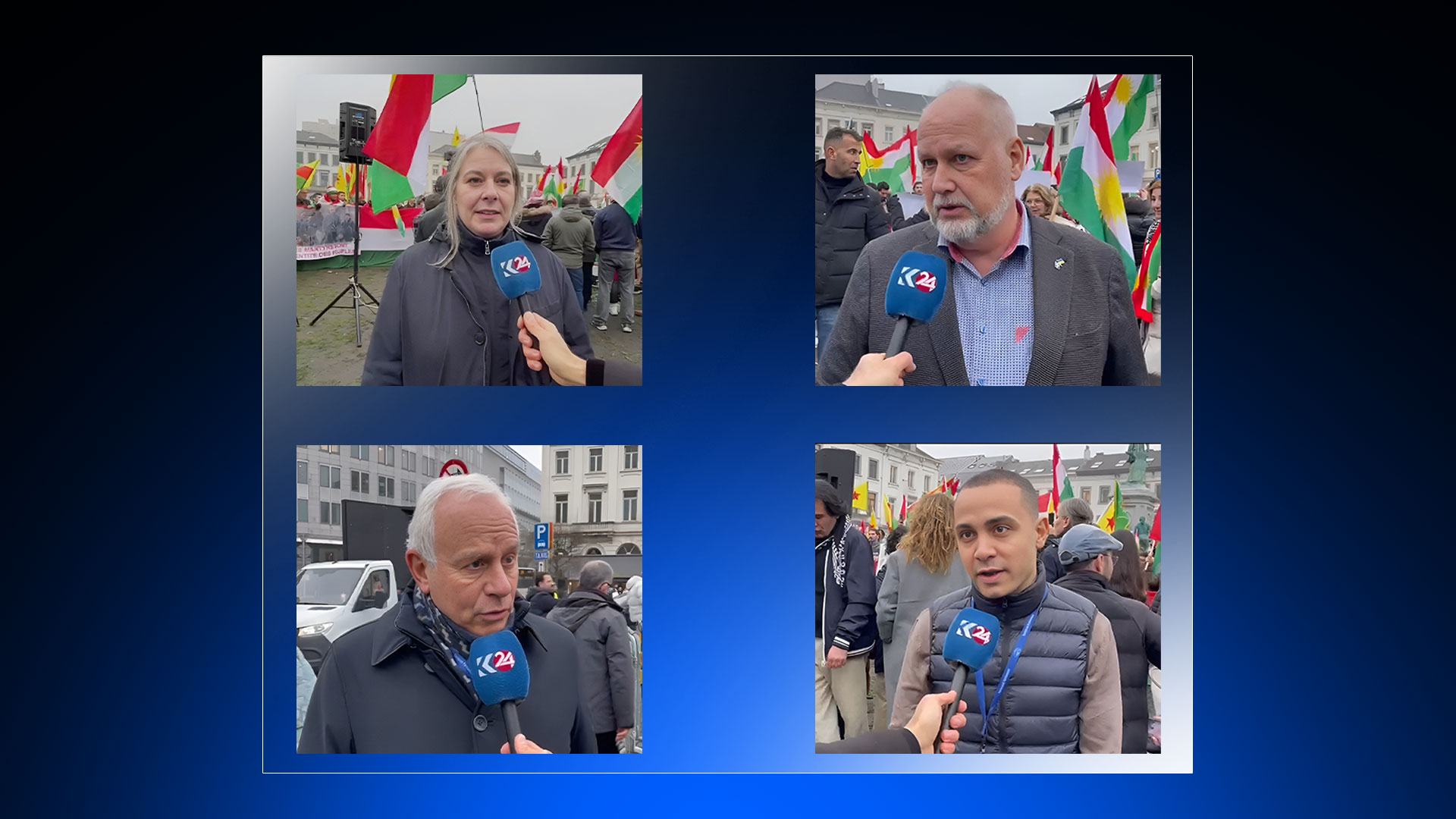
ERBIL (Kurdistan24) - As conflict, displacement, and humanitarian hardship deepen across Western Kurdistan, four Members of the European Parliament have warned that continued political silence is enabling suffering on the ground and disregarding Kurdish sacrifices in the fight against ISIS.
In an interview with Kurdistan24’s correspondent in Europe, Barzan Hassan, the lawmakers said European caution and inaction risk compounding the crisis in Western Kurdistan (Northern Syria), as military pressure, siege conditions, and uncertainty persist.
Jonas Sjöstedt, a Member of the European Parliament, said his presence was driven by deep concern over ongoing attacks against Kurds in Syria.
“I’m here because I’m very worried that the Kurds in Syria are under brutal attack, not only by the Syrian army but also by jihadistic groups,” Sjöstedt said. “Some of these groups are true extremists, and some of them are acting on behalf of Turkey, they are Turkey-led. And now is the time for a ceasefire, they must stop attacking the Kurds. They should withdraw their forces and start to sit down at the negotiating table and negotiate.”
Cecilia Strada, also a Member of the European Parliament, said her position was rooted in support for Kurdish rights and alarm over renewed siege conditions in Western Kurdistan.
“I am here because I fully support the need of the Kurdish people to live in freedom, in safety, in dignity in their land,” Strada said. “And as a member of the European Parliament, I’m very concerned about what’s happening there.”
She added: “We see that Western Kurdistan is again under siege, and we need to protect the Kurdish people. The European institution must act now to protect the Kurdish people, like the Kurdish people protected us when they were fighting against Daesh, when they were defeating Daesh.”
Strada also pointed to the political dimension of the administration in northeastern Syria. “We also need to protect that extraordinary experiment of grassroots democracy that is the administration in Northeastern Syria,” she said, adding: “Unfortunately, the European institutions are not acting, and we, members of the European Parliament, are pushing them to act and to act now.”
Daniel Attard, a Member of the European Parliament, said solidarity must be paired with concrete international action.
“I am here not just in solidarity with the Kurdish people who stood at the front line to defeat ISIS in Western Kurdistan, but also to demand clear action from the international community and from the European Union,” Attard said.
He warned against political inaction, stating: “We cannot tolerate a situation whereby a massacre is unfolding on the Kurds in Western Kurdistan with the blessing of the international community and of the European Union, because our silence amounts to complicity.”
Attard also raised concerns about funding, saying: “We cannot accept situation whereby European funds are going to a regime which is conducting a massacre, which is slaughtering Kurdish people in Western Kurdistan. So we are here in solidarity but also to demand clear and decisive action.”
Marco Tarquinio, a Member of the European Parliament from Italy, framed the issue as one with broader implications for democracy in the region.
“I am a Member of the European Parliament, my name is Marco Tarquinio, I am Italian,” he said. “I believe that every attack on Western Kurdistan at this moment is an attack on democracy, on the hope for democracy in the Middle East.”
He added that sustained attention is required within European institutions. “It is very important that in the European Parliament we work for meaningful attention toward the people of this part of Syria and all of Syria,” Tarquinio said.
The remarks come amid growing criticism within Europe over the response of international institutions to developments in Western Kurdistan.
In a separate interview with Kurdistan24’s correspondent in Europe, Evin Inger, a Member of the European Parliament, and Mani Hussaini, a Member of the Norwegian Parliament, previously criticized the silence of NATO and the European Union regarding the situation in Western Kurdistan.
Asked about NATO’s position following her meeting with NATO Secretary General Jens Stoltenberg, Inger said Turkey’s membership has contributed to alliance silence. “This is unacceptable,” she said, stressing that NATO should support those fighting ISIS and noting that Kurds are part of the coalition against the group.
Inger also addressed European funding, saying the European Union is sending funds to Syria, specifically to the Syrian government. She recalled that around two weeks earlier, the President of the European Commission and heads of states visited Syria without making any reference to Western Kurdistan. “When money is sent to a government, conditions must be attached,” she said, emphasizing respect for international law.
From the Norwegian perspective, Hussaini said lawmakers must raise their voices more forcefully. “What is happening is genocide,” he said, referring to developments in Western Kurdistan and the east, while reminding that more than twenty thousand Kurds were martyred in the fight against ISIS while defending European security.
He highlighted humanitarian concerns in Kobani, saying the city had been under siege for more than a week, with no food, water, or electricity, and noted Norwegian involvement in efforts to open a humanitarian corridor.
Both lawmakers urged European institutions to assume responsibility and called on Kurds across all four parts of Kurdistan and in the diaspora to remain united and vocal.
As European lawmakers intensify their warnings, they argue that continued silence risks deepening suffering in Western Kurdistan, underscoring calls for immediate political and humanitarian action in recognition of Kurdish sacrifices and ongoing hardship.
Kurdistan24’s correspondent in Europe, Barzani Hassan, contributed to this article