Zelensky Calls Putin a ‘Slave to War’ at Munich Security Conference
Ukrainian leader urges faster Western support and warns against territorial concessions ahead of new Geneva talks.
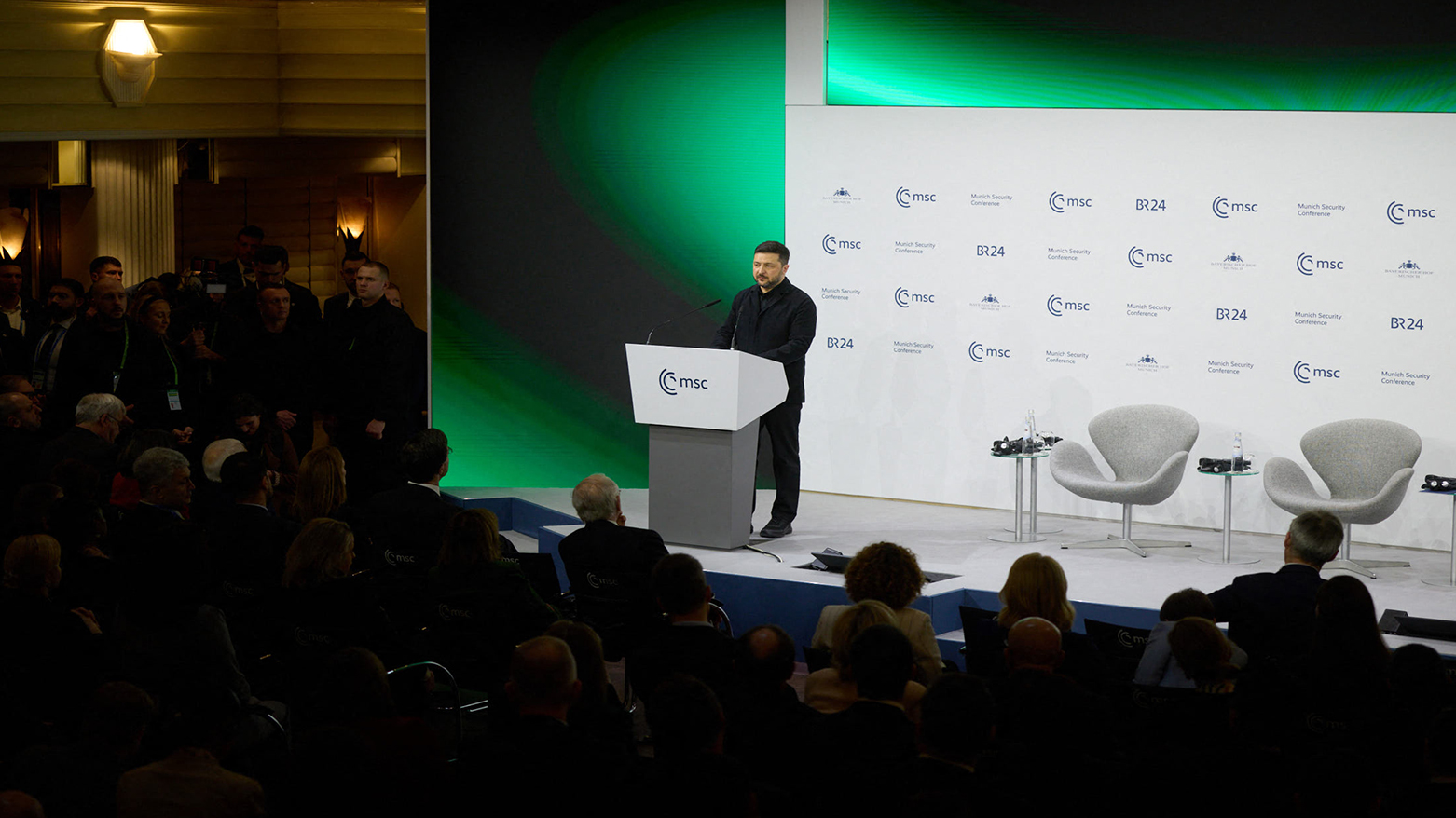
ERBIL (Kurdistan24) — Ukrainian President Volodymyr Zelensky on Saturday branded Russian leader Vladimir Putin a “slave to war,” delivering a forceful address at the Munich Security Conference in Munich as Kyiv prepares for another round of US-brokered negotiations with Moscow.
Speaking days before the fourth anniversary of Russia’s February 2022 invasion, Zelensky said relentless Russian strikes had damaged every power plant in Ukraine, accusing Moscow of systematically targeting the country’s energy infrastructure.
“There is not a single power plant left in Ukraine that has not been damaged by Russian attacks. Not one,” Zelensky said. “But we still generate electricity,” he added, praising thousands of workers involved in ongoing repair efforts.
Kyiv and its Western allies have long accused Moscow of seeking to freeze Ukraine’s civilian population through sustained attacks on the national power grid, particularly during the winter months.
Turning to Putin, Zelensky said: “He may see himself as a tsar, but in reality he is a slave to war.”
Zelensky’s remarks came ahead of fresh negotiations scheduled next week in Geneva, following two earlier rounds of talks in Abu Dhabi involving US, Russian, and Ukrainian officials.
Russia has demanded that Ukraine withdraw from its Donetsk region and recognize Moscow’s claims over territories currently under Russian occupation. Kyiv has firmly rejected surrendering any of its eastern regions.
“The Americans often return to the topic of concessions, and too often those concessions are discussed in the context only of Ukraine,” Zelensky said, suggesting that pressure has disproportionately focused on Kyiv.
He drew a historical parallel with the 1938 Munich Agreement, when European powers allowed Nazi Germany to annex part of Czechoslovakia in a failed bid to avert wider conflict.
“It would be an illusion to believe that this war can now be reliably ended by dividing Ukraine — just as it was an illusion to believe that sacrificing Czechoslovakia would save Europe from a great war,” he warned.
Zelensky stressed that durable security guarantees were essential to any settlement, arguing that only binding commitments could prevent renewed Russian aggression.
“With Russia, you cannot leave a single loophole Russians can use to start a war,” he said.
He also reiterated that European countries should have a seat at the negotiating table, a proposal Moscow has opposed.
On the sidelines of the Munich conference, Zelensky met with US Secretary of State Marco Rubio. In a social media post, he said he had also spoken by phone with US envoy Steve Witkoff and Jared Kushner, the son-in-law of US President Donald Trump.
“We count on the meetings being truly productive,” Zelensky wrote, adding that Kyiv was doing “everything” to bring the war to an end.
Despite diplomatic efforts, Zelensky voiced frustration at what he described as slow political decision-making in Western capitals.
“Weapons evolve faster than political decisions meant to stop them,” he said, noting that Iranian-designed Shahed drones used by Russia had become increasingly lethal.
Once again, he urged allies to accelerate the delivery of advanced air-defense systems, arguing that enhanced protection of Ukraine’s skies would both save lives and strengthen Kyiv’s hand in negotiations.
Addressing the issue of elections in Ukraine, Zelensky said they would be held once a ceasefire was secured and credible security guarantees were in place, underscoring that stability and safety were prerequisites for any democratic process.
As the war nears the end of its fourth year, with hundreds of thousands reported killed or wounded and millions displaced, Zelensky’s Munich address underscored Kyiv’s insistence that peace cannot come at the expense of sovereignty or long-term security.