Kurdish Officials Condemn Baghdad’s Administrative Changes in Khanaqin
Officials and Political Leaders Vow to Protect Kurdish Areas Against Unilateral Decisions and Demographic Change
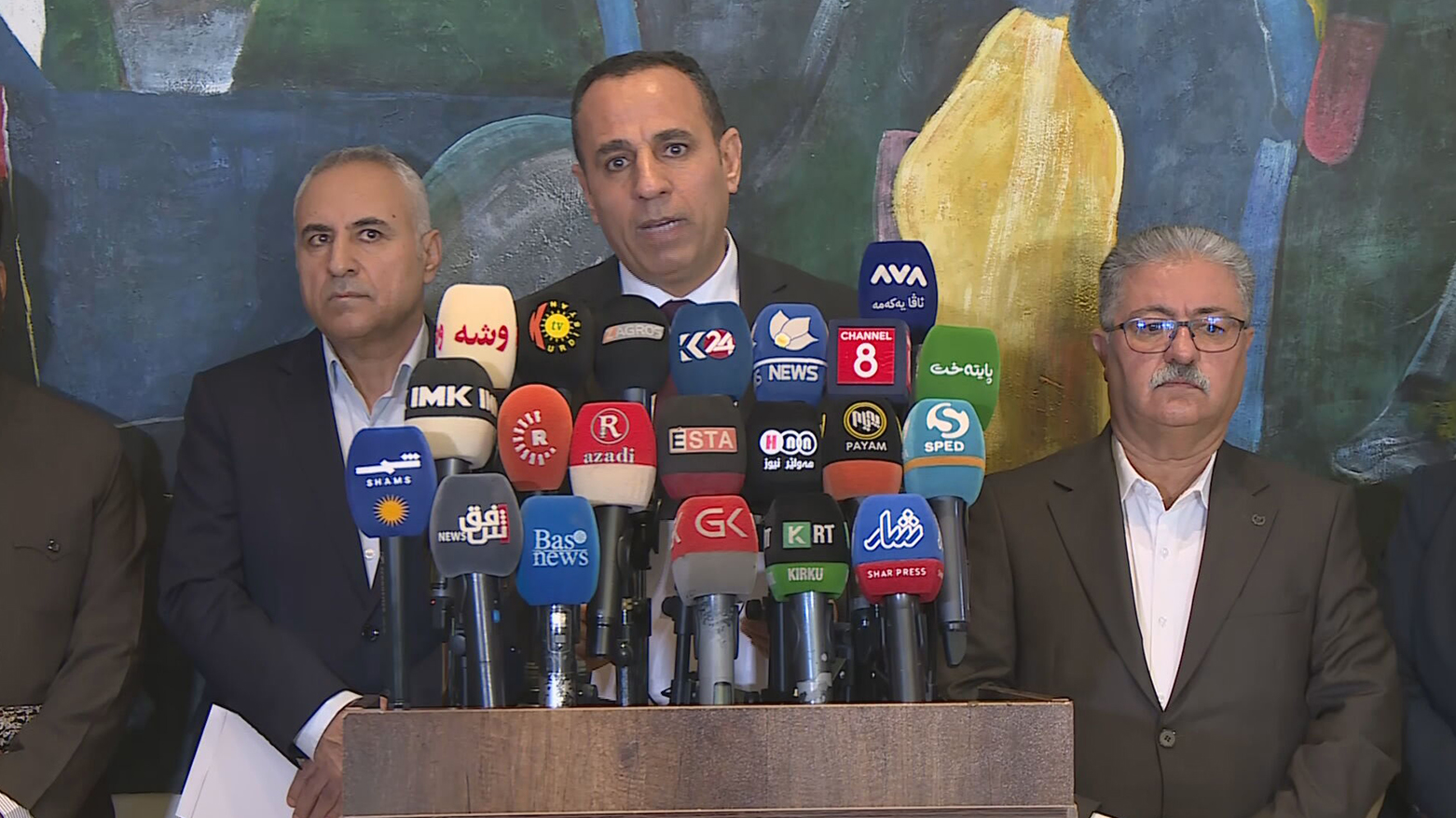
ERBIL (Kurdistan24) — The General Board for Kurdistani Areas Outside the Region, along with representatives of all Kurdistani political parties in Diyala province and Khanaqin district, on Thursday condemned recent administrative changes in Khanaqin, warning that unilateral decisions by Baghdad threaten the rights and demographic integrity of Kurdish areas.
Fahmi Burhan, head of the General Board for Kurdistani Areas Outside the Region, told a press conference Thursday that efforts to convert sub-districts into separate districts and detach them from Khanaqin “mirror the policies of the previous regime, aimed at Arabizing the area” and represent an unconstitutional violation of Article 140 of the Iraqi Constitution.
Burhan stressed that the Kurdistan Regional Government (KRG) and all Kurdish political parties stand in support of Khanaqin residents and will not allow any interference with the area’s demographics or administrative map.
He said formal complaints would be submitted to the Iraqi parliament, federal government, and judiciary regarding the decisions.
Representatives of Khanaqin’s political parties also warned that officials in Baghdad and Diyala “seek to revive the previous regime’s policies against Kurds,” and that such changes could negatively affect future population counts and administrative authority in the area.
The conference concluded with a unified call to ministers, lawmakers, and the Iraqi presidency to oppose these measures in Baghdad, noting that the issue could extend beyond Khanaqin to other disputed areas such as Kirkuk and Sinjar if left unchecked.
A general strike swept through Khanaqin on Wednesday, with markets shuttered and public institutions closed, as residents protested what they describe as attempts to alter the demographic and administrative structure of Kurdish areas.
Hawre Jaf, Kurdistan24’s correspondent in Khanaqin, reported that residents, political parties, and civil activists have unanimously rejected recent decisions by the Diyala Provincial Council and Iraq’s Ministry of Planning to separate the sub-districts of Jabara, Qaratapa, Gulala, and Saadiya from Khanaqin’s administrative boundaries. Protesters argue that the measures amount to an effort to weaken Khanaqin’s administrative status and marginalize its Kurdish identity.
Khanaqin, located in Diyala province near the Iranian border, is one of several territories disputed between Baghdad and the Kurdistan Regional Government (KRG). The area has long been a flashpoint in disputes over governance, security, and demographic balance.
Following the events of October 16, 2017 — when Iraqi federal forces reasserted control over disputed territories after the Kurdistan Region’s independence referendum — security instability led to the displacement of residents in several Kurdish villages, with nearly 40 villages reportedly emptied amid deteriorating conditions.
In the latest development, the Diyala Provincial Council reclassified Qaratapa from a sub-district to a town and elevated Jabara’s administrative status, steps that residents interpret as part of a broader plan to detach them from Khanaqin.
Critics argue that such administrative restructuring could dilute Khanaqin’s territorial scope and political weight, potentially altering future demographic and electoral calculations in the disputed areas.
Article 140 of the Iraqi Constitution was intended to settle the status of disputed territories through a three-stage process. However, nearly two decades after its adoption, its provisions remain unimplemented, leaving areas such as Khanaqin in prolonged legal and political limbo.
For many residents, the latest decisions are viewed not as routine administrative adjustments but as politically motivated measures taken in the absence of a comprehensive constitutional settlement.
The ongoing general strike, alongside efforts by KRG officials and political party representatives, signals growing frustration and a firm stance that any changes to administrative boundaries must be addressed within the constitutional framework rather than through unilateral decisions.