German FM Confirms Indirect U.S.-Iran Contacts, Direct Talks Expected in Pakistan
Germany is maintaining a non-combat role in the Strait of Hormuz, focusing on diplomatic coordination with the United States, other European allies, and regional stakeholders, while monitoring the impact of Iran’s partial blockade on global shipping and commodity prices.
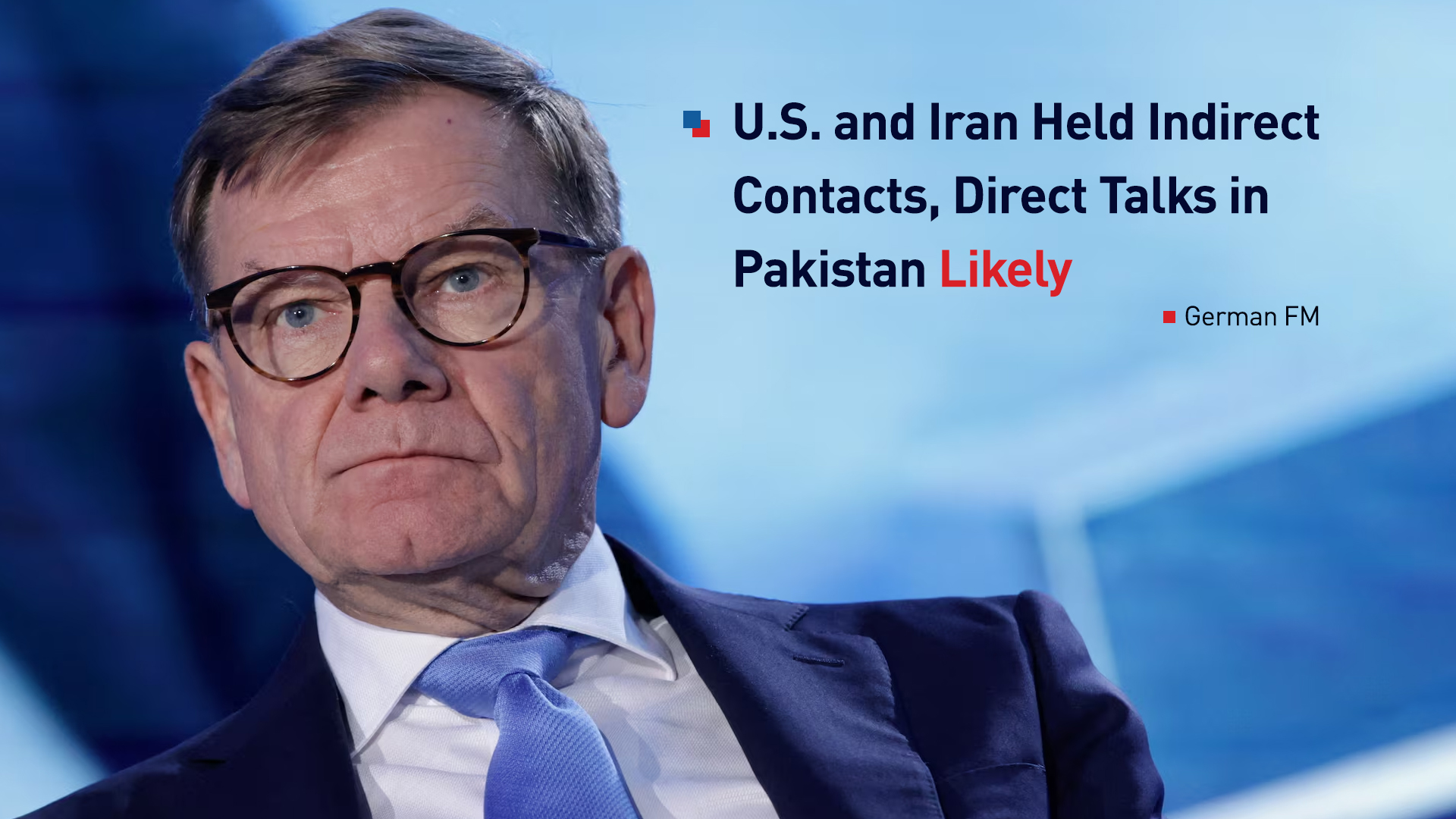
ERBIL (Kurdistan24) - Germany is not currently participating in military operations in the Strait of Hormuz, Federal Foreign Minister Johann Wadephul said Friday, noting that Berlin has received no formal request from Washington to assist in the ongoing maritime situation, though talks with the United States and other allies are underway to coordinate responses.
In a live interview with Deutschlandfunk, Wadephul said that Iran has not fully closed the strategic waterway but has restricted passage for most commercial vessels.
“Some ships—very few from China, Egypt, India, Malaysia, and other nations—have been allowed to pass, for which, according to media reports, fees were likely paid to Tehran,” he said. “Hundreds of other ships, however, are not allowed to pass, which is why the prices for oil, liquid gas, and fertilizer continue to rise.”
The minister emphasized that while Germany could consider a future role in securing maritime traffic, it currently lacks the legal framework and has not received a concrete request to intervene.
“No, they have not, and we also have the restrictions that the Federal Chancellor described in the plenary session,” Wadephul said. “We do not even have the legal prerequisites at this point in time to carry out a mission, and there is also no concrete request to do anything right now. Therefore, I think this is a question we are discussing here with one another.”
The comments come amid heightened global concern over Iran’s blockade of the Strait, which has disrupted the transport of energy and agricultural commodities and triggered price increases. Wadephul described ongoing coordination efforts among the G7 industrial nations, with participation from India and Saudi Arabia, noting that these discussions are being held near Paris.
“The coordination, however, is quite a feat when one ‘G’ of these G7 nations, namely the USA, does one thing today and the opposite tomorrow,” he said. The German minister was referring to prior public remarks from U.S. officials, including President Donald Trump and U.S. Secretary of State Marco Rubio, who have criticized European allies for insufficient support in ongoing confrontations with Iran.
Wadephul acknowledged the public tensions but highlighted that Germany is focused on clarifying and aligning positions.
“It is also indisputable that we have a common interest with the USA and with Israel in ensuring that Iran does not continue its behavior in the future, which endangers the entire international security order,” he said.
He cited Iran’s missile program, potential nuclear development, and support for groups like the Houthis as factors affecting both regional and European security, noting that German shipping is already being rerouted around Africa due to threats in the Red Sea.
According to Wadephul, indirect contacts between the United States and Iran have taken place, and preparations are underway for direct talks to occur in Pakistan in the near future.
“Initial positions have already been exchanged in writing through third parties,” he said. “The decisive factor is that the two adversaries are speaking with each other. And I see that as a positive sign in a world and a time where, looked at quite soberly, we simply have one more war in addition to the Ukrainian war.”
The minister clarified that the current discussions with the United States are focused on alignment rather than negotiation with Iran on Germany’s part.
“At this point in time, we are not conducting them,” he said, referring to direct talks with Tehran. He added that Germany is coordinating closely with France and the United Kingdom on a common European position. “If anyone should suggest that we get involved in the talks, then we will certainly do that. But that is a common position that I have also coordinated with the French and British colleagues.”
Wadephul described the German role as primarily diplomatic and preparatory. He noted prior trips to Qatar, the United Arab Emirates, and Türkiye to engage with regional stakeholders.
“The Federal Government is offering and already conducting numerous talks at this point. These have been continued here as well. The Saudi colleague is here, as is the Indian colleague. They are directly affected by this,” he said.
On the potential role of Germany in post-hostility operations, Wadephul referenced comments from Defense Minister Boris Pistorius.
“He clearly said that we stand ready to secure things for the period after the end of hostilities. And that is our position. There is no difference at all; rather, that is exactly our position. But we are not participating in these confrontations now, also for the legal reasons about which we spoke at the beginning.”
Wadephul stressed that the ongoing challenges in the Strait of Hormuz are as much diplomatic as operational.
“I do not believe that there is a lack of weapons and ammunition in the Strait of Hormuz or regarding Iran, but rather that there is a lack of words and a lack of understanding. And German foreign policy is making a contribution to that,” he said.
Regarding Iran’s leverage over the region, the minister stated that Tehran has recognized the strategic value of the Strait. “Yes, indeed, it has discovered that. And that, of course, shows once again the nature of this regime, which does not care about international law at all and which involves uninvolved third-party states in a nefarious manner. The entire shelling of the Gulf neighbor states is completely irresponsible, and we condemn it. And also now the impact it continues to create through the de facto closure of the Strait of Hormuz, namely for the global economy as a whole, but of course particularly for countries like India, which have a brisk exchange with the Gulf states. That is massive and shows that this is truly a regime with which it is very difficult to negotiate seriously.”
The minister said that Germany supports a strong Western position in negotiations with Iran, coordinated with the United States and Israel.
“That is why we will, of course, make it clear here that we have a common interest in the USA and also Israel having a strong position in the talks with Iran. Iran must know that at the end of the day, it will have to calculate that the political West stands together decisively, that we have the same interests as the USA. And I hope that those who are negotiating there for Iran will include that in their calculations.”
When asked about Israel’s role, Wadephul acknowledged the country as a key participant in broader strategic considerations but noted that the Israeli delegation was not present at the Paris meetings. “Correct, of course. But we are speaking now about Marco Rubio coming here. Of course, there are three. Naturally, Israel is also involved. But the Israeli colleague is not coming here now,” he said.
The minister also emphasized Germany’s understanding of U.S. goals. “He has always clearly said that it is about decimating Iran's military capabilities, which can be dangerous for its neighbors but also for Europe. And that is indeed, in the end, also a goal that serves German security interests,” Wadephul said.
Wadephul indicated that Germany’s priority in meetings with Secretary Rubio is to understand U.S. intentions and seek alignment while highlighting European concerns, including the economic impact of the conflict.
“The German interest is, of course, to try to define as large an overlap as possible with American interests. But the German interest is also to make it clear here that the impacts—the economic impacts that this war has by now—must be limited. To give one practical example, we will not be able to limit the increase in fuel prices through legal regulations in the end, but only by resolving this conflict. And that is the German interest. And I will express that,” he said.
On whether Germany might seek direct negotiations with Iran, Wadephul said that current engagement is through coordination and indirect channels. “I am concerned with coordinating this very closely now. And a polyphonic choir does not help there,” he said, adding that France is engaged separately, mainly concerning French citizens imprisoned in Iran.
The interview concluded with Wadephul underscoring Germany’s commitment to a structured diplomatic role while avoiding direct military intervention at this stage. “We are diplomatically active, and that is quite a lot in these times,” he said.