79 Years Ago: Kurdistan Republic in Mahabad’s Leaders Executed, Legacy Lives On
Today in History: March 31, 1947 – Peshawa Qazi Muhammad and fellow leaders of the short-lived Republic of Kurdistan in Mahabad were executed, ending the first modern Kurdish state and leaving a lasting legacy in language, army, and national identity.
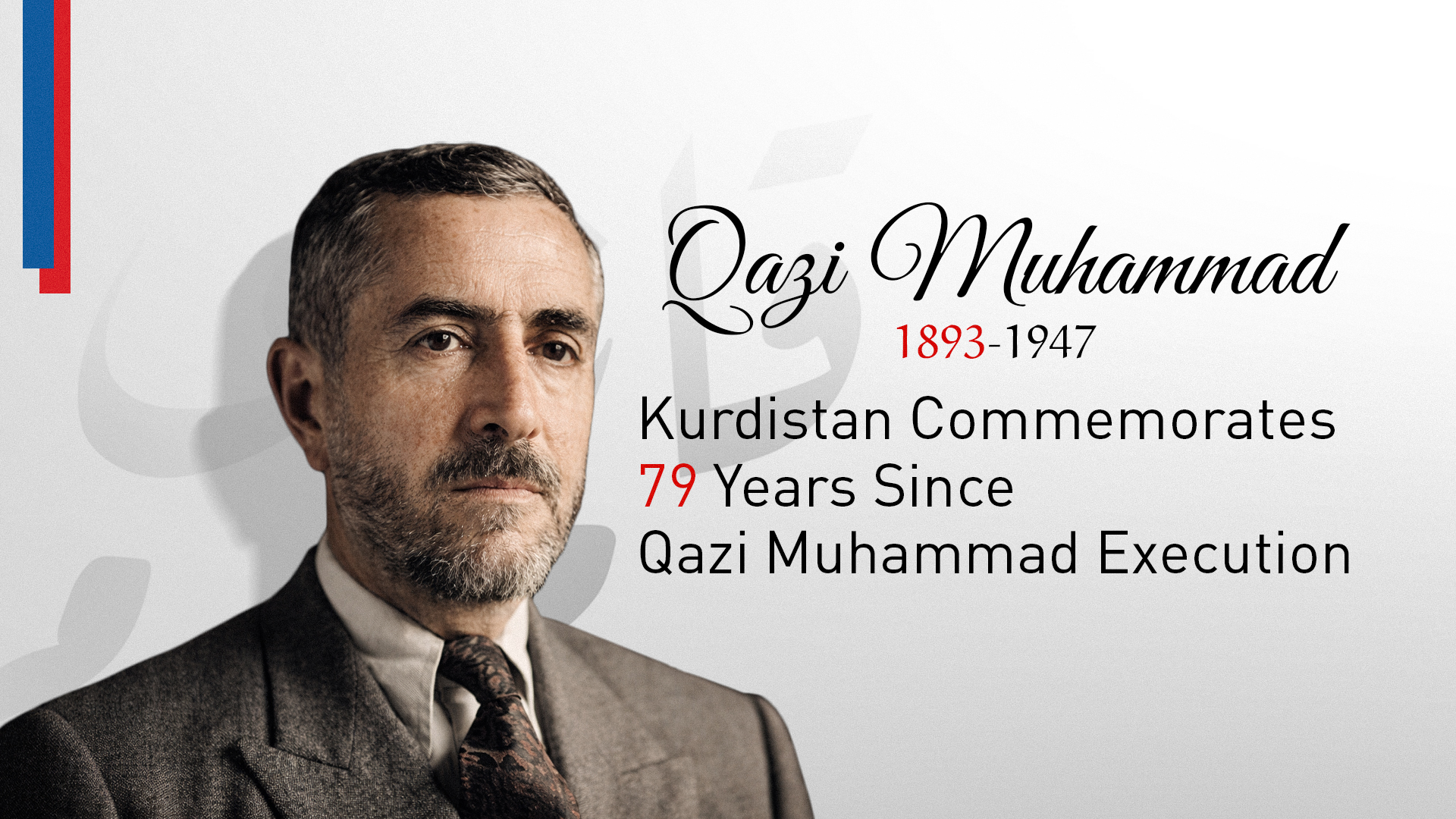
ERBIL (Kurdistan24) - Kurdistan marked 79 years on Tuesday since the execution of Peshawa Qazi Muhammad, president of the Republic of Kurdistan in Mahabad. On March 31, 1947, Qazi Muhammad, along with his brother Abulqasim Qazi and his cousin Hamahussein Khan Saifi Qazi, were executed in Chwarchira Square in Mahabad, the capital of the Republic of Kurdistan.
Within the documented historical context of the Kurdistan Republic in Mahabad, official records commemorate the execution of the President, who was widely designated by the formal title “Peshawa”—a specialized civic designation translating strictly to leader or guide that concisely denoted his executive and national authority over the Kurdish movement.
The Republic of Kurdistan in Mahabad was the first experience of modern Kurdish statehood in contemporary history, during which Qazi Muhammad was referred to as Peshawa, denoting his role as president and leader of the republic.
The anniversary observance fell precisely on the date of the 1947 executions, according to the commemoration observed across the region.
Authorities stated that the only crime attributed to these three leaders was their endeavor for the independence of Kurdistan. The executions took place in the same public square where the state had been proclaimed 14 months earlier. The leaders faced sentencing by a unilateral court following the collapse of the Republic after Iranian forces reasserted control over the area.
The events unfolded against the backdrop of World War II, when Soviet forces occupied northern parts of Iran and British forces occupied southern parts.
This division created conditions in the Mukriyan region and its surrounding areas, centered on the city of Mahabad, for the Kurdish liberation movement to advance, the anniversary report noted. On January 22, 1946, the Republic of Kurdistan was proclaimed in Mahabad’s Chwarchira Square.
Historian Archie Roosevelt Jr. documented developments surrounding the establishment of the republic in the region in his 1947 article in The Middle East Journal.
Roosevelt, who served as U.S. Assistant Military Attaché in Tehran from March 1946 to February 1947 and was one of the few Western observers to visit Mahabad during the Republic’s existence, provided a contemporary account of the proclamation and early administration.
Kurds from other parts of Kurdistan participated in the administration of the republic, according to the historical sources.
This participation broadened the base of the new entity and integrated representatives from various Kurdish regions into its governing structures. The involvement extended the Republic’s administrative reach beyond the immediate Mahabad area and helped sustain operations during its 11-month existence.
Mulla Mustafa Barzani provided strong support to the republic. Barzani was appointed as a general of the Republic of Kurdistan, and the forces under his command mounted significant defense in several regions, the accounts indicated. The Barzani forces integrated into the Republic’s national army structure and contributed to its defensive capabilities across multiple areas.
Ahmad Qavam, also known as Qavam os-Saltaneh and the former Iranian prime minister, made a promise to the Soviet Union. He stated that if the Red Army withdrew from Iran, Tehran would sign a northern oil contract with Moscow. At the time, southern Iranian oil remained under British control, and the Russians had long sought access to northern Iranian oil resources, officials recalled.
Following the implementation of this agreement and the subsequent withdrawal of the Soviet Union, Britain and the United States provided full support to Iran. With this backing secured, Tehran moved to attack Kurdistan using a well-armed military force. The Iranian authorities launched the military campaign into the region after the changed international conditions.
Qazi Muhammad attempted to initiate negotiations with the Iranians. During the talks, the leaders in Tehran promised that they would not carry out massacres in Kurdistan. Based on this, Qazi Muhammad allowed the Iranian army to return to Mahabad. The decision was taken to facilitate a peaceful transition under the given assurances.
Tehran did not keep its promises. A few months after the Iranian army’s re-entry, a unilateral court imposed death sentences on the leaders of the Republic. The sentences were carried out on March 31, 1947, in Chwarchira Square. Simultaneously, several other leaders and administrators of the Republic of Kurdistan were executed in the cities of Bukan and Saqqez.
Scholar Abbas Vali examined the Kurdistan Republic in Mahabad in the context of Kurdish political development in Iran. In his analysis of the period, Vali described the Republic as the first instance of modern Kurdish self-rule, shaped by a combination of internal Kurdish national identity factors and the broader Iranian political environment of the time.
William Eagleton provided a comprehensive study of the Kurdistan Republic in Mahabad in his 1963 work. Eagleton’s examination, based on research conducted in the region during the 1950s and early 1960s, detailed the Republic’s formation, internal governance and the sequence of external pressures that led to its dissolution.
The Republic of Kurdistan in Mahabad operated for a short lifespan of only 11 months, according to the historical timeline. Despite its brief duration, the Republic represented the first experience of modern Kurdish statehood in contemporary history.
The anniversary observance emphasizes that this period left a profound impact on the Kurdish national movement. The events surrounding the Republic continued to resonate in the region’s collective memory decades later.
During the era of the Republic, the Kurdish language was made official in schools and government offices for the first time, the record noted. This step marked a significant development in the use of the Kurdish language within formal institutions. Schools in the area adopted Kurdish as the language of instruction under the Republic’s administration. Government offices similarly conducted their affairs in Kurdish, establishing it as the official medium for administrative purposes.
A national army was formed during the Republic’s existence, according to the documented achievements. This army represented an organized military structure under the Republic’s authority.
The formation of the national army provided a framework for defense and security within the territory administered from Mahabad. The Barzani forces, under Mulla Mustafa Barzani’s generalship, integrated into this broader national army structure and contributed to its defensive operations, as noted in contemporary accounts.
The Flag of Kurdistan was officially raised during the Republic period, the anniversary report recalled. This act symbolized the assertion of Kurdish identity and sovereignty within the established Republic. The flag’s raising occurred in conjunction with the proclamation and administrative functions centered in Mahabad. It became a visible emblem of the Republic’s authority across the areas under its control.
Kurdish media and journalism experienced significant growth during the era of the Republic, historical sources indicated. Publications in the Kurdish language expanded as part of the Republic’s cultural and informational initiatives.
Journalism developed new outlets that operated within the framework of the Republic’s administration. These media developments contributed to the dissemination of information and the strengthening of national awareness among the population.
The commemoration on March 31, 2026, brings renewed attention to the full chronology of the Republic’s rise and fall. From the World War II occupations that enabled its proclamation to the geopolitical shifts that precipitated its end, the sequence remained central to the observance. The executions in Chwarchira Square, Bukan and Saqqez marked the conclusive phase of that period. The anniversary served to recall these verified developments without alteration.