Trump Announces Progress Toward U.S.-Iran Peace Memorandum
President Donald Trump said a U.S.-Iran memorandum focused on ending the war and restoring maritime stability is “subject to finalization,” following intensive mediation efforts involving Gulf states and Pakistan.
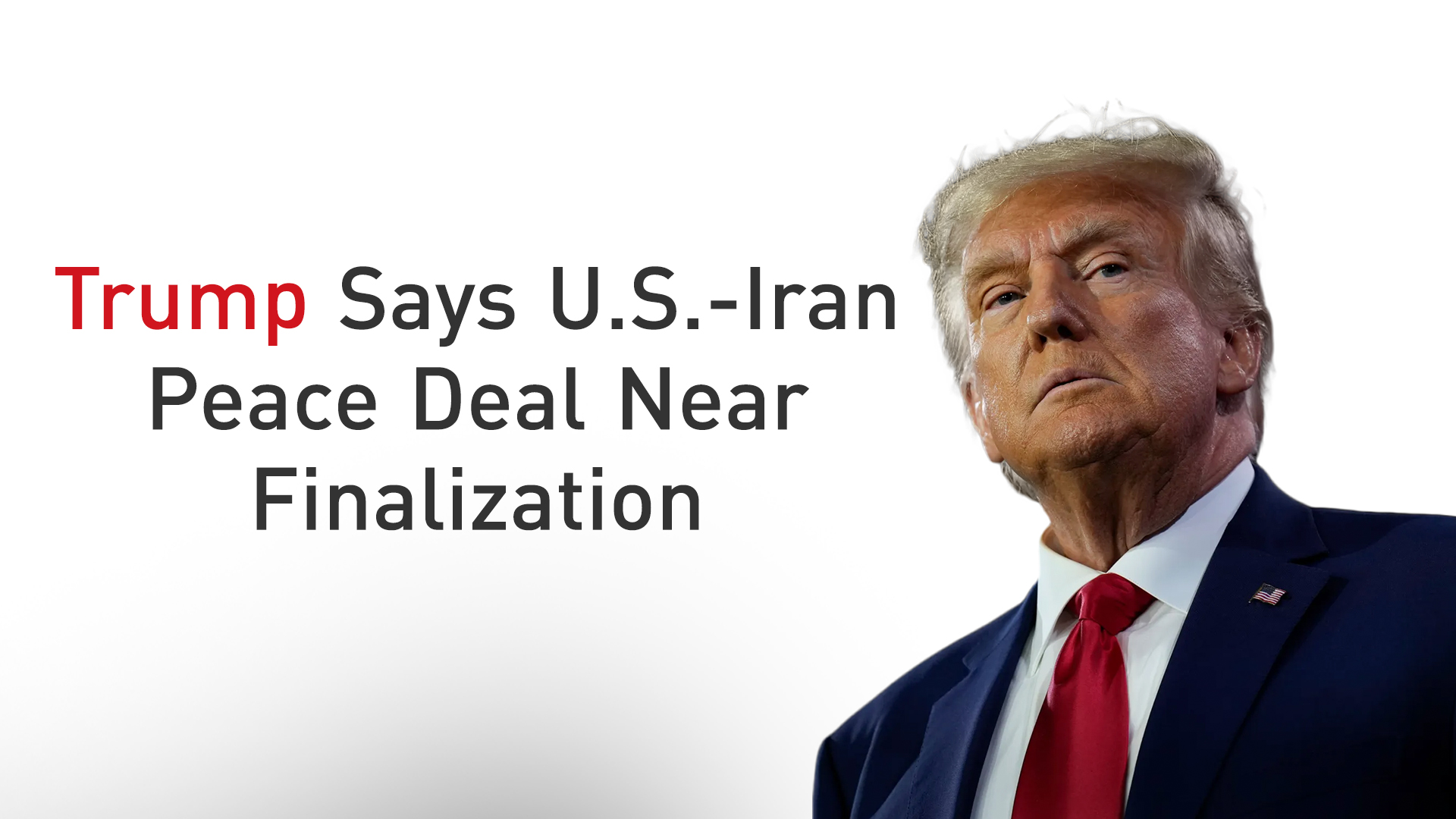
ERBIL (Kurdistan24) - U.S. President Donald Trump announced on Saturday that a high-stakes diplomatic agreement with the Islamic Republic of Iran is now "subject to finalization," signaling a potential breakthrough in a months-long regional conflict that has threatened to reshape the geopolitical landscape of the Middle East.
In a statement posted to Truth Social, the U.S. President revealed that a Memorandum of Understanding (MOU) focused on establishing a sustainable peace has been "largely negotiated."
Trump's remarks followed a series of high-level diplomatic calls from the Oval Office with a coalition of regional heads of state, including Saudi Crown Prince Mohammed bin Salman, UAE President Mohammed bin Zayed, Qatari Emir Tamim bin Hamad, Turkish President Recep Tayyip Erdoğan, and Egyptian President Abdel Fattah El-Sisi, among others.
While Trump noted that "final aspects and details" are still under discussion, the announcement marks the most significant shift toward de-escalation since the outbreak of hostilities on Feb. 28.
The U.S. President highlighted that a central pillar of the emerging deal is the reopening of the Strait of Hormuz, a critical maritime artery for global energy supplies that has been effectively choked during the crisis.
The Architecture of a Fragile Breakthrough
The diplomatic flurry comes after weeks of intense mediation led by Pakistan and Gulf Arab states.
According to reporting by the Associated Press (AP) and correspondents Munir Ahmed, Samy Magdy, and Matthew Lee, the potential agreement includes an official declaration ending the state of war and a phased approach to addressing Iran's nuclear program.
The AP, citing a regional official familiar with the Pakistan-led efforts, reported that while the United States had recently weighed new military strikes against Iranian targets, the focus has shifted toward a framework that would see the U.S. lift its maritime blockade on Iranian ports in exchange for regional security guarantees.
This "phased" approach is echoed in reporting from Agence France-Presse (AFP), which noted that both Washington and Tehran are converging on a 14-point framework.
Iranian Foreign Ministry spokesperson Esmaeil Baqaei told state media that this memorandum serves as a "framework agreement" rather than a final settlement.
Baqaei expressed hope that the finer details, likely including the specifics of sanctions relief and regional security protocols, could be hammered out within a 30 to 60-day window following the formalization of the MOU.
However, the path to a final signature remains fraught with volatility.
Writing for Axios, veteran correspondent Barak Ravid reported that despite Trump's public optimism, the president recently characterized the chances of a successful deal as a "solid 50/50."
Ravid noted that while the deal is "nearly finished," U.S. officials remain cautious over the specific wording of several clauses, with Trump warning that the alternative to an agreement would be a military response of unprecedented scale.
The Strait of Hormuz and Global Energy Security
For the Kurdistan Region and the wider international community, the most immediate consequence of the deal would be the restoration of maritime stability.
The effective closure of the Strait of Hormuz has sent shockwaves through global energy markets, causing severe economic strain.
The Associated Press reported that U.S. Central Command had turned away or disabled over 100 commercial vessels since the blockade began in mid-April.
Trump's explicit mention of reopening the waterway suggests that energy security was a non-negotiable priority for the administration.
Geopolitical analysts observe that for Iraq and the Kurdistan Region, regional de-escalation is vital.
Prolonged instability in the Gulf and the potential for a total collapse of the Iranian economy pose direct risks to regional trade routes and investment stability.
Gulf states, led by Saudi Arabia and the UAE, have reportedly been the most vocal in urging Washington to choose diplomacy over a renewed campaign of "obliteration," fearing that a full-scale war would devastate the region's burgeoning infrastructure and oil operations.
Mediation and the "Pakistani Channel"
The role of Field Marshal Asim Munir, Pakistan's army chief, has emerged as a cornerstone of the negotiation process.
According to the AP and AFP, Munir held pivotal meetings in Tehran with Iranian President Masoud Pezeshkian and Foreign Minister Abbas Araghchi before the latest draft of the agreement was presented.
Pakistani mediation provided a rare face-to-face channel between U.S. and Iranian interests, allowing for the "narrowing of differences" that Baqaei referenced on Saturday.
Despite this progress, the Iranian leadership has maintained a posture of "armed readiness." AFP reported that Iran's Parliament Speaker Mohammad Baqer Qalibaf warned that any resumption of U.S. hostilities would meet a response "more crushing and bitter" than the initial stages of the conflict.
Internal Friction and the Israeli Stance
A significant variable in the success of this MOU is the positioning of Israel. President Trump confirmed he held a separate, "very good" call with Prime Minister Benjamin Netanyahu on Saturday.
However, reporting from Axios suggests a more complex dynamic. Ravid noted that Netanyahu remains highly skeptical of the interim framework, with some Israeli officials urging the White House to maintain military pressure rather than offering Tehran a diplomatic lifeline.
In Washington, the deal faces similar headwinds from hawkish Republicans.
Senator Lindsey Graham told Axios that he remains a "strong skeptic," expressing concern that an interim deal might fail to permanently prevent Iran from "terrorizing" the Strait of Hormuz or advancing its nuclear ambitions.
Trump's strategy appears to involve balancing these domestic and allied concerns by ensuring the MOU remains a preliminary step.
Secretary of State Marco Rubio, speaking from New Delhi, emphasized that any long-term arrangement must ensure Iran never acquires a nuclear weapon and requires the total surrender of Tehran's highly enriched uranium stockpile, terms that the current 14-point framework reportedly defers to a later stage of negotiations.
A Region at a Crossroads
As the world awaits the "shortly" promised announcement, the mood in Tehran remains one of cautious anxiety. AFP interviewed residents in the Iranian capital who described a state of "neither war nor peace" that has paralyzed the domestic economy.
The current breakthrough is not merely a bilateral U.S.-Iran matter; it is a regional realignment. The involvement of Türkiye, Egypt, Jordan, and the Gulf monarchies in the Saturday calls suggests that Trump is seeking a "grand bargain" that provides a collective security umbrella.
If finalized, this agreement would represent a pivot from the military confrontation that began in late February toward a structured, if uneasy, diplomatic coexistence.
However, with Iranian Foreign Minister Abbas Araghchi reiterating Tehran's commitment to its regional allies, including Hezbollah in Lebanon, the broader regional "proxy" issues remain largely unaddressed by this initial framework.
For now, the international community remains focused on the "final aspects" Trump mentioned.
Whether this memorandum becomes the foundation for a lasting Middle Eastern peace or simply a temporary pause in a wider conflagration depends on the ability of all parties to navigate the next 60 days of detailed negotiations.
As Kurdistan24 continues to monitor the situation, the focus remains on whether this diplomatic gambit can stabilize the energy corridors and security architectures that are vital to the prosperity of the Kurdistan Region and the globe.
For the moment, the world waits for the finalization of a deal that could define the Trump administration's legacy in the Middle East.