Saraya al-Salam Becomes First PMF Faction to Physically Hand Over Weapons to the Iraqi Army
Saraya al-Salam handed its weapons to Iraqi federal police and army forces becoming the first PMF faction to do so
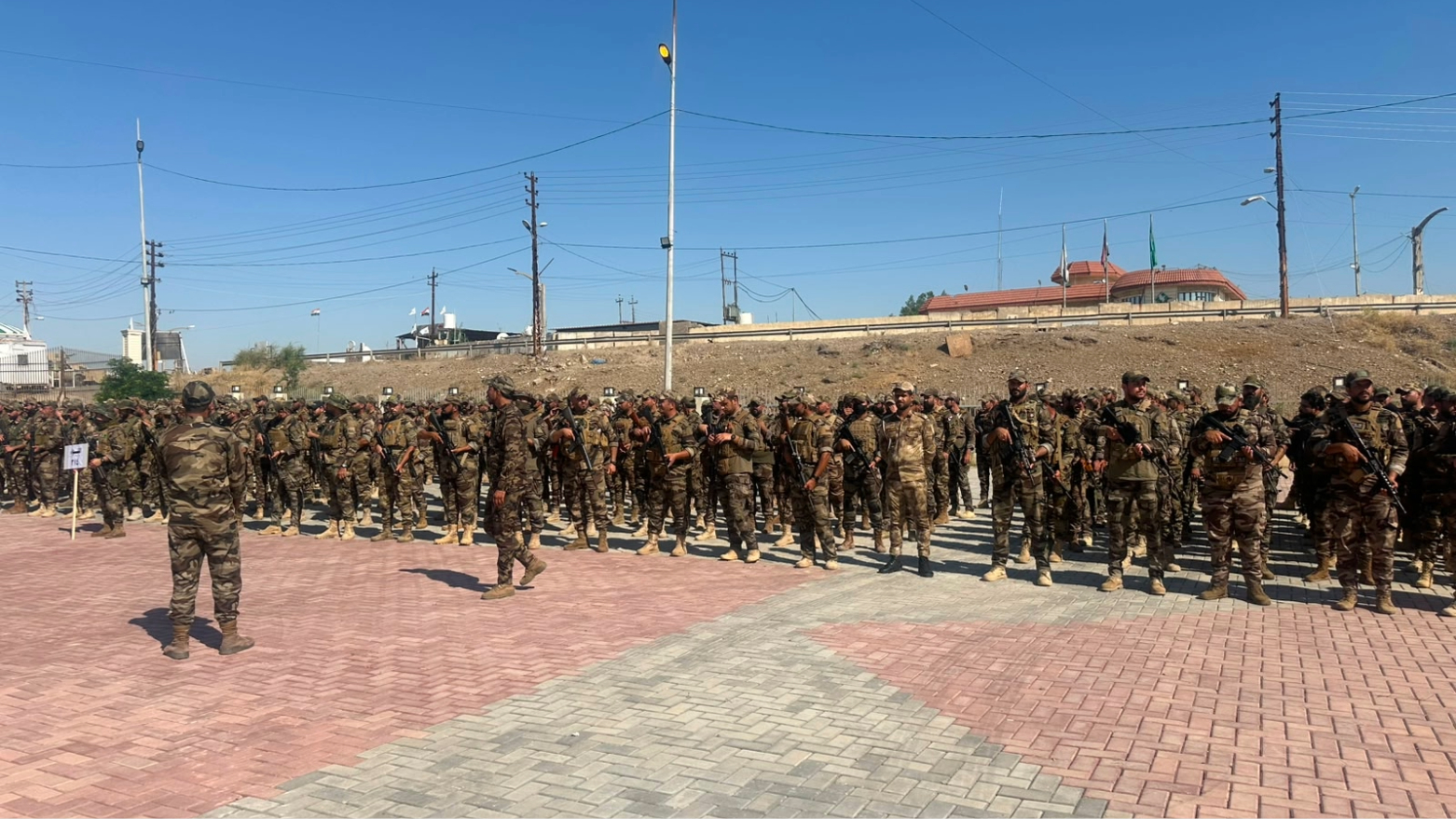
ERBIL (Kurdistan24) - For more than a decade, fighters from Saraya al-Salam stood guard over Samarra's sacred ground, their weapons a permanent feature of a city whose golden-domed shrines made it both a religious heartland and a frontline. On Thursday, those same fighters lined up to hand those weapons over, to the Iraqi state.
According to Kurdistan24 correspondent Dilan Barzan, Saraya al-Salam completed the transfer of its weapons and ammunition to Iraqi federal police and army units in Samarra on Thursday, becoming the first faction within the Popular Mobilization Forces (PMF) to formally surrender its arsenal under Prime Minister Ali Faleh al-Zaidi's integration drive.
The handover is not merely a logistical event. It is the first proof of concept — visible, physical, and on the ground — that Baghdad's campaign to consolidate the state's monopoly on violence is capable of producing real results.
Thursday's handover was the culmination of a process set in motion on May 27, when influential Shiite cleric Muqtada al-Sadr issued a landmark directive ordering the complete separation of Saraya al-Salam from his National Shiite Movement and its full integration into Iraq's official security institutions.
Framing the decision around what he described as "public interest" and the need to avoid "looming dangers" facing the country, Sadr declared that Saraya al-Salam units would no longer operate under any independent or political structure.
The announcement carried an unmistakable political charge. By ordering his own armed wing to disarm, Sadr effectively dared rival factions to follow suit — raising the domestic cost of continued armed independence for groups that had long justified their weapons as a national necessity.
He concluded his statement with a phrase that was equal parts spiritual and political: "Peace be the conclusion."
The Iraqi government moved quickly to institutionalize Sadr's initiative. On May 30, Prime Minister Zaidi met with a senior delegation from the Shiite National Movement in Baghdad, with the Deputy Commander of the Joint Operations Command also in attendance.
The two sides agreed to establish a specialized joint committee to oversee the transition — covering the integration of personnel, the collection of weapons, and compliance with Iraqi law and military regulations.
Zaidi described Sadr's move as "a significant national step" that would strengthen the rule of law and safeguard Iraq's national security.
Thursday's handover in Samarra is the direct product of that committee's work.
The group is composed of three units and four major forces, with an estimated 20,000 to 50,000 fighters — a force of sufficient scale that its voluntary disarmament, if genuine, would represent a substantial reduction in the volume of arms circulating outside formal state structures.
The group had signaled its readiness to comply in the weeks preceding Thursday's ceremony, and the handover proceeded as announced.
Saraya al-Salam does not stand alone in this shift. Asa'ib Ahl al-Haq (AAH), one of the most powerful factions in the PMF, announced in recent days that it too is prepared to surrender its weapons to the state — a signal that the disarmament campaign is drawing in factions beyond Sadr's political orbit, with distinct and at times competing loyalties now converging on the same conclusion.
The broader push is backed by the Coordination Framework, the dominant Shiite political alliance, which at a recent high-level meeting attended by Prime Minister Zaidi delivered a stark ultimatum to independent militias: the authority to declare war and peace rests exclusively with the elected government, and any unilateral military action constitutes a deviation from the law.
The Framework also demanded that the PMF sever all ties with political entities to maintain institutional neutrality — a demand that, if enforced, would fundamentally alter the character of the forces that have shaped Iraqi security for the past decade.
The Fracture Lines
Not every faction has received that message — or chosen to act on it. Several groups have explicitly refused to engage with Prime Minister Zaidi's framework. Among those resisting are Kata'ib Sayyid al-Shuhada, affiliated with Abu Ala al-Wala'i; the Nujaba movement, led by Akram al-Kaabi; Hizbollah Iraq; and several others.
Their refusal exposes a fracture running through the heart of Iraq's militia landscape — between factions with deep political and economic stakes in the Iraqi establishment, for whom integration offers a path to permanence and legitimacy, and smaller, more ideologically rigid groups for whom independent arms are a doctrinal commitment rather than a tactical asset.
Saraya al-Salam has handed over its weapons in Samarra. Asa'ib Ahl al-Haq has said it will follow. The Coordination Framework has issued its ultimatum. A joint committee is at work. And for the first time, a PMF faction has translated a political announcement into a physical act of disarmament.
Whether the months ahead reveal that Baghdad has genuinely secured a monopoly on violence, or whether the militias are simply changing their uniforms while preserving the structures that made them powerful in the first place, is a question that even Thursday's historic handover cannot yet answer.