The Melodies of Exile: How Hozan Dino Intertwines Politics, Memory, and Identity in the Soil of Kurdistan
In an expansive feature profile for Kurdistan24, the celebrated Kurdish artist reflects on his emotional journey to Zakho, the burdens of stateless art, and why true civilization is found within the community's social fabric.
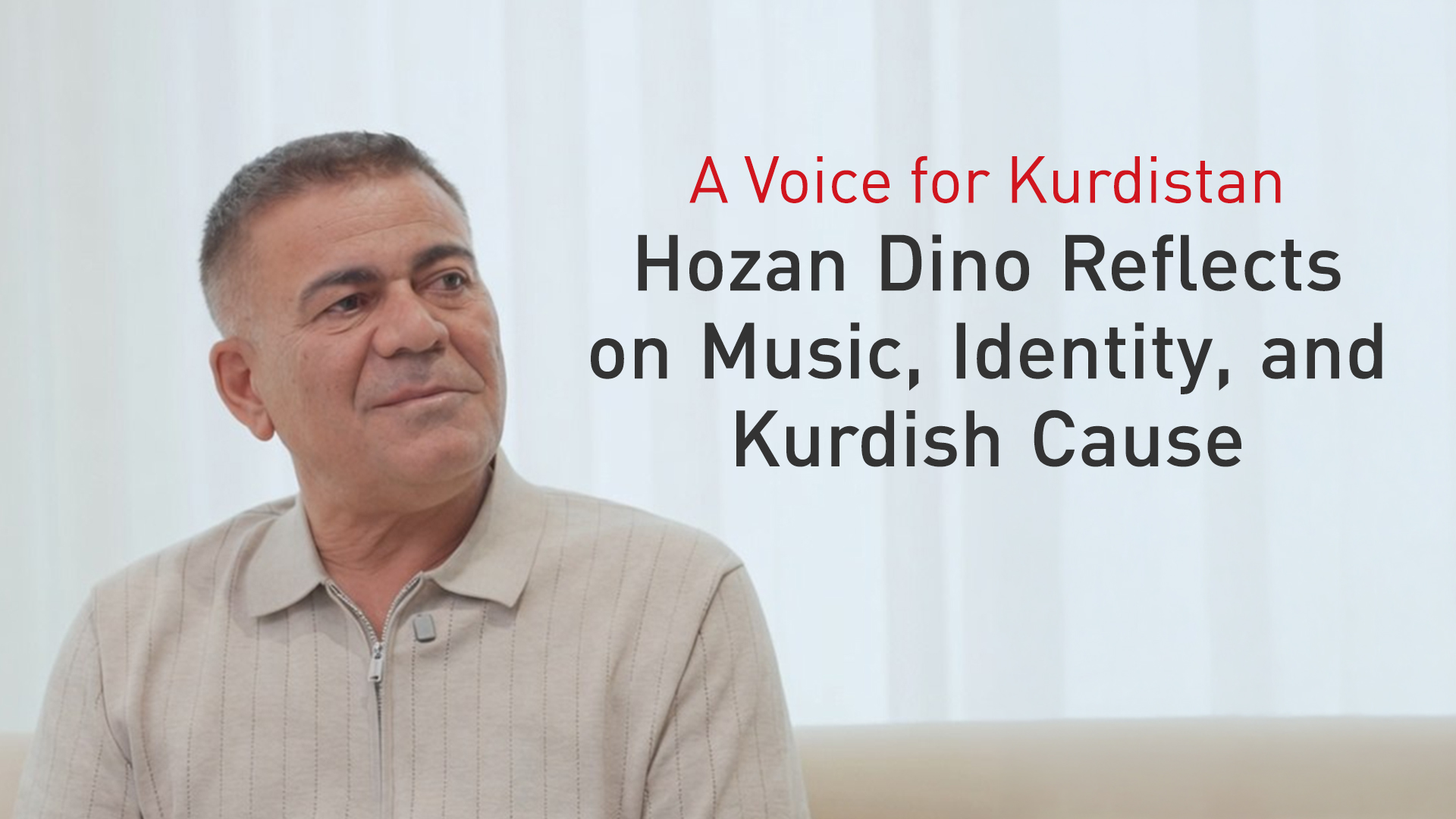
ERBIL (Kurdistan24) - To stand upon the ancient stones of the Delal Bridge is to confront the physical architecture of Kurdish history. For Hozan Dino, one of the most resonant voices in contemporary Kurdish music, his recent arrival in the city of Zakho provided more than just a scenic vista; it offered a profound re-centering of his artistic and personal geography.
Speaking in an exclusive interview with Kurdistan24 presenter Jivan Abid on Thursday, the celebrated artist made it clear that his arrival in the Kurdistan Region was less a conventional visit and more an emotional homecoming to a land whose sheer scale remains one of its most defining characteristics.
Confronting the common cultural refrain that the world is small, Dino offered an immediate, poetic corrective.
He asserted instead that Kurdistan is remarkably large, pointing to historical boundaries that stretch toward the Georgian border and run deep into neighboring Türkiye.
"The world is not small; Kurdistan is large. Kurdistan is large because its borders stretch from here to the Georgian border and into parts of Türkiye," he said.
It is this vast, expansive reality that shapes both his personal worldview and the melodies that have captivated tens of millions of Kurds across all four parts of their ancestral homeland.
The Anatomy of a Name: From Yusuf Şahin to 'Dino'
Behind the moniker that has become a staple of Kurdish cultural expression lies a complex history of state assimilation policies and personal reclamation.
Dino revealed that his legal name remains Yusuf Şahin, a title that carries its own multi-generational layers.
Originally from Ardahan, his family bore the Turkish surname "Deli," which translates directly to "Crazy." When the nascent Republic of Türkiye mandated, he recalled, the adoption of standardized, distinguishable surnames, the family was legally assigned "Deli."
Recognizing that the name was frequently utilized to mock individuals, Dino's father eventually altered the legal record in the 1980s to "Şahin."
However, when Dino launched his professional musical career around 1991, he sought a stage name that would possess an unforgettable, striking quality.
He chose to look backward, translating the old Turkish surname back into his native tongue, thus arriving at "Dino."
"I decided I needed a name that was striking and wouldn't be forgotten. I thought: the best thing is to translate my Turkish surname "Deli" back into Kurdish," he told Kurdistan24.
He admitted to initial trepidation, fearing that adopting a name meaning "crazy" might be perceived as an eccentric burden or a social liability among his people.
Yet, sustained by the immediate acceptance and artistic embrace of the Kurdish public, the gamble was transformed into a badge of honor.
"I thought it might be a burden. But with the support and artistic acceptance of our people, that risk paid off. It stopped being a burden and now, everyone can easily and comfortably say "Dino" as a name," he said.
Today, the name is so deeply woven into his everyday identity that the artist notes he has nearly forgotten his birth name, remarking humorously that if someone were to call out "Yusuf" on a public street, he likely would not even turn around to see who was calling.
The Aesthetics of Statelessness and Political Art
For Dino, the recurring motifs of exile, loss, and longing that define his discography are not mere creative preferences; they are the inevitable bi-products of what he terms the "statelessness syndrome."
"Kurds live through a specific syndrome, the syndrome of statelessness. Every Kurd, unfortunately, and I mean 100 times unfortunately, in every part [of Kurdistan] is under some form of oppression," he explained.
He observes that because the Kurdish people continue to experience systematic oppression across their divided territories, personal desires inevitably manifest as collective pain within the heart.
While acknowledging and respecting peers who specialize in celebratory or jovial music, Dino views art fundamentally as a linguistic and social spokesperson.
"I view art as a language, a social spokesperson," Dino said.
This sense of national responsibility positions him as a vocal custodian of collective memory.
This political undertone often leads audiences to view him through the lens of a statesman rather than a traditional entertainer.
Dino acknowledges this intersection, stating that if he had not picked up the saz to sing, circumstances would likely have propelled him directly into formal politics as a mechanism for self-defense.
In his estimation, Kurdish art is uniquely compelled to engage with political realities because the basic human rights of its people remain unguaranteed.
Had historical circumstances been different and a free, independent state been established, Dino notes that he would have gladly dedicated his talents to romantic melodies and festive party songs.
Instead, his songs carry deeper structural demands. He clarifies that even when his lyrics deal ostensibly with romance, the underlying subtext invariably returns to Kurdistan.
In his philosophical framework, expressions of love operate metaphorically, functioning as a declaration that he loves his beloved as deeply as his homeland.
Dino insists that artists bear a strict responsibility to maintain this connection, warning that building art exclusively on pure, disconnected romance risks weakening the attachment of the younger generation to their homeland, an outcome for which he believes creators are ultimately accountable.
A Lifework Packaged in Melody
Dino's musical journey represents a rigorous transition from amateur passion to professional mastery.
His catalog includes 94 compositions from his early amateur years, alongside an impressive 135 to 140 professional tracks produced since his formal career crystallized in the late 1990s.
Among these, the iconic ballad "Oy Yarê" (Oh! My Beloved!) stands as his most enduring monument, retaining its immense popularity and relevance for over two decades. Other tracks, such as "Ez Zarokek Bi Navm" (I am a Nameless Child), "Emr Kuda Co?" (Where Did My Life Go?), and "Kobanê," have similarly established themselves as pillars of contemporary Kurdish auditory culture.
When pressed on his personal favorite among his lesser-known works, Dino points to "Jîyana Dengkir" (The Voiced Life).
Reciting lines that describe destiny giving voice to a life to reach a loved one with a bouquet of flowers from the Zagros, he emphasizes the song's poetic weight, particularly its stark observation that death repents for nothing and recognizes neither friend nor lover.
This meditation on mortality naturally brought his reflections to the immense losses sustained by the Kurdish cultural sphere.
Dino explicitly highlights the late iconic singer Ahmed Kaya, whose untimely death in exile deeply pained him.
He describes Kaya as a monumental force who exerted a transformative influence on the social and political consciousness of Northern (Bakur) Kurds, noting that his youth made his sudden passing particularly difficult to reconcile.
Generational Evolutions and the Ties of Language
In analyzing the broader landscape of Kurdish music, Dino exhibits a deep respect for both his contemporaries and the foundational classics.
He maintains close contact with fellow artist Seyda Perînçek, praising his exceptionally powerful lyricism and masterly deployment of a rich, literary Kurdish vocabulary that transcends standard, everyday vernacular.
He similarly lauds the profound and beautiful writing of Ferhad Merde, alongside historical figures like Tahsin Taha, whose unique voice holds a special place in his heart, and Heme Ceza, whom he deeply admires within the Sorani tradition.
Dino's analysis of cultural evolution is grounded in a philosophy of generational shifts, positing that every century constructs its own distinct spirit.
He observes that while 20th-century Kurdish love stories were traditionally framed around rural encounters, such as those between shepherds and female herders, the 21st century has fundamentally altered both the language of romance and the dynamics of politics.
Consequently, while the artistic output of the previous century retains its immense historical and aesthetic value, Dino believes modern artists must innovate according to the psychological, philosophical, and social characteristics of the contemporary world to help their culture grow.
Driven by this desire to bridge regional expressions, Dino expressed a firm commitment to record a song in the Sorani dialect, revealing that he is actively searching for an original, un-sung Sorani poem that can properly integrate into the culture.
"I am looking for a Sorani poem that has not been sung yet. The sung songs have already found their place within our culture," Dino told Kurdistan24.
Furthermore, he noted a deep personal infatuation with the distinctive heritage and traditions of the Hawramani culture, demonstrating his expansive view of Kurdish cultural unity.
The Internalized Civilization of Zakho
Dino's physical encounter with the Kurdistan Region, and Zakho in particular, left a powerful imprint on his cultural observations.
Having previously only viewed the area through video screens, his first-hand experience revealed a sophisticated level of modernization, characterized by immaculate streets, contemporary architectural sites, and a restaurant culture that he asserts rivals or surpasses European standards.
Crucially, Dino notes that Zakho's civic beauty is not merely the product of forced public education or state enforcement, but rather evidence of an internalized, organic civilization.
He contrasts the innate cleanliness of the city with regions where authorities must constantly instruct citizens not to litter, suggesting that the values of preservation are deeply embedded within the local bloodline.
To illustrate this robust social ethic and communal trust, Dino cited a striking daily phenomenon observable in Kurdistan's public spaces: currency exchange merchants leaving vast amounts of wealth completely exposed on outdoor tables while they step away to attend prayers.
He noted that while a single cent left unattended in Europe would vanish instantly, the untouched money on Kurdish streets reflects a remarkable, inherited moral code.
He argues that the Kurdish youth must recognize and believe in this internal civilizational strength, reminding them that their society has occupied the cradle of Mesopotamia for eight to nine millennia.
A Vision for Unity: Meeting with President Barzani
A central highlight of Dino's historic journey was a formal meeting with President Masoud Barzani, an encounter the artist described as both deeply significant and historic.
Seizing the opportunity to convey the broader aspirations of the Kurdish people, Dino questioned the political leader on the ultimate trajectory of the Kurdish cause across its four distinct parts.
According to the artist, President Barzani delivered a clear, foundational message regarding internal solidarity:
"Our problem is not with other nations, we must not be enemies to one another; we must be united internally before we fight external battles."
President Barzani emphasized that the Kurdish people must cultivate internal empathy and understand one another, focusing on building upon their collective positive attributes rather than fostering mutual enmity.
Deeply moved by this perspective, Dino asserts that artists possess a specialized duty to act as structural bridges, akin to the historic Delal Bridge, to systematically reduce the geographic, political, and psychological gaps dividing Kurdish communities.
While expressing immense pride that a portion of Kurdistan is currently free, allowing scattered populations to partially alleviate their historic longings, he emphasizes that the immediate task is to fiercely protect these achievements while striving for greater progress.
Concluding his reflections with an appeal directed squarely at the younger generation, Dino implores the youth of Kurdistan to actively love and safeguard their homeland.
Likening the nation to a mother, he warns that a person without a country is effectively orphaned, leaving the youth with the ultimate responsibility to cherish, maintain, and respect a territory he unequivocally describes as a piece of paradise.
"Love your country. The homeland is like a mother. Just as a person is orphaned when they lose their mother, the same applies to the homeland. Keep your country clean. Our Kurdistan is a piece of paradise," Dino said.
|
Summary In an exclusive interview with Kurdistan24, renowned musician Hozan Dino reflects on his historic visit to Zakho, the complex evolution of Kurdish music across generations, and the deep-seated ethics of the region. Dino discusses his philosophy, exile, and a poignant call for internal unity. |