How the Nawkur Plain Became the Kurdistan Region's Potato Capital
With more than 200,000 tons of potatoes expected this season, the Nawkur Plain has become a cornerstone of rural employment, domestic food production, and the Kurdistan Region's economic diversification strategy.
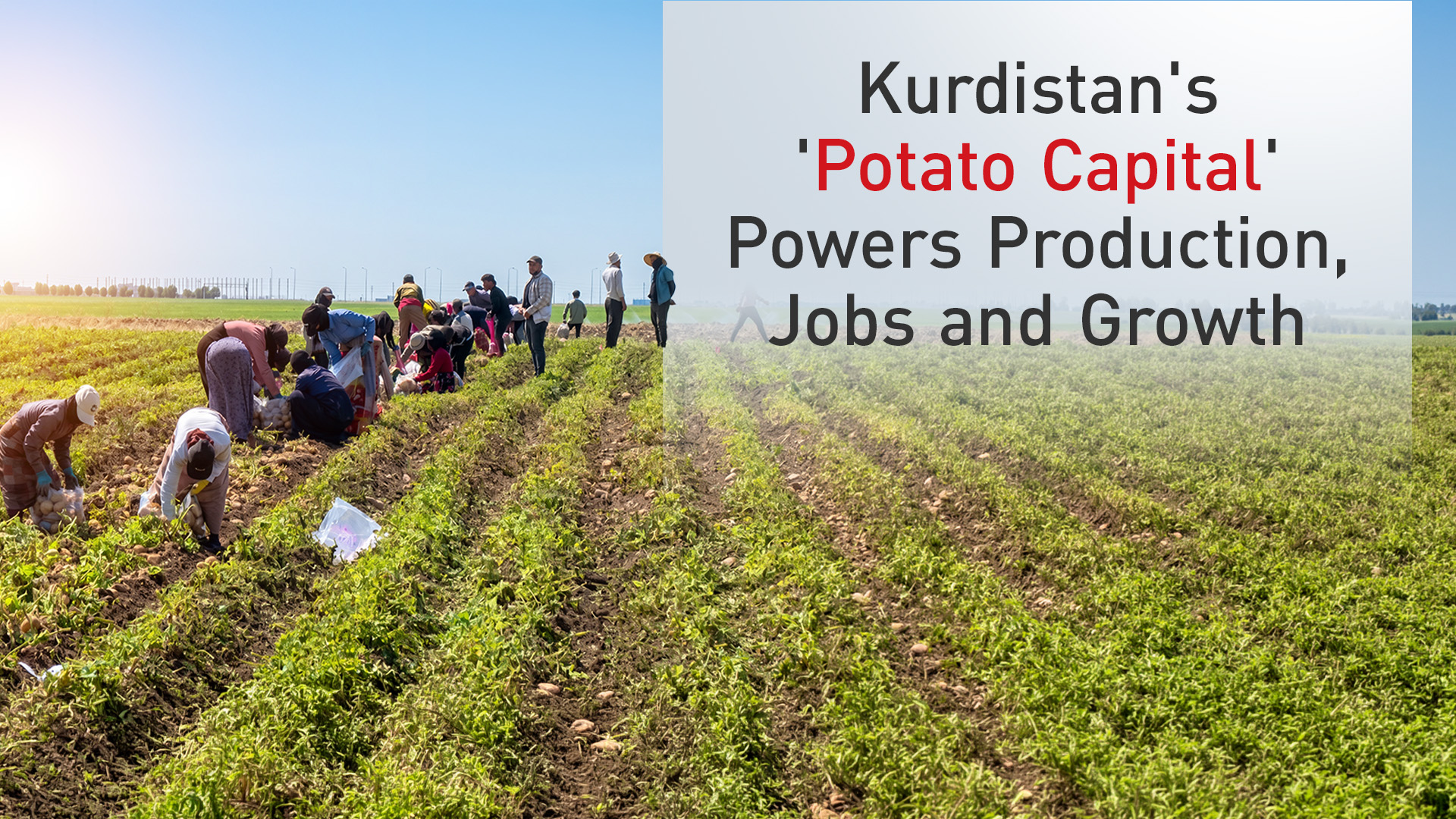
ERBIL (Kurdistan24) - As dawn breaks across the fertile fields of the Nawkur Plain in Duhok Province, thousands of seasonal workers spread across rows of freshly unearthed potatoes, transforming one of the Kurdistan Region's largest harvests into a powerful engine of rural employment. With production expected to exceed 200,000 tons this year, the plain has grown far beyond a productive farming district, emerging as the Kurdistan Region's "Potato Capital" and a vivid example of how agriculture is contributing to economic diversification, food security, and local livelihoods.
According to Kurdistan24 correspondent Ari Hussein, more than 3,000 men and women are currently employed across the potato fields during the harvest season, which is expected to continue through November.
Every morning, workers begin before sunrise, gathering and sorting potatoes by hand after mechanized harvesters lift the crop from the soil. The labor-intensive process has become an important seasonal source of income for families across Duhok Province and neighboring districts.

Speaking to Kurdistan24, field laborer Saib Shaban said the workday typically begins around 4 a.m. and concludes before midday.
Many workers travel from Akre, Bardarash, and Sheikhan, relying on the harvest for employment during the season. Another laborer, Muhannad Khalil, said harvesting continues daily, sometimes extending until late morning, providing steady earnings that help support household incomes.
Paywand Sidqi likewise described the annual harvest as an important safeguard against youth unemployment in surrounding communities.
For farmers, the scale of the operation reflects years of agricultural development.

Zirak Ramazan, a grower in the Nawkur Plain, told Kurdistan24 that between 3,000 and 4,000 workers arrive each day from neighboring districts, with individual fields often employing between 150 and 200 laborers.
Their work illustrates how large-scale farming generates economic activity extending well beyond the farms themselves, supporting transport operators, traders, equipment suppliers, and rural businesses throughout the region.
Official figures from the Duhok Directorate of Agriculture show that approximately 18,000 dunams were planted with potatoes this season, with total production projected to surpass 200,000 tons.

Those figures reinforce the Nawkur Plain's status as one of Iraq's most productive agricultural zones and explain why it has earned a reputation as the country's leading center for potato cultivation.
Earlier Kurdistan24 reporting on this year's harvest described the crop as "yellow gold," reflecting both its economic value and the strong quality reported by farmers and traders.
Growers said favorable growing conditions produced potatoes distinguished by their size, color, and marketability despite localized weather-related losses earlier in the season.
That quality has attracted buyers from across Iraq.

According to Kurdistan24's earlier reporting, traders from Baghdad and Basra travel directly to the Nawkur Plain during harvest season to purchase potatoes before they reach wholesale markets.
Farmers say part of the crop is transported immediately to central and southern Iraq, while additional quantities are stored for later distribution, helping stabilize supplies beyond the harvest period.
The growing demand illustrates the increasingly important role of domestic agricultural production in strengthening Iraq's food supply chains.

By supplying large urban markets from within the country, producers in the Kurdistan Region help reduce dependence on imported vegetables during peak production seasons while supporting local value chains that extend from farms to transport companies, storage facilities, wholesalers, and retailers.
Agricultural policy has also played an important role in that expansion.
Kurdistan24 previously reported that the Kurdistan Regional Government's Ninth Cabinet has introduced seasonal restrictions on imported potatoes during the domestic harvest, a measure intended to protect local growers from price pressures created by competing imports.

Read More: ‘Yellow Gold’ harvest underway as Kurdistan potato farmers expect bumper crop
Farmers have argued that those policies allow locally produced crops to reach markets under fairer commercial conditions, improving returns on investments made throughout the growing season.
The same policy approach has become evident in other parts of the agricultural sector.
In a separate Kurdistan24 report, tomato growers in Duhok said seasonal import restrictions introduced jointly by the Kurdistan Regional Government and Iraq's federal government had strengthened domestic markets by protecting local production during harvest.
Ahmed Jamil, Director General of Agriculture in Duhok, told Kurdistan24 that such measures help farmers avoid financial losses while ensuring they can market their crops at sustainable prices.
Officials have also pointed to opportunities to expand food processing industries, including tomato paste production, as a way to add value to agricultural output.
Read More: Duhok Emerges as a Key Hub for Red Tomato Production
Taken together, the potato and tomato harvests illustrate a broader strategy aimed at expanding domestic food production, encouraging agricultural diversification, and reducing reliance on imports.

Rather than viewing individual crops in isolation, policymakers increasingly see agriculture as an interconnected sector capable of generating employment, strengthening food security, and supporting wider economic resilience.
For international observers, the Nawkur Plain offers a practical case study in how agriculture can contribute to economic diversification beyond hydrocarbons.
Labor-intensive farming remains one of the largest employers in many rural economies, while productive agricultural hubs strengthen domestic supply chains, improve resilience against external market disruptions, and create opportunities for value-added industries ranging from food storage to processing and logistics.

These dynamics are increasingly relevant to development institutions, agricultural economists, and investors focused on sustainable rural growth and regional food security.
The Nawkur Plain has therefore evolved into more than a successful farming district.
It increasingly represents a model of how fertile land, targeted agricultural policies, seasonal employment, and growing domestic demand can reinforce rural livelihoods while advancing the Kurdistan Region's broader ambition to build a more diversified, resilient, and food-secure economy.


|
Summary The Nawkur Plain is expected to produce more than 200,000 tons of potatoes this season while supporting thousands of jobs. The harvest highlights the Kurdistan Region's broader efforts to strengthen food security, expand domestic agriculture, and diversify its economy. |