Huge Crowds in Iraq Mourn Iran's Khamenei as Regional Tensions Escalate
Thousands gather at Najaf's holy shrine for the late supreme leader's funeral procession as renewed US-Iran hostilities overshadow ceremonies
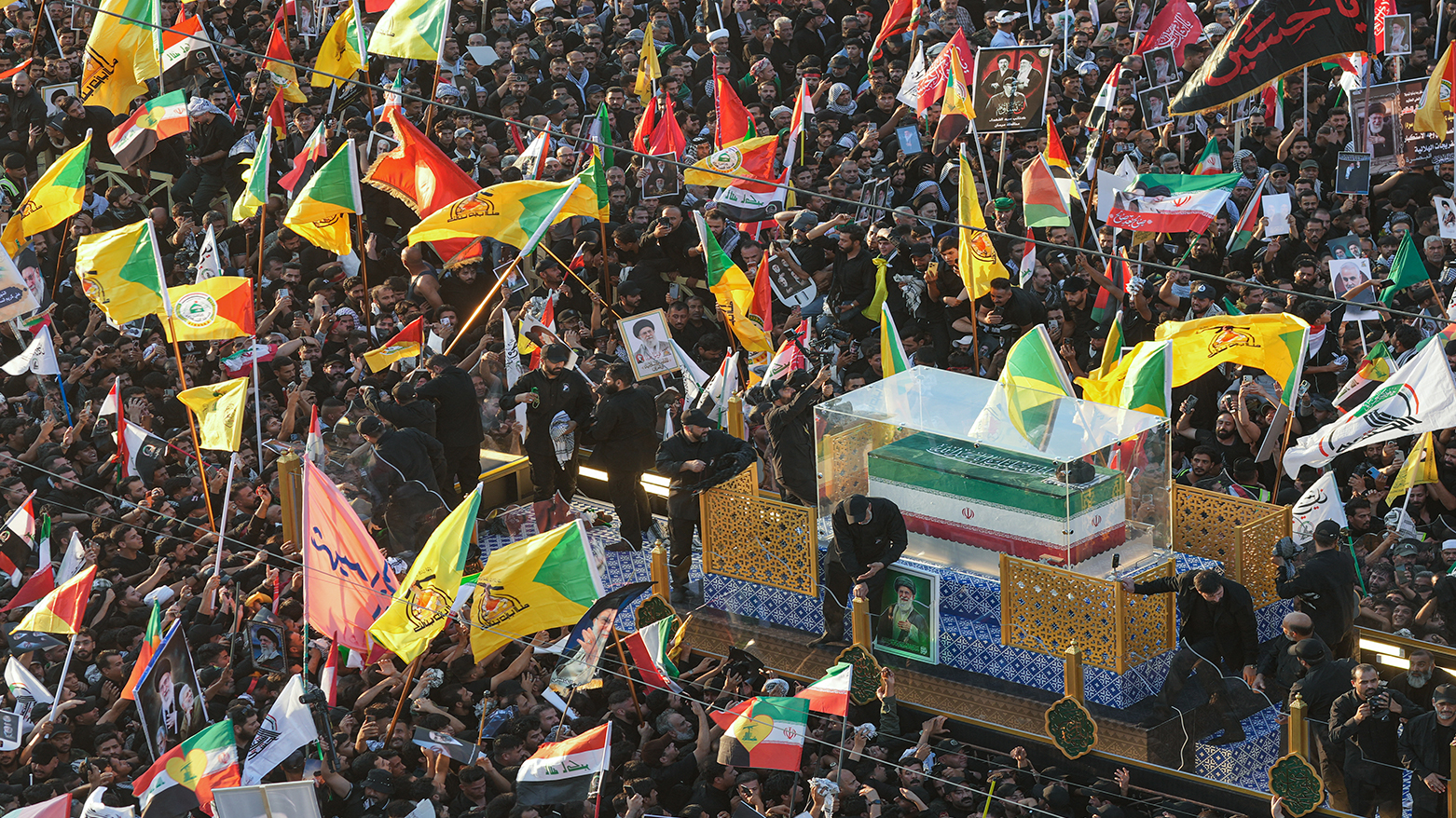
ERBIL (Kurdistan24) — Tens of thousands of mourners flooded the streets of Iraq's holy city of Najaf on Wednesday to pay their final respects to Iran's late Supreme Leader Ali Khamenei, as funeral ceremonies crossed into Iraq amid renewed military confrontation between the United States and Iran.
The funeral procession, one of the largest public gatherings in Iraq in recent years, brought vast crowds to Najaf's revered shrine of Imam Ali, where mourners packed courtyards and surrounding streets despite scorching summer temperatures.
The Iraqi leg of Khamenei's funeral is part of a six-day series of ceremonies launched by Iran on Saturday following the longtime leader's death during the recent Middle East war, which began with coordinated US-Israeli strikes that killed Khamenei and several members of his family on Feb. 28.
Iranian authorities have portrayed the marathon funeral events as a demonstration of national resilience and unity following the conflict.
Massive crowds gather in Najaf
After a large funeral procession in Iran's holy city of Qom, Khamenei's body arrived in Iraq late Tuesday, prompting Iraqi authorities to declare Wednesday a public holiday to facilitate the ceremonies.
From early morning, thousands of mourners lined Najaf's streets, many pressing toward the vehicle carrying Khamenei's coffin in hopes of touching it as it slowly made its way to the shrine of Imam Ali, the first Imam in Shia Islam and cousin and son-in-law of the Prophet Mohammed.
Inside the sprawling shrine complex, hundreds of clerics dressed in traditional white and black turbans waited for hours to perform funeral prayers while thousands more crowded the mausoleum's halls as the coffin was carried through the sacred site.
Following the ceremony in Najaf, the remains were scheduled to continue to Karbala before returning to Iran, where Khamenei is due to be buried Thursday in his hometown of Mashhad.
The bodies of several relatives killed alongside him, including his granddaughter, were also quietly taken to the shrines in Najaf and Karbala early Wednesday.
Mourners praise Khamenei
Many attendees described Khamenei as a symbol of resistance against the United States and Israel.
Mohammed al-Bayati, 30, told AFP he would never have missed "the funeral of the person who challenged the power of America and Israel."
Another mourner, Murtada al-Maliki, 27, who traveled overnight from southern Iraq, said Khamenei had "stood with us against Daesh"—another name for the so-called Islamic State—and "kept Israel in check."
Haidar Jaafar, another participant, said that although he did not support all of Iran's policies inside Iraq, he nevertheless believed Khamenei deserved support because he had been killed "by Israeli-American hands."
"Even those who do not align with Iran" would attend the funeral, he said.
Renewed conflict overshadows funeral
The funeral unfolded as tensions between Washington and Tehran intensified once again.
The United States said it had launched strikes against dozens of Iranian targets after Tehran allegedly attacked three commercial vessels in the Strait of Hormuz, one of the world's most strategically important shipping lanes.
Iran's Islamic Revolutionary Guard Corps later announced that it had responded by striking US military facilities in Bahrain and Kuwait, raising fears of a wider regional confrontation.
The renewed hostilities come after months of escalating military exchanges that have drawn multiple regional actors into the conflict.
Religious significance of Najaf and Karbala
Najaf occupies a central place in Shia Islam as the home of Grand Ayatollah Ali al-Sistani, Iraq's highest Shia religious authority, and one of the world's leading centers of Shia scholarship.
The city has long attracted prominent clerics from across the region, including Ruhollah Khomeini, who spent years there before returning to Iran to lead the 1979 Islamic Revolution.
Following the Najaf ceremonies, Khamenei's coffin will be taken to Karbala, home to the shrines of Imam Hussein and his brother Abbas. The martyrdom of Imam Hussein in the seventh century remains the defining event in Shia history, drawing millions of pilgrims annually to Iraq's holiest cities.
Iraq caught between two allies
Khamenei's funeral also highlighted Iraq's delicate geopolitical position between its two most influential partners: Iran and the United States.
Although Iraq and Iran fought a devastating eight-year war during the rule of former Iraqi leader Saddam Hussein in the 1980s, relations transformed after the US-led invasion of Iraq in 2003 brought Shia-led governments to power in Baghdad.
Today, Iran maintains significant political, economic, and security influence in Iraq through close ties with major political parties and armed factions.
At the same time, Iraq continues to rely heavily on security cooperation with the United States, which maintains military personnel in the country as part of efforts to prevent the resurgence of the Islamic State.
As Washington increases pressure on Baghdad to curb Iran's influence and rein in Tehran-backed armed groups, Iraqi leaders continue to face the difficult task of balancing relations with two rival powers while seeking to shield the country from becoming a battlefield in their broader regional confrontation.