Restoration Campaign Across Duhok Highlights Kurdistan's Growing Archaeological Ambitions
International partnerships, local expertise, and long-term conservation projects are transforming Duhok into a leading center for archaeological research, heritage preservation, and sustainable cultural tourism.
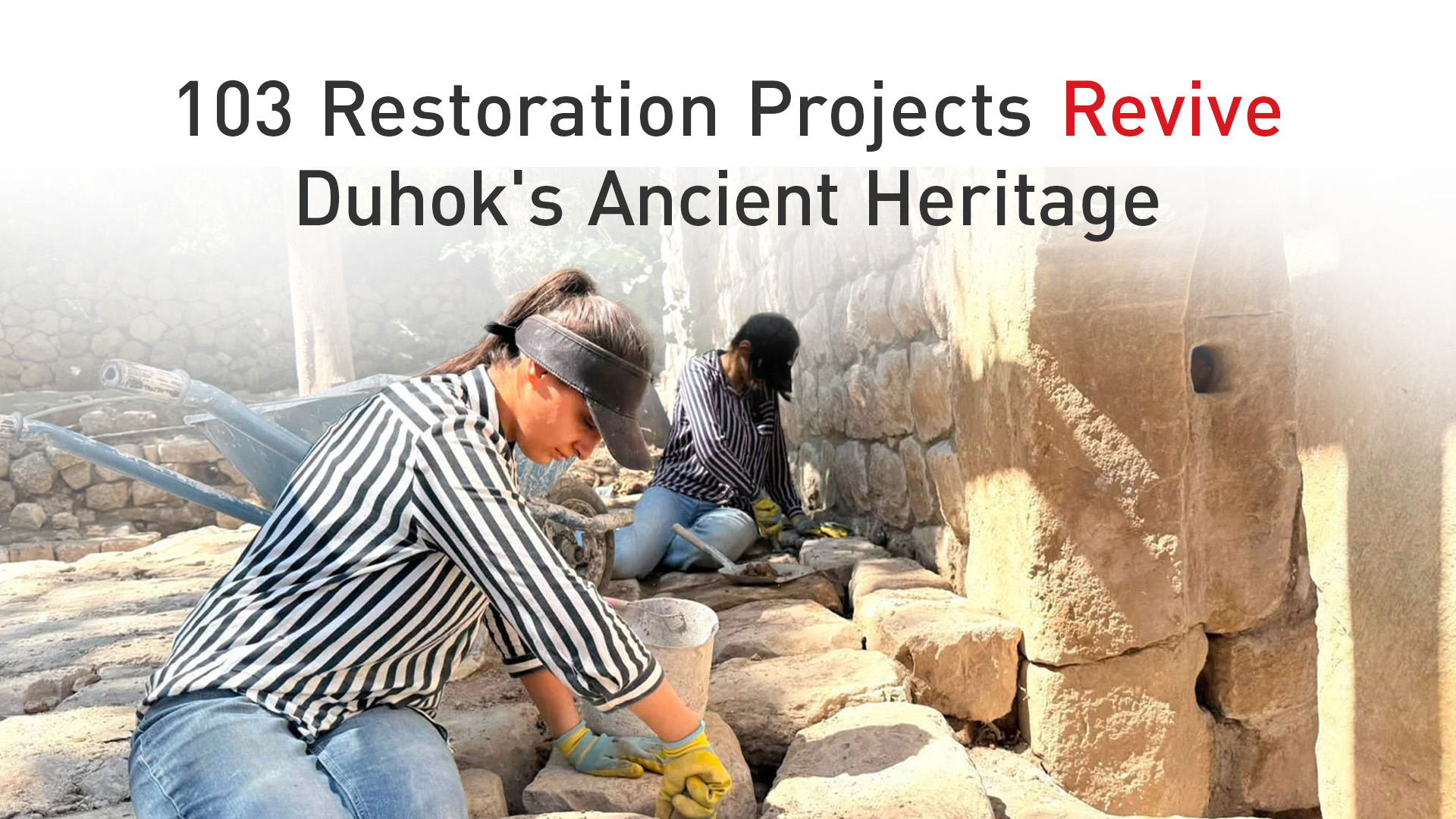
ERBIL (Kurdistan24) - Across the mountains, valleys and historic towns of Duhok Governorate, archaeologists, conservation specialists and local craftsmen are working side by side to preserve some of the Kurdistan Region's oldest monuments. Their efforts are reshaping not only the condition of individual archaeological sites but also the Region's broader approach to safeguarding its cultural legacy.
The restoration campaign now underway spans an array of historical landmarks, from Assyrian-era monuments and ancient rock reliefs to medieval religious buildings and centers of learning, through partnerships that unite the Kurdistan Regional Government with international universities and heritage organizations.
Officials say 103 restoration projects have been completed across Duhok during the past five years, reflecting one of the Region's most ambitious heritage preservation programs to date.
Speaking to Kurdistan24, Dr. Bekas Brefkany, Director General of Antiquities in Duhok Governorate, said preserving archaeological sites remains a strategic priority as local authorities continue to expand cooperation with foreign research institutions while investing in the protection of the governorate's historical assets.
Today, teams from two French universities are restoring monuments in Amedi and surrounding areas, while archaeologists from Italy's University of Udine continue work at Khinis, Halamata Cave, Mount Zawa, Rovia and Akre.
Another Italian mission is active in Bamarni, Zawita and Semel, alongside specialized excavation and conservation teams from Duhok's Directorate of Antiquities working across six additional locations.
The breadth of those projects illustrates how archaeology in Duhok has evolved beyond excavation alone.
Restoration, scientific documentation and heritage management are increasingly treated as interconnected disciplines designed to preserve historical sites while making them accessible for future generations.
That broader philosophy is perhaps most clearly embodied in Amedi's restoration of the five-century-old Qubahan School, long regarded as one of Kurdistan's greatest centers of scholarship.
Read More: Restoring Qubahan, the 500-Year-Old 'Oxford of Kurdistan'
Once a destination for students studying theology, philosophy, medicine, astronomy and literature, the institution occupies a distinctive place in Kurdish intellectual history.
Its rehabilitation represents more than the repair of a historic structure.
By conserving one of the Region's most influential educational landmarks, authorities are preserving a physical reminder of a scholarly tradition that helped shape cultural and religious life across a much wider geography.
The project also reflects a growing recognition that protecting historical monuments can reinforce cultural identity while creating new opportunities for heritage tourism.
The restoration extends beyond Qubahan itself. Multiple religious and historical landmarks throughout Amedi, including historic mosques, churches, shrines and cemeteries, are undergoing conservation through cooperation with French partners.
Read More: Major Restoration Project Launched to Save Amedi’s Ancient Qubahan School and Religious Landmarks
Specialists have relied extensively on archival photographs and historical records to guide the work, while traditional materials and locally trained craftsmen are being used to preserve architectural authenticity rather than replace it with modern construction techniques.
Such projects increasingly form part of a long-term strategy that views heritage conservation as both a cultural responsibility and an economic investment.
Officials in Duhok point to growing visitor numbers at restored archaeological destinations as evidence that carefully managed preservation can strengthen tourism while supporting local communities.
Charsteen Cave alone welcomed approximately 25,000 visitors during the first half of this year, according to the Directorate of Antiquities, highlighting growing public interest in historical destinations.
For many international visitors, archaeological tourism has become an opportunity to engage with the Kurdistan Region's diverse civilizations, which span the Sumerian, Akkadian, Assyrian, Mitanni and Islamic periods. Duhok alone contains roughly 2,000 registered archaeological sites, making it one of the Region's richest concentrations of historical heritage.
That local effort also aligns with wider ambitions reaching beyond the governorate.
Later this year, authorities plan to inaugurate the Jerwan-Faida Archaeological Park, a project expected to become the largest archaeological park in both the Kurdistan Region and Iraq.
By bringing together the Faida canal system, the Jerwan aqueduct and the Khinis archaeological complex within a protected landscape, officials hope to strengthen conservation while advancing efforts to secure UNESCO World Heritage recognition.
Read More: Kurdistan Region Unveils Largest Archaeological Park, Advancing UNESCO Heritage Ambitions
The initiative demonstrates how archaeological preservation is increasingly being linked with sustainable tourism, international academic cooperation and regional development.
Rather than treating historical sites as isolated attractions, the park is designed to present an integrated cultural landscape where engineering, religion and political history can be understood together.
International cooperation has become central to achieving that vision.
Italian researchers working alongside Kurdish specialists have introduced advanced digital documentation techniques, including three-dimensional laser scanning, to record fragile monuments with exceptional precision.
These technologies complement traditional conservation methods by creating permanent scientific archives that can guide future restoration and protect irreplaceable archaeological records against natural deterioration.
Such collaborations are part of a wider pattern across the Kurdistan Region, where between 20 and 30 international archaeological missions typically conduct research each year under agreements with the Directorate of Antiquities and Heritage.
Many projects extend over several excavation seasons, combining field archaeology with conservation science, historical research and specialist training.
The Region's growing archaeological profile reflects the remarkable scale of its historical resources.
More than 6,500 registered archaeological sites have been documented across Kurdistan, although significant areas remain unsurveyed because of geographical and administrative challenges. Each new survey continues to expand scholarly understanding of a landscape that has witnessed thousands of years of continuous human settlement.
Read More: Cradle of Civilizations: 6,500 Archeological Sites Place Kurdistan at the Heart of History
Within that broader context, Duhok has emerged as one of the Region's principal centers for archaeological research.
Ancient cities such as Amedi, monumental Assyrian reliefs at Faida and Khinis, the sacred valley of Lalish, and numerous lesser-known sites collectively illustrate the extraordinary historical diversity preserved across the governorate.
For Kurdish authorities and their international partners, the significance of the restoration campaign ultimately extends well beyond protecting aging monuments.
Each restored school, temple, canal, relief and fortress contributes to preserving the historical record while encouraging scientific research, educational exchange and responsible tourism.
Together, they strengthen local economies, deepen international academic partnerships and ensure that future generations inherit a richer understanding of the civilizations that shaped the Kurdistan Region.
As restoration work continues across Duhok, the governorate is steadily establishing itself not only as a repository of ancient history but also as a model for how heritage conservation, research and sustainable development can reinforce one another through long-term collaboration.
|
Summary International and local archaeological teams are restoring historic landmarks across Duhok as the Kurdistan Region expands heritage preservation. More than 100 projects, UNESCO ambitions, and growing academic partnerships are reinforcing cultural tourism, research, and long-term economic development. |