Putin Signals Readiness for Peace Talks While Claiming Strategic Momentum Across Ukraine
Putin says Russia is open to peace talks on Ukraine but claims decisive battlefield gains and demands talks on Moscow’s terms.
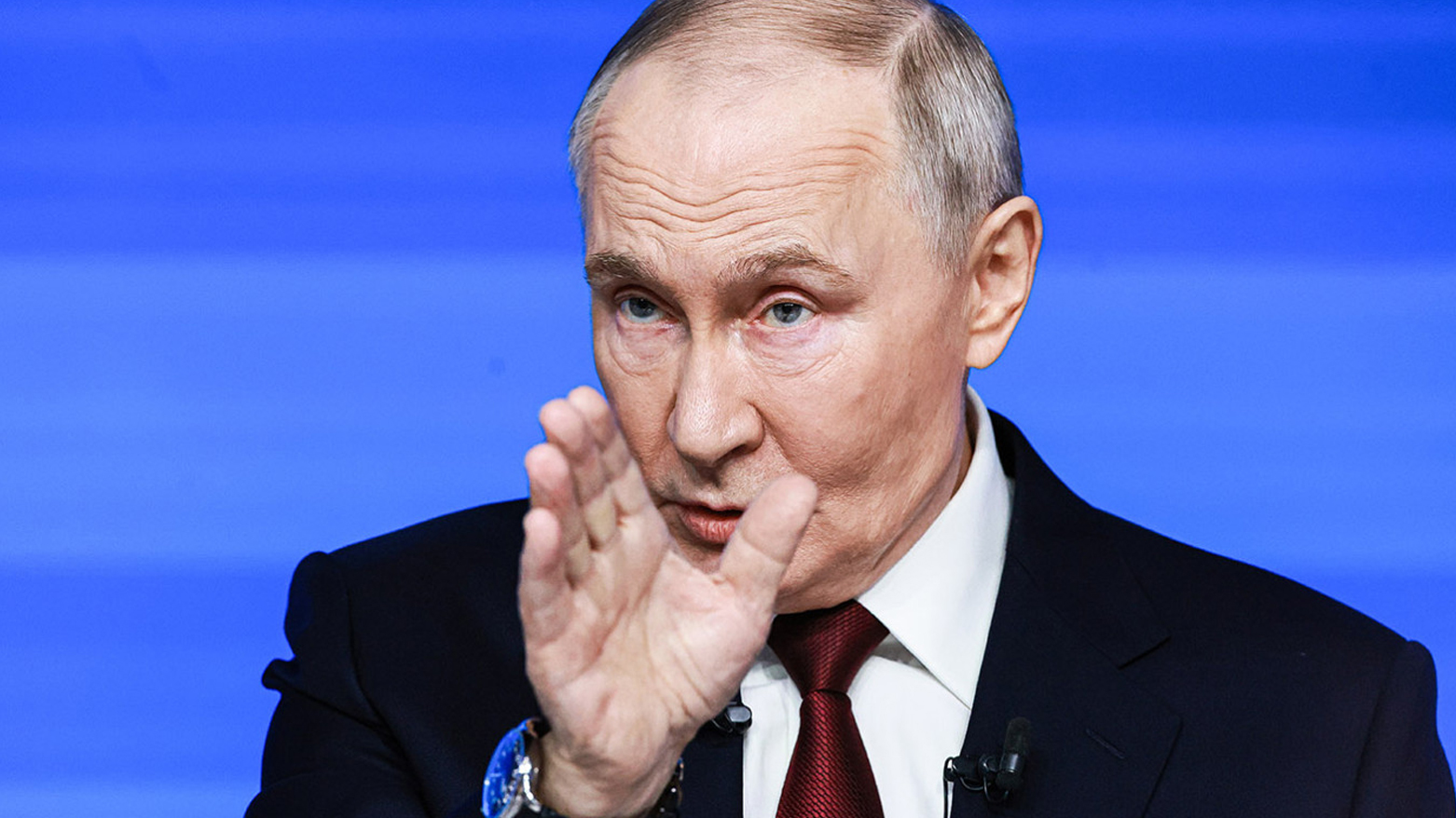
ERBIL (Kurdistan24) – Russian President Vladimir Putin on Thursday presented a dual message of diplomatic openness and battlefield confidence, asserting that Moscow remains prepared to end the war in Ukraine through negotiations while simultaneously declaring that Russian forces have seized the strategic initiative and are advancing on multiple fronts.
Speaking during a combined Direct Line question-and-answer session and year-end press conference titled "Results of the Year," Putin framed Russia’s military posture as decisive and its political position as consistent, reiterating conditions he first articulated at the Russian Foreign Ministry in 2024, according to the state-run TASS news agency.
"We have always talked about this and we are ready and willing to end this conflict by peaceful means based on the principles that I outlined in June last year at the Russian Foreign Ministry," Putin said, as reported by TASS, adding that any settlement must address what he described as the "root causes" of the crisis. At the same time, he maintained that Russian troops in the "special operation zone” are advancing “in all directions," with the strategic initiative having "entirely and completely" shifted into Moscow’s hands.
Putin’s remarks came as TASS compiled what it described as the head of state’s key statements on the conflict, providing a comprehensive account of Russia’s military assessments and diplomatic posture.
Central to his message was the assertion that while Moscow is open to talks, Kyiv has yet to demonstrate readiness to engage on what he characterized as the most sensitive and decisive issues, particularly territory. Russia, he said, is receiving signals from Kyiv about a willingness "to engage in some kind of dialogue," but has not seen preparedness to discuss territorial questions. "So far, we truly do not see such readiness," he stated.
Putin used the forum to restate in detail the conditions he outlined in the summer of 2024 during a meeting with the leadership of Russia’s Foreign Ministry.
These conditions include the withdrawal of Ukrainian armed forces from Donbass and Novorossiya, Kyiv’s refusal to join NATO, and the establishment of Ukraine as a non-aligned and non-nuclear state. He also emphasized that the rights, freedoms, and interests of the Russian-speaking population in Ukraine must be fully protected, and that all Western sanctions imposed on Russia should be lifted as part of any comprehensive settlement, according to TASS.
Alongside diplomacy, the Russian president devoted significant attention to battlefield developments, particularly in eastern Ukraine.
He highlighted what he described as major progress in the Donetsk People’s Republic (DPR), portraying Russian operations there as both methodical and strategically consequential.
The reported "liberation of Seversk", he said, represents a significant advance that opens the way toward Slavyansk, a city he characterized as essential due to its location within one of the region’s key fortified zones. Russian troops, he added, are expected to take control of Krasny Liman in the near future before continuing their advance toward Slavyansk.
Putin further claimed that Russian forces have liberated more than half of the city of Konstantinovka in the DPR, while Ukrainian troops are making what he described as ineffective attempts to retake parts of Krasnoarmeysk.
"They are making unsuccessful attempts to retake at least parts of the city of Krasnoarmeysk," he said. "The enemy is suffering heavy losses and achieving no success."
He characterized the liberation of Krasnoarmeysk as a “very important event,” calling it “a very good springboard for further offensive operations.”
According to the Russian leader, the settlement of Dimitrov in the DPR has been fully encircled by Russian forces.
Ukrainian troops there, he said, have not received any order or permission to lay down their weapons and are instead "trying to break out in small groups," a description that reinforced his broader narrative of Russian operational dominance and Ukrainian disarray.
Putin extended his assessment beyond Donetsk, asserting that Russian forces are advancing at a high pace in other regions as well. In the Zaporozhye Region, he said, Russian servicemen are "liberating one populated locality after another," with half of the city of Gulyaipole already under their control.
He added that Russian troops continue to establish security zones along the border with Ukraine, a statement that suggests an effort to consolidate gains and limit Ukrainian counteractions.
In the Kharkov Region, Putin claimed that Kupyansk is under Russian control.
"Our troops control the city there," he said, while also asserting that a major group of Ukrainian armed forces—approximately 3,500 personnel—has been surrounded near Kupyansk.
According to his account, these forces have not received an order to surrender and face bleak prospects. "Their chances are slim to none. They are tightly surrounded by our armed forces," Putin said, as cited by TASS.
The Russian president also addressed what he characterized as the public relations efforts of Ukrainian President Vladimir Zelensky, commenting on a selfie Zelensky allegedly took near a stele at the entrance to Kupyansk.
Putin dismissed the plausibility of such an appearance, asserting that Russian drones control "the entire sky above the city."
"It’s impossible to just approach," he said.
While stating that he does not closely follow Zelensky, Putin added a personal remark, describing the Ukrainian leader as "an actor, and a talented actor, at that," a comment he said was made "without any irony."
Taken together, Putin’s statements at the "Results of the Year" event presented a carefully calibrated narrative: Russia as a power confident in its military momentum yet publicly committed to a negotiated end to the conflict on its own terms.
By repeatedly referencing principles outlined in 2024, the Russian leader sought to portray continuity and predictability in Moscow’s position, even as he emphasized what he described as rapidly changing realities on the ground.
The remarks, as reported by TASS, underscore the central tension shaping the war’s current phase - between claims of battlefield advantage and the stated desire for diplomacy.
While Putin insisted that Russia is ready for peace talks, his repeated emphasis on territorial issues, security guarantees, and sanctions relief suggests that any negotiations would hinge on far-reaching concessions.
At the same time, his depiction of Russian forces advancing across Donetsk, Zaporozhye, and Kharkov regions reinforced the message that Moscow believes time and momentum are on its side.
Whether these assertions translate into tangible diplomatic movement remains uncertain.
For now, Putin’s year-end address offered a snapshot of Russia’s official narrative at a critical juncture in the conflict, combining confidence, conditional openness, and a detailed account of military operations as conveyed by the country’s state news agency.