Ukrainian President Reveals Revised U.S.-Backed Peace Plan for Ukraine, Recognizing De Facto Troop Lines
20-point proposal preserves Ukraine’s sovereignty, NATO stance, and security guarantees, while establishing international oversight of Zaporizhzhia nuclear plant and outlining global reconstruction support
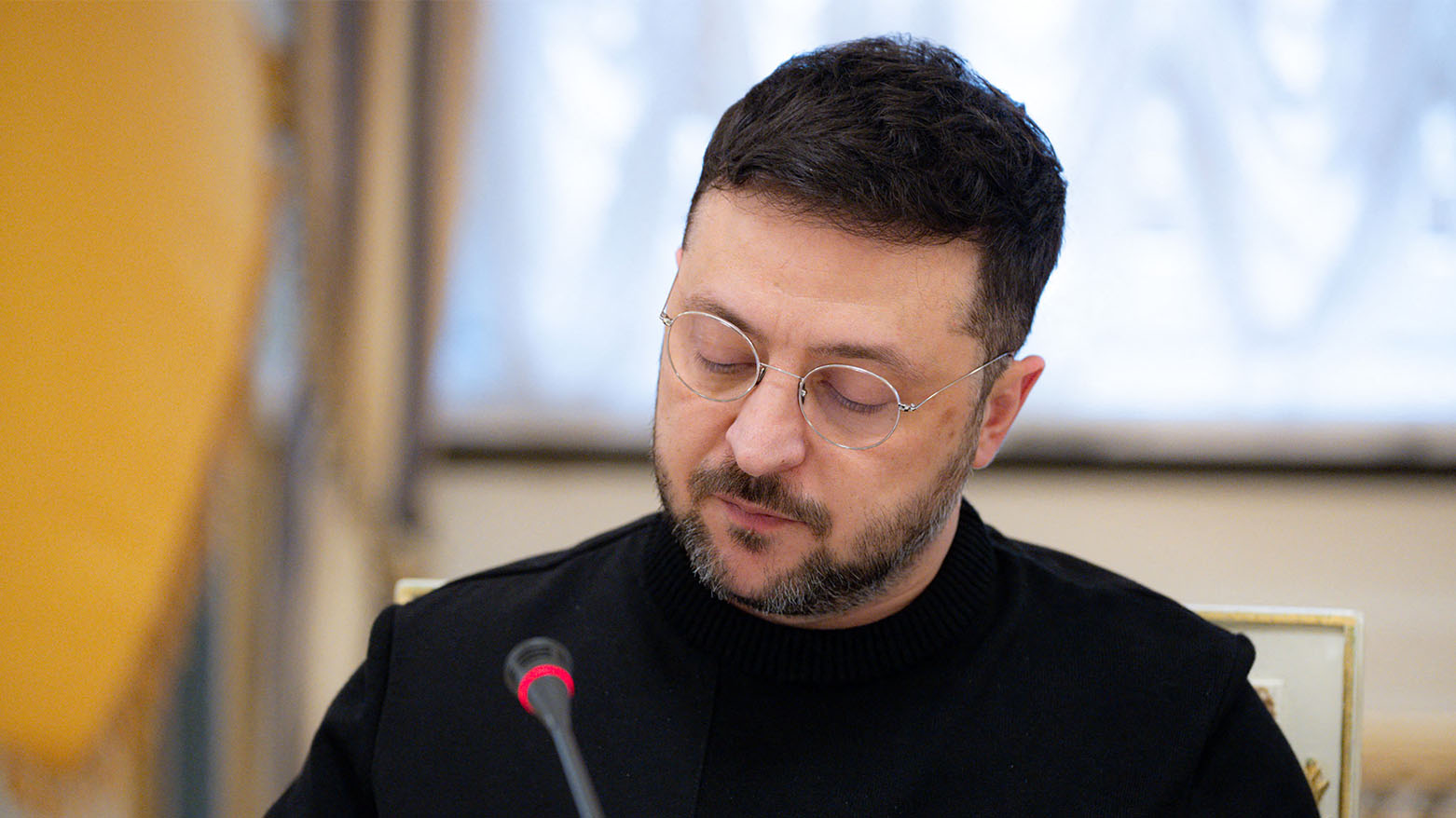
ERBIL (Kurdistan24) - Ukrainian President Volodymyr Zelensky has revealed details of a US-led draft plan aimed at ending Russia’s invasion of Ukraine, saying Kyiv secured several concessions, even as fundamental disagreements remain unresolved over territory, security guarantees, and Russia’s willingness to accept the terms.
Zelensky said the 20-point plan was agreed between US and Ukrainian negotiators and has been sent to Moscow for review. He acknowledged that there are elements of the proposal he does not support, but said Kyiv succeeded in removing provisions that would have required an immediate Ukrainian withdrawal from the Donetsk region or formal recognition of territory seized by Russian forces as Russian.
He also said demands obliging Ukraine to legally renounce its bid for NATO membership were removed from the document.
Zelensky presented the proposal during a two-hour briefing with journalists, reading from a highlighted and annotated version of the text. He said the plan de facto recognizes current troop deployment lines in Donetsk, Luhansk, Zaporizhzhia, and Kherson as the line of contact at the time of the agreement.
“In the Donetsk, Lugansk, Zaporizhzhia, and Kherson regions, the line of troop deployment as of the date of this agreement is de facto recognized as the line of contact,” Zelensky said.
He added that a working group would be formed to determine the redeployment of forces needed to end the conflict and to define parameters for potential future special economic zones.
“We are in a situation where the Russians want us to withdraw from the Donetsk region, while the Americans are trying to find a way,” Zelensky said. “They are looking for a demilitarized zone or a free economic zone, meaning a format that could satisfy both sides.”
While the document does not explicitly mandate a Ukrainian troop withdrawal, Zelensky said it could open the way for limited pullbacks, including from areas of the Donetsk region currently controlled by Kyiv, where demilitarized zones may be established. He said any such step would require approval through the Ukrainian parliament or a referendum.
On NATO, Zelensky said Ukraine’s position remains unchanged. “It is the choice of NATO members whether to have Ukraine or not. Our choice has been made,” he said, adding that Kyiv moved away from proposed constitutional changes that would have barred NATO membership. He acknowledged, however, that Washington has ruled out Ukraine’s accession to the alliance.
The plan also includes provisions for joint US-Ukrainian-Russian management of the Zaporizhzhia nuclear power plant, which is currently under Russian control. Zelensky said he does not want any Russian oversight of the facility.
He also said Ukraine would hold presidential elections only after an agreement is signed, responding to calls from both Russian President Vladimir Putin and US President Donald Trump for elections.
Russia has yet to comment on the latest version of the proposal. Moscow has repeatedly insisted on full Ukrainian withdrawal from eastern regions and has shown no sign of softening its territorial demands. Zelensky said Kyiv faces pressure to accept certain compromises or risk losing US military support.
The 20-point plan outlines a broad framework for ending the war and establishing long-term security arrangements. Zelensky said the agreement would reaffirm Ukraine’s sovereignty and constitute a full and unconditional non-aggression pact between Russia and Ukraine, monitored through space-based unmanned systems.
The proposal includes:
1-Ukraine’s sovereignty will be reaffirmed, with all signatories confirming this through their signatures.
2-The document constitutes a full and unconditional non-aggression agreement between Russia and Ukraine. A monitoring mechanism will oversee the line of contact using space-based unmanned monitoring to detect violations and resolve disputes.
3-Ukraine will receive strong security guarantees.
4-The strength of the Armed Forces of Ukraine will remain at 800,000 personnel in peacetime.
5-The United States, NATO, and European signatory states will provide security guarantees mirroring NATO’s Article 5.
a. If Russia invades Ukraine, all global sanctions against Russia will be reinstated.
b. If Ukraine invades Russia without provocation, the guarantees will be null and void.
c. Bilateral security guarantees are not excluded.
6-Russia will formalise a policy of non-aggression toward Europe and Ukraine in its laws and ratification documents.
7-Ukraine will become a member of the European Union within a defined timeframe and gain short-term privileged access to the European market.
8-A global development package for Ukraine will be established in a separate agreement, covering investment, infrastructure, gas facilities, reconstruction, mineral extraction, and a Ukraine Development Fund, with World Bank financing and a high-level prosperity administrator.
9-Several funds will address economic recovery, reconstruction, and humanitarian needs, including a $200 billion US-European capital and grants fund, with Ukraine retaining the right to compensation.
10-Ukraine will accelerate negotiations on a free trade agreement with the United States.
11-Ukraine confirms it will remain a non-nuclear state under the Treaty on the Non-Proliferation of Nuclear Weapons.
12-The Zaporizhzhia Nuclear Power Plant will be jointly operated by Ukraine, the United States, and Russia.
13-Both sides commit to educational programs promoting tolerance and the elimination of racism and prejudice, with Ukraine applying EU standards on religious tolerance and minority languages.
14-In Donetsk, Luhansk, Zaporizhzhia, and Kherson, current troop deployment lines are de facto recognised as the line of contact.
a. A working group will determine force redeployment and potential special economic zones.
b. International forces may be deployed along the line of contact, subject to parliamentary approval or a referendum.
c. Russia must withdraw from Dnipropetrovsk, Mykolaiv, Sumy, and Kharkiv regions for the agreement to take effect.
d. The parties will adhere to the Geneva Conventions and international human rights law.
15-After agreement on territorial arrangements, neither side will alter them by force.
16-Russia will not obstruct Ukraine’s commercial use of the Dnipro River and the Black Sea.
17-A humanitarian committee will resolve outstanding issues, including:
a. An all-for-all exchange of prisoners of war.
b. The return of all detained civilians, hostages, and children.
c. Measures to address the suffering of conflict victims.
18-Ukraine will hold elections as soon as possible after the agreement is signed.
19-The agreement will be legally binding and monitored by a Peace Council chaired by President Trump, with sanctions imposed for violations.
20-Once all parties agree, a full ceasefire will take effect immediately.
The plan comes amid continued fighting and previous failed talks, including negotiations held earlier in Istanbul.
As the proposal undergoes review in Moscow, Zelensky said the plan reflects difficult compromises while preserving Ukraine’s core positions, leaving the outcome dependent on whether diplomacy can bridge the remaining gaps.