Iraqi PM Says Baghdad Working to Broker Renewed U.S.–Iran Talks as Arms Control Debate Intensifies
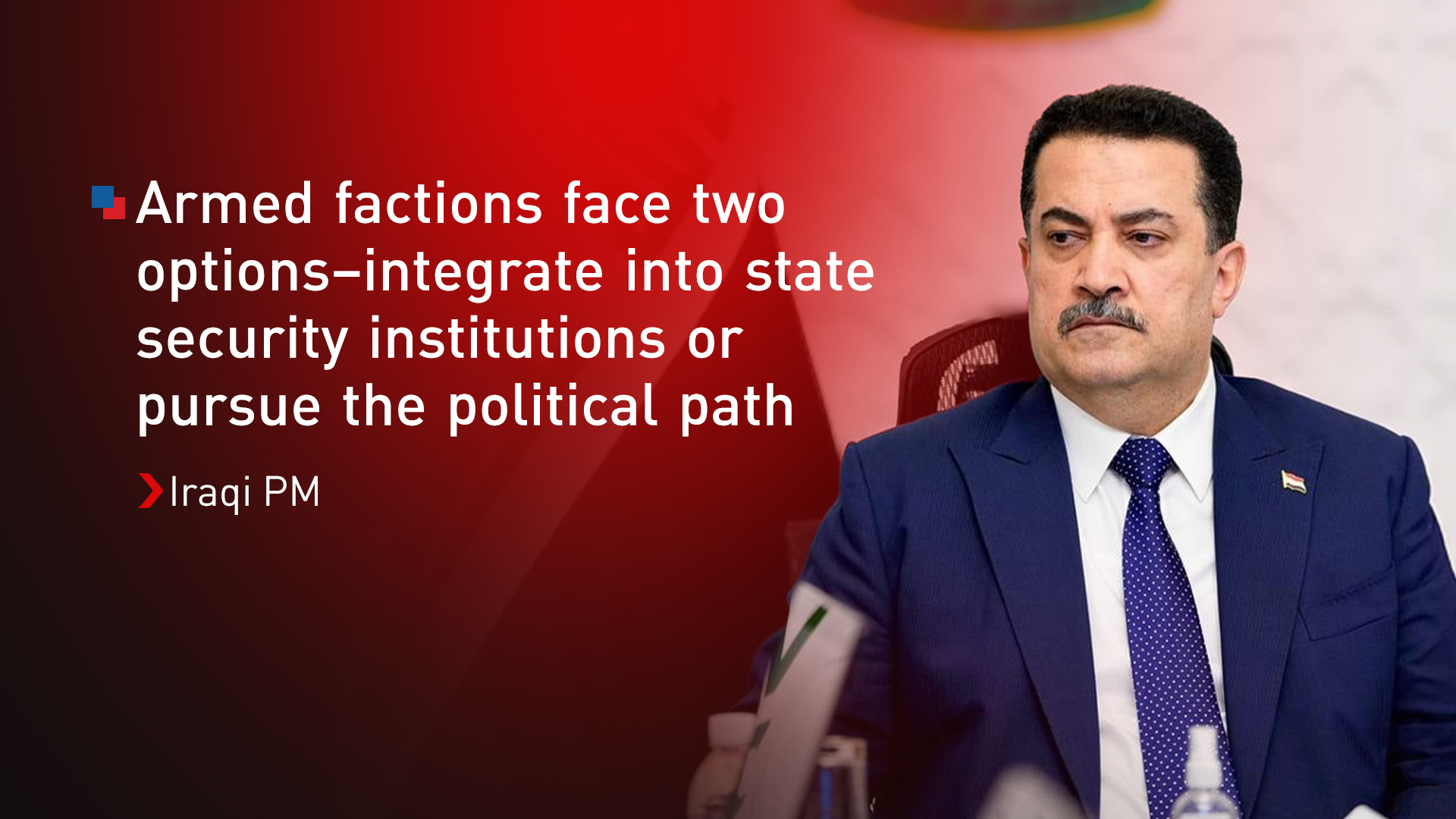
According to the Iraqi PM, armed factions are now faced with two options: integration into official security institutions or a transition to go down the political path.
ERBIL (Kurdistan24) — Iraqi PM Mohammad Shia al-Sudani said on Saturday that Baghdad is currently making efforts to arrange renewed negotiations between the United States and Iran, even as his government faces mounting internal and external pressure over the future of armed factions in the country.
In a televised interview with Lebanon’s Al-Mayadeen channel, al-Sudani said Iraq is seeking to host a bilateral meeting between Tehran and Washington in the capital.
“We are now undertaking an important initiative to arrange a bilateral meeting between Iran and the United States in Baghdad to resume dialogue between the two sides,” he said.
Al-Sudani added that his government has proposed leveraging Iraq’s relationship with Iran to facilitate renewed talks, noting that the idea was raised directly with U.S. envoy Tom Barrack. According to the Iraqi PM, neither side has rejected the principle of resuming dialogue, though each maintains its own conditions.
Iranian Foreign Minister Abbas Araghchi has previously said Tehran would not return to negotiations as long as the United States continues to advance what he described as “unreasonable and exaggerated” demands.
Tehran and Washington previously held five rounds of indirect nuclear negotiations. While Iran was preparing for a sixth round, Israel launched a surprise air campaign in June that lasted 12 days, followed by U.S. airstrikes targeting Iranian nuclear facilities. In late August, the so-called European troika activated the “snapback” mechanism, leading to the reimposition of UN sanctions on Iran.
Armed factions and state authority
On the domestic front, al-Sudani addressed the highly sensitive issue of restricting weapons to the state, stressing that the move is not driven by U.S. demands but by Iraq’s own political commitments.
“Restricting weapons is not an American request; it is an Iraqi decision included in the government program that was approved by parliament,” he said.
He added that he had set clear red lines upon taking office. “One of my conditions was that I would not accept being prime minister while standing by as embassies and camps are shelled,” al-Sudani said.
According to the Iraqi PM, armed factions are now faced with two options: integration into official security institutions or a transition to go down the political path.
In recent weeks, several factions have publicly expressed support for the principle of limiting arms to the state, including statements by the secretary general of Kataib al-Imam Ali, Shibl al-Zaidi, followed by similar positions from Asaib Ahl al-Haq leader Qais al-Khazali, the Ansar Allah al-Awfiya faction, and a spokesperson for Kataib Sayyid al-Shuhada.
However, Kataib Hezbollah has rejected disarmament, arguing that full sovereignty, security control, and an end to foreign interference must precede any discussion of restricting weapons to the state.
The group said its position aligns with guidance from religious authorities. A senior figure in the al-Nujaba Movement has also reiterated the group’s commitment to continuing resistance against U.S. forces by all means.
Iraq’s Supreme Judicial Council head, Faiq Zidan, announced on Dec. 20, 2025, that several armed factions had responded positively to the principle of state-controlled arms. His remarks came amid intensified U.S. pressure on Baghdad to curtail the role of armed groups and prevent their participation in the formation of a new government, particularly after they secured a significant number of parliamentary seats.
Earlier, U.S. presidential envoy to Iraq Mark Savaya described recent steps by Iraqi armed groups toward disarmament as a “welcome and encouraging” development, saying they reflect long-standing calls by Iraq’s religious authorities.
For months, Washington has applied sustained pressure on the Iraqi government to dissolve armed factions, bring all weapons under state control, and exclude those groups from the next government—demands that continue to test Baghdad’s balancing act between domestic stability and regional diplomacy.