U.S. Treasury Sanctions Network Facilitating Iran-Venezuela Drone Trade and Missile Proliferation
US Treasury sanctions 10 entities in Iran and Venezuela, targeting a network facilitating drone production and missile chemical procurement.
ERBIL (Kurdistan24) — The U.S. Department of the Treasury’s Office of Foreign Assets Control (OFAC) announced on Tuesday the imposition of sanctions against 10 individuals and entities based in Iran and Venezuela, targeting a transnational network accused of facilitating the proliferation of combat drones and procuring critical components for Tehran’s ballistic missile program.
The designations, released on Dec. 30, 2025, specifically identify a Venezuelan state-linked company involved in the manufacture of Iranian-designed unmanned aerial vehicles (UAVs) and several Iranian operatives procuring chemical propellants for rocket motors.
The action represents a significant escalation in Washington’s efforts to disrupt the military cooperation between Tehran and Caracas. Treasury officials stated that the measures are designed to hold both nations accountable for what the department described as the "aggressive and reckless proliferation of deadly weapons around the world."
“We will continue to take swift action to deprive those who enable Iran’s military-industrial complex access to the U.S. financial system,” said Treasury Under Secretary for Terrorism and Financial Intelligence John K. Hurley in a statement accompanying the announcement.
The designations build upon previous nonproliferation actions taken in October and November, following the Sept. 27, 2025, reimposition of United Nations sanctions and other restrictions regarding Iran.
Targeting the Venezuela-Iran UAV Nexus
Central to Tuesday's designations is Empresa Aeronautica Nacional SA (EANSA), a Venezuela-based company that the Treasury Department asserts has played a pivotal role in Iran’s UAV trade within the Western Hemisphere. OFAC also designated the company’s chair, Jose Jesus Urdaneta Gonzalez.
According to the Treasury Department, EANSA maintains and oversees the assembly of Iranian-designed Mohajer-series UAVs on Venezuelan soil.
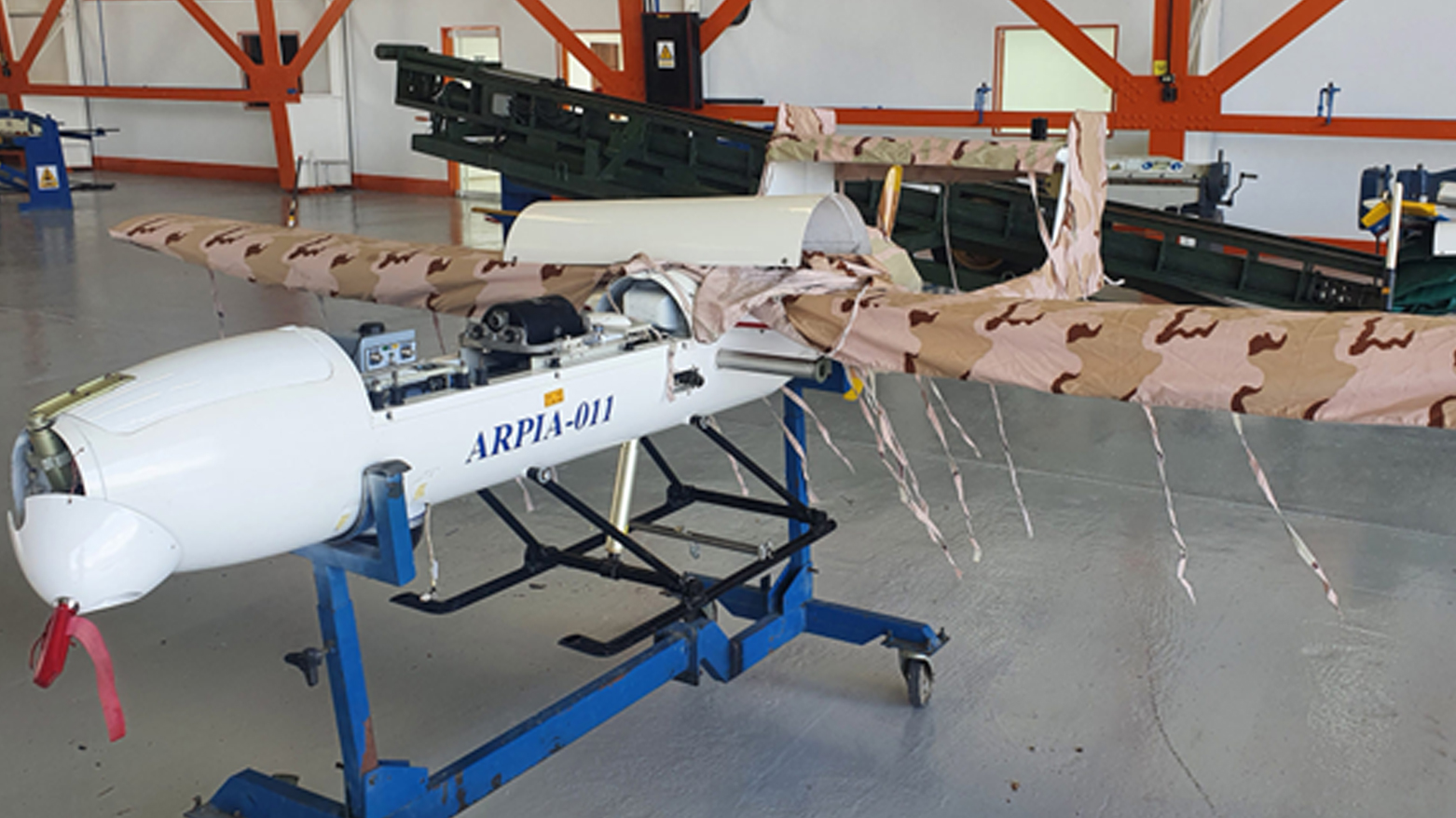
The relationship between the two nations regarding this technology dates back to 2006, involving the provision of drones from Iran’s Qods Aviation Industries (QAI). These aircraft are subsequently rebranded in Venezuela as the ANSU-series.
The Treasury noted that EANSA has engaged in direct negotiations with QAI, facilitating the sale of millions of dollars’ worth of Mohajer-6 UAVs to Venezuela. The Mohajer-6 is a combat drone equipped with intelligence, surveillance, and reconnaissance capabilities.
Furthermore, EANSA is responsible for maintaining the UAV fleet operated by the Venezuelan armed forces, which includes the Iranian Mohajer-2, known locally as the Arpia or ANSU-100.
The ANSU-100 is described by the Treasury as an updated, armed version of the Arpia-001, itself a direct derivative of the Mohajer-2 and the first UAV produced within Venezuela. Technical specifications released by the Treasury indicate that the ANSU-100 is capable of launching Iranian-designed Qaem air-to-ground guided bombs.
Jose Jesus Urdaneta Gonzalez, serving as the chair of EANSA, was designated for his leadership role in the entity. The Treasury Department stated that Urdaneta, acting on behalf of EANSA, has coordinated closely with members and representatives of both the Venezuelan and Iranian armed forces to manage the production of these unmanned systems in Venezuela.
These designations were enacted pursuant to Executive Order 13949, which targets the property of certain persons with respect to the conventional arms activities of Iran. QAI, the Iranian supplier, was previously designated in October 2023 for being owned or controlled by Iran’s Ministry of Defense and Armed Forces Logistics (MODAFL).
Disrupting Ballistic Missile Chemical Procurement
Parallel to the actions against the drone network, OFAC designated three Iran-based individuals and one entity connected to the procurement of sensitive chemicals used in the manufacture of ballistic missiles.
These efforts were allegedly undertaken for the benefit of Parchin Chemical Industries (PCI), an element of Iran’s Defense Industries Organization (DIO) responsible for the import and export of chemical goods.
The Treasury identified the procured materials as sodium perchlorate, sebacic acid, and nitrocellulose. Sodium perchlorate is a precursor used to manufacture ammonium perchlorate, a chemical controlled by the Missile Technology Control Regime (MTCR) that serves as an oxidizer in solid propellant rocket motors commonly used for ballistic missiles.
Sebacic acid is utilized to produce resins and plasticizers sought by Iran for its missile program, while nitrocellulose is used to improve the performance of solid propellant rocket motors.
Mostafa Rostami Sani, an Iran-based individual, was designated for procuring dozens of metric tons of sodium perchlorate for PCI.
The Treasury alleges that Rostami Sani coordinated these acquisitions with Marco Klinge, Majid Dolatkhah, and MVM Amici Trading LLC—parties that OFAC designated recently on Nov. 12, 2025. Rostami Sani also reportedly served as a liaison to PCI for these facilitators, assisting in the procurement of sebacic acid and nitrocellulose.
Rostami Sani serves as the chairman of the board of directors of the Iran-based Pardisan Rezvan Shargh International Private Joint Stock Company.
Consequently, OFAC designated Pardisan Rezvan Shargh for being owned or controlled by Rostami Sani. Additionally, the company’s managing director and board member, Reza Zarepour Taraghi, was designated for his role within the firm.
PCI, the beneficiary of these procurement activities, has been under U.S. sanctions since July 2008 pursuant to Executive Order 13382, which targets weapons of mass destruction proliferators and their supporters. Both PCI and its parent organization, DIO, are also subject to asset freezes under United Nations Security Council Resolutions.
Sanctions on Rayan Fan Group Affiliates
The third pillar of the Treasury’s action targets the corporate infrastructure supporting Iran’s Islamic Revolutionary Guard Corps (IRGC). OFAC designated two entities and three individuals linked to the Rayan Fan Kav Andish Co (RFKA), also known as the Rayan Fan Group. RFKA is a U.S.-designated holding company that controls various firms operating in high-technology sectors.
RFKA owns Rayan Roshd Afzar Company (RRA), which the Treasury states has produced components for the IRGC’s UAV program and software for its aerospace program. RRA was designated by OFAC in July 2017 for providing support to the IRGC.
Tuesday’s action designates Fanavari Electro Moj Mobin Company (Fanavari), an entity in which RFKA is a principal shareholder.
Bahram Rezaei, the managing director of Fanavari, was also designated. The Treasury noted that RFKA is represented on Fanavari’s board by Mohsen Parsajam, who is already under U.S. sanctions. Two other board members of Fanavari, Seyyed Reza Ghasemi and Farshad Hakemzadeh, were previously designated by the U.S. for their roles within RRA.
In a further extension of these sanctions, OFAC designated Kavoshgaran Asman Moj Ghadir Company (KAMG). Bahram Rezaei serves as the majority shareholder and chairman of the board for KAMG. The company’s managing director, Erfan Qaysari, and the vice chairman of its board, Mehdi Ghaffari, were also designated for acting on behalf of KAMG.
Strategic Context and Enforcement
The Treasury Department framed these designations as part of a broader strategy to enforce National Security Presidential Memorandum 2.
This directive instructs the U.S. government to curtail Iran’s ballistic missile program, counter its development of asymmetric and conventional weapons, deny it nuclear weapons capabilities, and restrict the IRGC’s access to resources.
Officials emphasized that Iran’s UAV and missile programs pose a direct threat to U.S. and allied personnel in the Middle East and destabilize commercial shipping in the Red Sea. Additionally, the ongoing transfer of conventional weapons to Caracas is viewed by the Treasury as a threat to U.S. interests in the Western Hemisphere, including the homeland.
As a legal consequence of these designations, all property and interests in property of the named individuals and entities that are in the United States or in the possession or control of U.S. persons are blocked and must be reported to OFAC.
This blocking mandate extends to any entities that are owned, directly or indirectly, 50 percent or more by one or more blocked persons.
The Treasury warned that U.S. persons are generally prohibited from engaging in transactions involving the property of blocked persons. Violations of these sanctions can result in civil or criminal penalties.
Furthermore, foreign financial institutions that knowingly conduct or facilitate significant transactions on behalf of the designated persons risk the imposition of secondary sanctions, which could sever their access to the U.S. financial system.
Under Secretary Hurley reiterated that the ultimate goal of these sanctions is not merely to punish, but to bring about a positive change in behavior, noting that the power of OFAC sanctions relies on the office's willingness to remove persons from the list consistent with the law.