Trump Voices Concern Over Aleppo Violence, Calls for Peace Between Kurds and Damascus
Trump called for an end to Aleppo clashes as US and Kurdish officials engaged in urgent diplomacy. Meanwhile, Syrian forces besieged Kurdish districts, displacing 150,000 and disabling a key hospital.
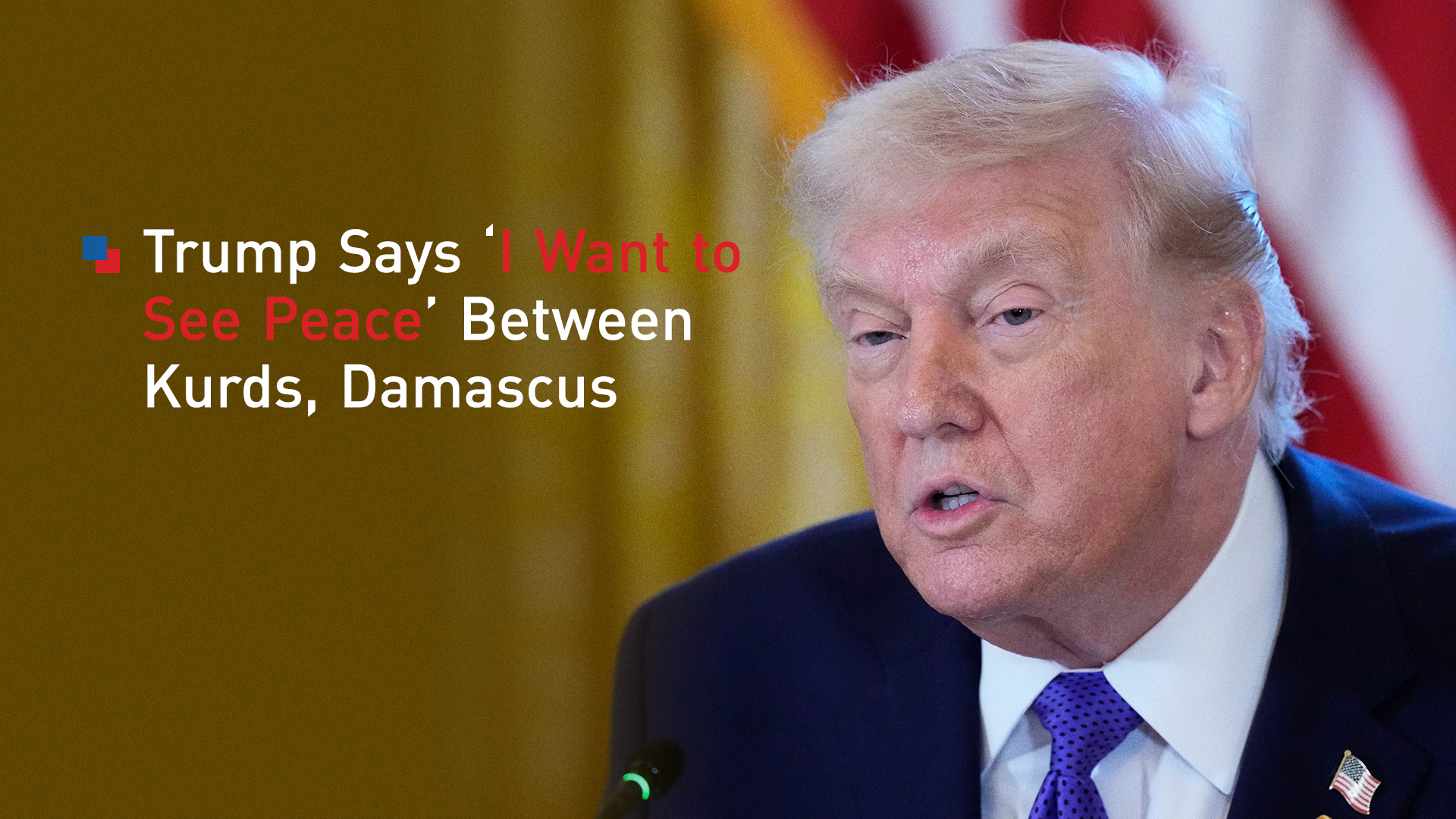
ERBIL (Kurdistan24) — United States President Donald Trump intervened publicly on Friday regarding the rapidly deteriorating security situation in northern Syria, calling for an immediate halt to the intensifying clashes between Syrian government forces and the Syrian Democratic Forces (SDF) in Aleppo.
Speaking to reporters at the White House on January 9, 2026, President Trump framed the United States as a mediator capable of navigating the historic animosity between the warring factions, even as reports from the ground indicated a deepening humanitarian crisis and the collapse of local ceasefires.
"I want to see peace. Yes, I do," President Trump said during the press conference. "The Kurds and the Syrian government, we get along with both, as you know very well. They have been natural enemies over the years, but we get along [with] both."
The President expressed a desire to preserve what he characterized as the broader success of stabilization efforts in Syria, viewing the current violence as a localized, albeit dangerous, disruption.
"And, we want to see Syria succeed. And so far, I think they are succeeding, but this is just breaking out and we want to see that stopped," President Trump said.
Diplomatic Channels Activate
The President’s comments were part of a wider flurry of high-level diplomatic activity involving Washington, Erbil, and European capitals, aimed at containing the violence that has engulfed the Kurdish-majority neighborhoods of Sheikh Maqsud and Ashrafiyeh since January 6.
On Friday evening, President Masoud Barzani and Amb. Tom Barrack, the U.S. Ambassador to Türkiye and President Trump’s Special Envoy for Syria, held a telephone conversation to discuss the crisis.
According to a statement from Barzani Headquarters, the two officials exchanged views on the evolving political landscape and stressed the urgent need to de-escalate tensions.
Both sides underscored the importance of taking "serious steps toward achieving security, stability, and peace," agreeing that sustained engagement is essential to prevent a further unraveling of the situation.
This diplomatic engagement occurred simultaneously with a direct communication between President Barzani and Syrian President Ahmed al-Sharaa.
In a separate telephone call on Friday, President al-Sharaa reaffirmed to President Barzani that the Kurds are an "indigenous and main component" of the Syrian people.
According to the readout of the conversation, the Syrian leader pledged the state’s "full commitment" to guaranteeing the national, political, and civil rights of Kurds without discrimination.
President Barzani expressed appreciation for President al-Sharaa’s assurances, advocating for a Syrian state that includes all components as "genuine partners in governance."
However, these high-level assurances of partnership stood in stark contrast to the kinetic reality on the ground in Aleppo, where Syrian government forces have designated Kurdish districts as military zones and unleashed heavy bombardment.
Germany Urges Implementation of March 10 Agreement
European powers also mobilized to address the breakdown in stability. Tobias Tunkel, Germany’s Special Envoy for Middle East Affairs, held a phone call with Mazloum Abdi, the commander-in-chief of the SDF.
In a statement published on his official X account, Tunkel conveyed Germany’s profound concern over the violence and called for an immediate cessation of fighting.
The German envoy emphasized the necessity of implementing the March 10, 2025, agreement signed by Syrian President Ahmed al-Sharaa and Mazloum Abdi.
That agreement included provisions for a nationwide ceasefire, the integration of civilian and military institutions in northern and eastern Syria into state structures, and the formal recognition of Kurdish rights.
Implementation has stalled, however, with the Damascus government recently submitting a written proposal to integrate SDF forces into three military divisions—a topic that was under discussion when the current hostilities erupted.
Both The United Kingdom and France had also voiced their concerns regarding the escalation situation in Aleppo's Kurdish neighbourhoods.
Siege, Shelling, and "Military Zones"
Despite the diplomatic maneuvers, the situation in Aleppo has become increasingly dire.
On Friday, the Operations Body of the Syrian Arab Army declared Sheikh Maqsud a "closed military zone" and imposed a full curfew starting at 6:30 p.m.
State media outlets urged civilians to stay away from windows and move to lower floors, signaling an expansion of the offensive.
The Syrian government’s military posture has drawn accusations of war crimes from Kurdish internal security forces.
The controversy centers on a map published by the Damascus government’s Ministry of Defense, which identified specific sites for targeting. Among the marked locations was the Khalid Fajr Hospital, the only functioning medical facility serving the two besieged neighborhoods.
The hospital was subsequently rendered out of service following four consecutive artillery strikes and a drone attack.
The Internal Security Forces stated that listing a civilian medical facility on a public targeting map constituted "documented evidence of prior criminal intent."
The collapse of medical services has left dozens of wounded civilians without access to treatment, exacerbating a crisis already defined by a lack of food and heating fuel due to the siege.
Casualties and Displacement
The human toll of the offensive continues to rise. The United Nations Office for the Coordination of Humanitarian Affairs (OCHA) reported that renewed fighting has displaced approximately 150,000 people.
The UN confirmed that heavy shelling is damaging homes and critical infrastructure, mobilizing partners to respond to the growing needs.
Local sources and monitoring groups report higher casualty figures than initial estimates.
The Syrian Observatory for Human Rights (SOHR) stated that at least 23 civilians have been killed and nearly 100 wounded since the escalation began. The deadliest single incident occurred on Thursday evening, when shelling struck a home in Sheikh Maqsud, killing six members of the Rasho family, including three children.
The victims were identified as Amin Rasho, Zainab Amin Rasho, Sharwin Hassan, Nura Rasho, Amin Rasho, and Mira Rasho. The mother, Nura Hassan, survived with serious injuries but was transferred to a facility that has since been disabled.
Rami Abdulrahman, the Director of the SOHR, explicitly attributed responsibility for the violence to Syrian President Ahmed al-Sharaa.
"Ahmed al-Sharaa is responsible for all massacres," Abdulrahman told Kurdistan24.
He characterized the campaign as a continuation of previous regime policies targeting a population instrumental in the fight against ISIS.
Abdulrahman also noted that video evidence suggests gunmen are harassing residents in a manner reminiscent of ISIS tactics.
SDF and Local Resistance
Facing this onslaught, the SDF and local councils have adopted a posture of defiance.
The Council of Sheikh Maqsud and Ashrafiyeh announced it would not evacuate, accusing the Syrian Arab Army of shelling mosques, schools, and homes to force demographic change.
Sipan Hamo, a member of the SDF General Command, issued a video message declaring that the resistance of the neighborhoods is "dismantling enemy plans."
Hamo clarified that while SDF forces formally withdrew from the districts in April according to prior agreements, they continue to support the local internal security forces and are prepared to intervene if necessary.
"We believe that their firmness and unity will make the aggressors realize the price of their aggression," Hamo said.
Farhad Shami, Head of the SDF Media Center, reported that internal security forces had thwarted two attempted incursions by government-affiliated factions, including the al-Amshat and al-Hamzat militias, which attempted to advance from the Wadi al-Zaytoun axis with tank support.
Ilham Ahmed, a senior official in the Kurdish administration, reiterated that the Kurds remain committed to the agreements reached with Damascus despite the violence.
She accused the authorities of "choosing the path of war" to dismantle those very agreements.
Domestic Solidarity and Regional Protests
The conflict in Aleppo has triggered a significant reaction across Syrian society and the broader region. In a notable development, prominent Alawite and Druze religious bodies issued statements condemning the attacks on Kurdish neighborhoods.
The Supreme Islamic Alawite Council warned of a "systematic and organized campaign of violence" targeting Alawites, Kurds, and Druze alike. The Council described the events in Aleppo as an attempt to impose a "coercive demographic reality amounting to full ethnic cleansing."
Similarly, the Druze Spiritual Leadership expressed full support for the Kurdish people, condemning the "barbaric attacks" and warning of genocide against minorities. Both groups called for a decentralized federal system in Syria under international guarantees.
Solidarity protests also erupted in the Kurdistan Region.
On Friday evening, large crowds gathered on 60 Meter Road in Erbil and in the city of Rania, chanting slogans in support of the resistance in Sheikh Maqsud and Ashrafiyeh. Zubair Abdulrahim, a representative of the demonstrators in Rania, emphasized confidence in the morale of the Kurdish people across the region.
"This confrontation and resistance will become another source of inspiration," he said.