U.S. Senator Warns Damascus That Attacks on Kurds Endanger ISIS Prisoner Security
Senator Graham warned Damascus that attacks on Kurds endanger the security of 9,000 ISIS prisoners, promising bipartisan pushback. SDF’s Farhad Shami welcomed the stance as an "early warning" against further escalation.
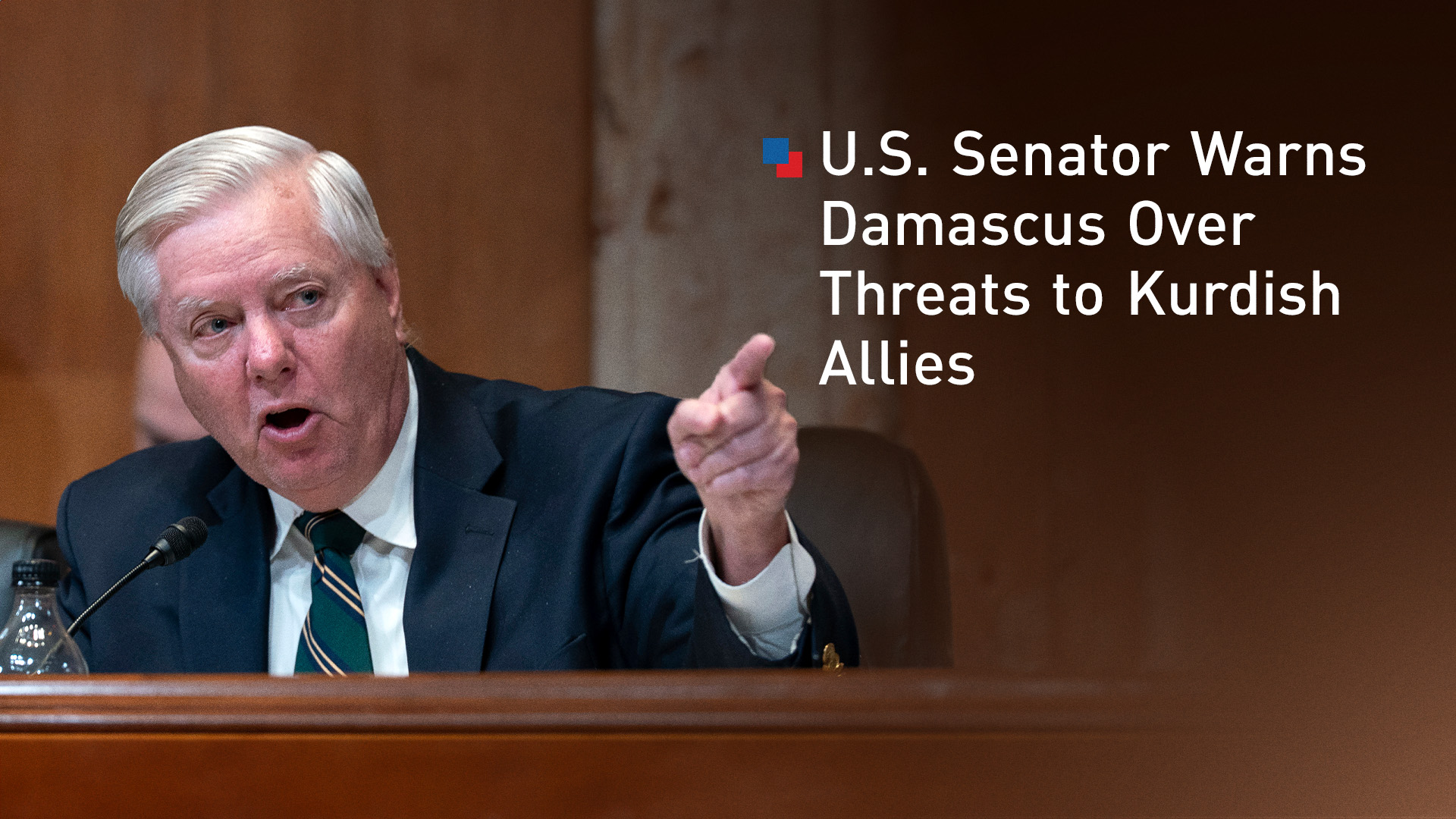
ERBIL (Kurdistan24) – United States Republican Senator Lindsey Graham issued a stern warning to the new Syrian government on Friday, cautioning that any military escalation against Kurdish forces threatens the security of thousands of detained Islamic State (ISIS) fighters, a concern immediately echoed by the Syrian Democratic Forces (SDF) as vital for preventing further massacres.
In a statement addressing the shifting security dynamics in the region, the Senator described the protection of the Kurdish-led partner force as a matter of vital national security interest for the United States, prompting the SDF leadership to welcome the intervention as a necessary measure to prevent further bloodshed and stabilize the region.
In a statement posted to the social media platform X on Friday, Jan. 16, 2026, Senator Graham expressed growing alarm over reports regarding the strategic posture of the new leadership in Damascus.
The Republican senator, a longstanding voice on foreign policy, stated that he is "growing increasingly concerned that the new Syrian government is aligning with Türkiye to use military force against the Syrian Kurds." He emphasized that the Kurdish forces remain Washington's "strongest ally in the enduring defeat of ISIS in Syria."
Sen. Graham explicitly linked the safety of the region and the U.S. homeland to the continued Kurdish custody of approximately 9,000 of the "worst of the worst" ISIS prisoners currently held in facilities across northeast Syria.
Highlighting the stakes involved, the Senator noted that it is in the vital national security interest of the United States that these detainees do not return to the battlefield. While expressing support for a "fair chance" for the new Syrian government, Sen. Graham drew a firm red line regarding the treatment of the SDF.
"If there’s an escalation of attacks against the Kurds by Syrian forces supported by Türkiye, this will create a whole new dynamic," Sen. Graham wrote. He predicted that such a move would trigger "wide and deep bipartisan support" in Washington to push back against the aggression.
The Senator concluded his statement with a direct admonition to those who might assume the U.S. would accept a transfer of custody for the detainees to other regional actors.
"If anyone believes that I or any of my colleagues would be comfortable - at this stage - for the ISIS prisoners to be guarded by the Syrian army or Türkiye instead of the Kurds, you are sadly mistaken. Choose wisely," he stated.
As I have previously stated, I am growing increasingly concerned that the new Syrian government is aligning with Turkey to use military force against the Syrian Kurds, who are our strongest ally in the enduring defeat of ISIS in Syria.
— Lindsey Graham (@LindseyGrahamSC) January 16, 2026
They also have control of about 9,000 of…
SDF Welcomes "Early Warning"
Farhad Shami, the spokesperson for the SDF, responded to the senator’s comments in a post on X later on Friday, characterizing Sen. Graham’s intervention as a responsible step toward stabilizing the region.
Shami wrote that the SDF highly appreciates Sen. Graham’s "clear stance and efforts," suggesting that such responsible positions can help "prevent new massacres against our people."
The spokesperson framed Sen. Graham’s comments as an "early warning" regarding the risks of escalation against the SDF and the people of northern and eastern Syria.
Reaffirming the SDF's role as a key partner in the global coalition’s defeat of ISIS, Shami stated that the senator’s concerns reflect a "deep understanding of the requirements of regional and international security."
He emphasized that the Kurdish-led forces remain committed to dialogue to address Syrian issues in a manner that "preserves the security and rights of our people, honors their sacrifices, and spares the region further bloodshed."
We highly appreciate Mr. Lindsey’s clear stance and efforts, as such responsible positions can help prevent new massacres against our people.
— Farhad Shami (@farhad_shami) January 16, 2026
The early warning about the risks of escalation against our SDF forces and our people in northern and eastern Syria, the key partner in… https://t.co/QTvCNHpYSC
Prisons Under Threat
The exchange between Senator Graham and the SDF leadership comes less than a day after Kurdish forces issued a formal alert regarding the vulnerability of ISIS detention centers amid the rising violence.
In a statement released Thursday, the SDF warned that sleeper cells belonging to the terrorist organization are actively attempting to exploit the security vacuum created by the recent military escalation to stage attacks on prisons.
According to the SDF, the military build-ups and continuous threats against the regions of North and East Syria by Damascus-affiliated factions have created an environment that ISIS elements are eager to leverage.
"The persistence of this situation, and the military escalation accompanying it, may lead to destabilizing the overall security environment, which constitutes a real danger to the prisons holding ISIS elements and threatens to return the region to square one," the statement read.
While the SDF asserted that its forces are on high alert and that the prisons remain under full control, they cautioned that sustained conflict diverts resources and attention, potentially opening operational windows for extremist resurgence.
Bipartisan Support in Washington
Senator Graham’s assertion regarding "wide and deep bipartisan support" for the Kurds appears substantiated by recent comments from a broad spectrum of U.S. lawmakers.
In a series of interviews conducted by Kurdistan24 in Washington, members of Congress from both the Republican and Democratic parties voiced strong support for the Kurdish people, framing them as indispensable allies.
Congressman Joe Wilson (R-SC) underscored the importance of avoiding fragmentation in Syria, warning that divisions create openings for ISIS. He pointed to the Kurdistan Region of Iraq as a "star example of success" and a model for how a level of independence can coexist within a unified state.
Wilson also expressed confidence in U.S. Special Envoy Tom Barrack’s efforts to align the interests of President Masoud Barzani and Syrian President Ahmed al-Sharaa to foster stability.
Democrats shared similar sentiments regarding the necessity of protecting Kurdish autonomy. Congressman Adam Smith (D-WA) stated, "I think it’s very important that the United States protect the Kurdish minority in Syria," describing the Kurds as "the best partner that we’ve had in the Middle East in a long time."
Congressman Mark Takano (D-CA), who has visited Erbil, emphasized the need to keep "Kurdistan’s autonomy intact" while resolving national issues.
Congressman Gabe Evans, citing his 12 years of military service, noted that the Kurds were critical allies in the fight against terrorism, while Congressman Seth Moulton affirmed that the U.S. must "always stand up for our allies." Congressman Tim Burchett focused on the moral obligation, stating, "They were loyal to us. I just don’t see how we could turn our backs on ’em."
Diplomatic Push for De-escalation
The heightened rhetoric from Capitol Hill aligns with intensified diplomatic activity by the U.S. State Department. As tensions continue to grip northern Syria, the United States has communicated to Kurdistan24 that it is closely monitoring developments on the ground.
The State Department confirmed that it has tasked U.S. Ambassador and Special Envoy to Syria, Tom Barrack, with facilitating dialogue between the Syrian government and the SDF to ease the crisis.
"Ambassador Barrack continues to support and facilitate dialogue between the Syrian government and the Syrian Democratic Forces," the State Department said in a statement provided to Kurdistan24. The administration is urging all parties to exercise restraint and prioritize stability over a renewed cycle of violence.
Ambassador Barrack has been advocating for a return to the "March 10, 2025 Integration Agreement" between the SDF and the Syrian government. This accord, which Barrack described as being on the verge of finalization just days prior to the recent outbreak of hostilities, outlines a framework for security coordination, shared governance, and the incorporation of SDF elements into national institutions.
Amb. Barrack recently met with Syrian President Ahmed al-Sharaa in Damascus to convey the urgency of de-escalation, warning that continued military action could jeopardize the country’s political transition following the fall of the Assad government.
Context of the Military Crisis
The current diplomatic and political firestorm was ignited by a significant military escalation in early January 2026.
The Syrian Arab Army (SAA), supported by heavy armor and artillery, launched a large-scale offensive against the Kurdish-led Internal Security Forces (Asayish) in the Aleppo neighborhoods of Sheikh Maqsud and Ashrafiyeh.
The operation resulted in a decisive shift in control, effectively ending years of Kurdish autonomous administration in those districts.
The urban combat in Aleppo generated a severe humanitarian toll. Reports indicate at least 216 deaths among combatants, while more than 260 Kurdish civilians remain missing.
The violence triggered a mass displacement event, with estimates suggesting between 142,000 and 155,000 residents were forced to flee, many seeking refuge in the Afrin district amid harsh winter conditions.
The Khalid Fajr Hospital, the sole medical facility serving the affected neighborhoods, was rendered inoperable by repeated shelling.
While international mediation eventually secured a partial ceasefire and the evacuation of fighters and civilians to northern Syria, the conflict has since expanded geographically. Syrian forces have redeployed from coastal regions toward the Deir Hafer front in the eastern countryside of Aleppo.
The SDF reported multiple attacks in recent days, including strikes by suicide drones and artillery targeting the vicinity of the strategic Tishreen Dam and the village of Umm al-Marra.
Adding to the complexity, the SDF reported direct involvement by the Turkish military, noting that a Turkish Bayraktar drone struck a position in the village of al-Buassi near Tabqa, injuring several fighters.
The SDF stated this was the third such incident within a single week. Turkish Foreign Minister Hakan Fidan has concurrently issued warnings to the SDF, describing the group as an obstacle to peace and demanding an end to what he termed separatism.
Fragile Security Architecture
The convergence of drone strikes, Syrian Army advances, and the displacement of Kurdish populations has created a volatile security environment that U.S. officials fear could be exploited by ISIS. The SDF's containment of 9,000 high-value detainees relies heavily on stability and resources that are currently being diverted to defensive lines against state actors.
Senator Graham’s intervention highlights the fragility of the current arrangement. By drawing a direct line between the safety of the Kurdish ally and the containment of the ISIS threat, Washington is signaling that the post-Assad transition in Syria cannot come at the expense of the partners who bore the brunt of the campaign against the caliphate.
As the new government in Damascus navigates its relationship with neighboring powers, the clear message from the U.S. legislature is that any joint military venture targeting the Kurds will be met with significant resistance, viewed not as an internal matter of sovereignty, but as a direct threat to U.S. national security interests.