Macron Pledges to Defend Europe Amid Hormuz Crisis Warnings
Macron said the Hormuz situation is “under control” and no shortages are expected, while calling for full reopening of the strait.
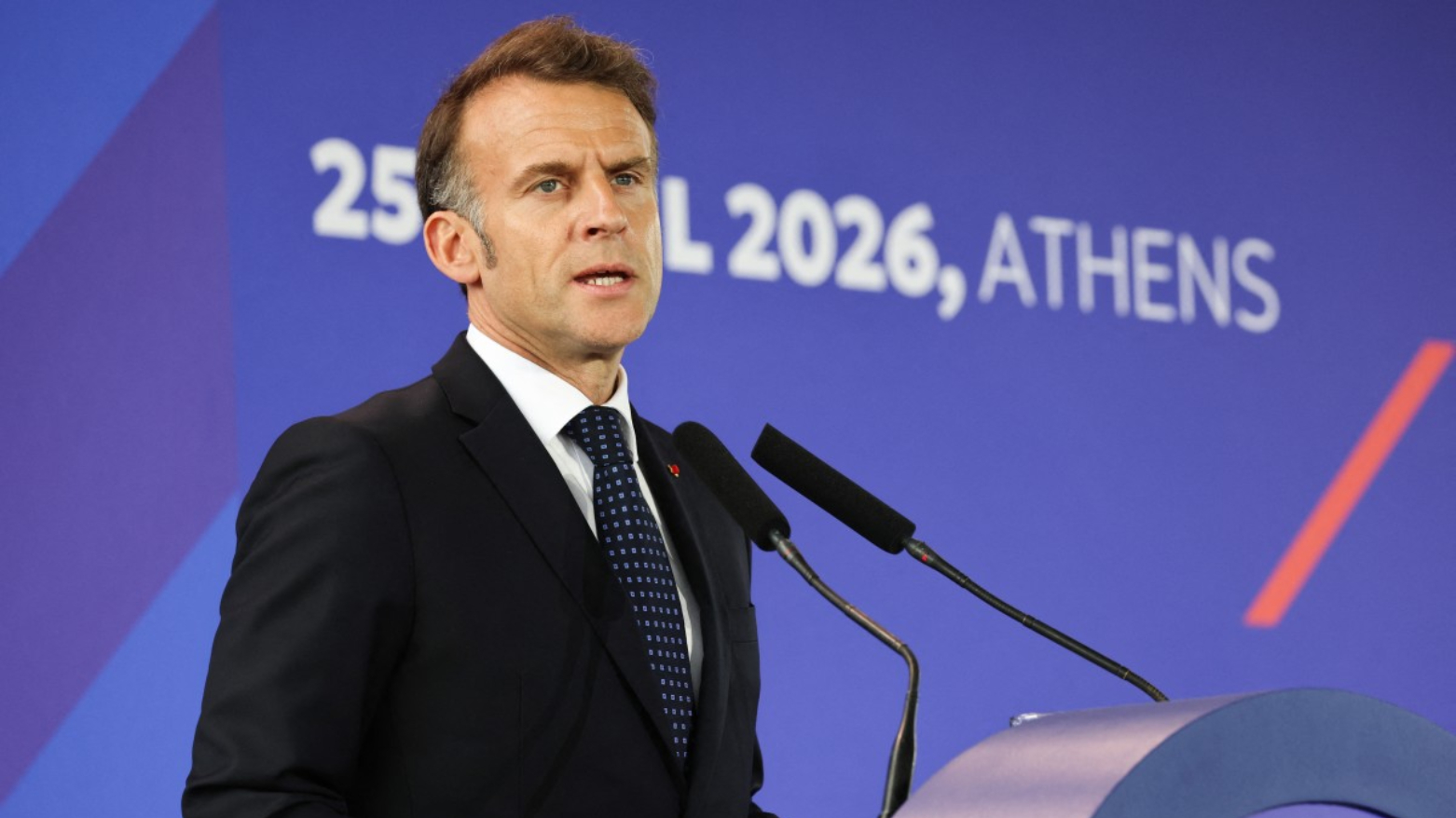
ERBIL (Kurdistan 24) — French President Emmanuel Macron pledged to uphold Europe’s collective security while urging calm over potential energy disruptions linked to the ongoing conflict affecting the Strait of Hormuz.
Speaking on Saturday, April 25 during a joint press conference in Athens with Greek Prime Minister Kyriakos Mitsotakis, Macron said efforts are focused on restoring full access to the strategic waterway.
“Our goal is to achieve a full reopening in the coming days and weeks, in accordance with international law, guaranteeing freedom of navigation without tolls on the Strait of Hormuz. Then things can gradually return to normal,” Macron said.
He also emphasized that the current situation remains manageable, stating: “At this stage the situation is under control and does not make us envisage any shortage,” while reiterating calls for “a complete reopening, in accordance with international law, to freedom of navigation, without tolls of the Strait of Hormuz.”
His remarks came a day after TotalEnergies CEO Patrick Pouyanne, head of one of the world’s largest energy companies, warned that prolonged disruption in the Strait of Hormuz could trigger widespread global energy shortages, given the waterway’s central role in transporting a significant share of international oil and gas supplies.
“If it lasts two, three months more, we are entering in a world of scarcity of energy, which Asian countries have already suffered,” Pouyanne said on Friday at the World Policy Conference in Chantilly. “You cannot have 20% of the oil and gas of the planet being stranded and not accessible without major consequences.”
The Strait of Hormuz, a critical maritime corridor through which about one-fifth of global oil and gas flows, has faced significant disruption amid the conflict involving the United States, Israel, and Iran.
The recent tensions surrounding the Strait of Hormuz have intensified following a series of military and strategic developments. According to Kurdistan24, Iran’s Islamic Revolutionary Guard Corps declared on Saturday that controlling the Strait of Hormuz remains a “definitive strategy” in its confrontation with the United States, emphasizing Tehran’s intent to maintain what it described as a “deterrent shadow” over the vital waterway.
In parallel, Iran’s military issued warnings that any continuation of the U.S. naval blockade of Iranian ports would prompt a response. In a statement carried by state broadcaster Islamic Republic of Iran Broadcasting, the central command Khatam Al-Anbiya described U.S. actions as “banditry” and “piracy,” warning of retaliation if pressure persists. These developments have contributed to disruptions in maritime traffic and heightened concerns over global energy flows through the strait.
At the diplomatic level, differences in approach among Western allies have also emerged. French President Emmanuel Macron previously stated that France had neither been consulted nor participated in the military offensive led by the United States and Israel against Iran, underscoring Paris’s independent position as it continues to advocate for de-escalation and the restoration of maritime stability.
Macron cautioned against overreaction, noting that panic itself could worsen supply challenges.
“Panic caused by geopolitical uncertainty can in itself lead to shortages,” he said.
Despite the concerns, Macron sought to reassure the public that the worst-case scenario remains unlikely.
France is “not facing the worst-case scenario you described, which is not the most likely outcome at present and which I am not in a position to comment on,” he said, responding to questions about potential shortages.
The disruption has also prompted international coordination. More than a dozen countries have indicated readiness to join a France- and Britain-led mission to secure shipping in the Strait once conditions allow.
“We're all in the same boat, and it's not a boat we chose, if I may say. We're victims of geopolitics and we're victims of this war that started several months ago,” Macron said.
Macron’s remarks highlight Europe’s effort to balance reassurance at home with diplomatic and security engagement abroad, as tensions around the Strait of Hormuz continue to test both energy stability and international coordination.